Quick Answer: Bufo alvarius venom and synthetic 5-MeO-DMT share the same primary psychedelic molecule but are not identical. Bufo venom is a complex mixture containing cardiotoxic steroids and multiple tryptamines. Synthetic 5-MeO-DMT is a single, ≥99% pure compound with consistent, measurable dosing and no cardiac toxins.
Introduction: Why This Comparison Actually Matters
Most articles on this topic give you a surface-level answer: “Bufo contains 5-MeO-DMT, so they’re basically the same.” That is not accurate, and for anyone considering either substance — whether from curiosity, therapeutic interest, or serious spiritual practice — the distinction between them carries real clinical and safety weight.
This guide draws on published analytical chemistry, peer-reviewed clinical trials, psychometric data, and naturalistic survey research to give you hard numbers, not just opinions. You will find specific compound concentrations, onset and duration data organized into comparison tables, real psychometric scores from validated instruments, and toxicity figures that most content in this space ignores entirely.
Whether you are a first-time researcher, a facilitator doing due diligence, or someone who has already worked with one of these medicines and is trying to understand what actually happened — this is the breakdown you have been looking for.
What Is Bufo Alvarius? Understanding the Source
Bufo alvarius — formally reclassified as Incilius alvarius — is the Sonoran Desert toad, native to the northwestern Sonoran Desert of Mexico and the southwestern United States. Its parotoid glands produce a milky venom as a defense mechanism. When that secretion is collected, dried, and vaporized, it produces an intense, rapid-onset psychedelic experience.
The venom is not a pure drug. It is a biochemically complex mixture, and that complexity is precisely what makes Bufo pharmacology fundamentally different from synthetic 5-MeO-DMT.
The active and inactive compounds present in Bufo venom include:
- 5-MeO-DMT — the dominant psychedelic molecule
- Bufotenin (5-OH-DMT) — another tryptamine with its own receptor activity
- Trace DMT — present in microgram quantities
- N-methylserotonin — serotonergic activity
- 5-MeO-tryptamine — a related alkaloid
- Bufogenins and bufotoxins — cardioactive steroidal compounds capable of causing cardiac arrhythmia
Each of these co-occurring compounds interacts with human physiology in ways that are not yet fully mapped. This is not a footnote — it is a core feature of Bufo that has direct implications for safety, dose accuracy, and experience predictability.
What Is Synthetic 5-MeO-DMT?
Synthetic 5-MeO-DMT is a laboratory-produced version of the exact same primary molecule found in Bufo venom. In clinical-grade manufacturing, it achieves ≥99% purity by HPLC analysis, containing essentially no other active compounds. Every milligram is what it says it is.
Routes of administration used in research and therapeutic settings include:
- Inhalation (vaporized) — fastest onset, shortest duration; closest to the inhaled Bufo experience
- Intramuscular injection (IM) — controlled onset of 1–6 minutes; longer, more titrated experience arc up to ~60 minutes
- Intranasal (IN) — used in GH Research’s clinical trial program under the formulation name GH001/mebufotenin; antidepressant effects measurable within 48 hours
Unlike Bufo venom, synthetic 5-MeO-DMT contains zero cardiotoxic steroids, zero bufotenin, and zero batch-to-batch compound variability. Every dose delivered is chemically identical to every other dose — a property that makes it suitable for clinical study and meaningful dose-response analysis.
Is Bufo the Same as 5-MeO-DMT? The Chemical Truth
This is the most-searched question on this topic. The answer is nuanced.
Both sources deliver 5-MeO-DMT as the primary psychoactive molecule. The core phenomenology — ego dissolution, non-dual awareness, complete surrender — is driven by 5-MeO-DMT in both cases. In that sense, yes, they share the same driver.
But Bufo venom is not just 5-MeO-DMT. Every gram of dried Bufo secretion contains a range of compounds alongside the primary psychedelic:
What Does the Molecule Actually Do in the Brain?
Before comparing the two sources, it helps to understand what 5-MeO-DMT does at the receptor level — because this is the shared mechanism behind every data point in this article.
5-MeO-DMT is a non-selective serotonin agonist with higher affinity for the 5-HT1A receptor subtype than the 5-HT2A subtype — a receptor profile that sets it apart from classic psychedelics like psilocybin and LSD, which are primarily 5-HT2A agonists. This distinct pharmacological signature is thought to be responsible for the non-visual, highly immersive, and often “white light” quality of the 5-MeO-DMT experience — as opposed to the geometric, narrative, or vision-rich quality of classic psychedelics.
5-MeO-DMT also has a short plasma half-life, which accounts for the rapid onset and brief duration relative to psilocybin or LSD. The molecule is metabolized quickly, which is part of why intranasal and IM routes extend the experience arc — slower absorption produces slower clearance.
All of this pharmacology applies equally to the 5-MeO-DMT in Bufo venom and to synthetic 5-MeO-DMT. The receptor doesn’t care about the source. What differs is what else arrives alongside it — and that is the entire substance of this comparison.
Compound Profile per Gram of Dried Bufo Secretion
| Compound | Amount per gram (dried venom) |
|---|---|
| 5-MeO-DMT | 250–410 mg/g |
| Bufotenin (5-OH-DMT) | 0.6–3.5 mg/g |
| DMT | 0.016–0.041 mg/g (trace) |
| N-methylserotonin | 0.01–0.17 mg/g |
| 5-MeO-tryptamine | ~0.49 mg/g |
| Bufogenins / Bufotoxins | Present in mg/g range (variable) |
By contrast, 1 gram of pharmaceutical-grade synthetic 5-MeO-DMT contains ~990 mg of pure 5-MeO-DMT — roughly 3–4× the concentration found in dried Bufo secretion, with zero additional compounds.
Here is the practical implication: for every 100 mg of 5-MeO-DMT delivered via Bufo venom, a user is simultaneously exposed to several milligrams of other tryptamines and cardioactive steroidal compounds. In a synthetic preparation, that 100 mg is 100 mg of one thing — and nothing else.
Potency Comparison: How Much Are You Actually Getting?
Purity and potency data, side by side:
| Source | 5-MeO-DMT per Gram | Purity | Batch Variability |
|---|---|---|---|
| Pharmaceutical-grade synthetic | ~990 mg/g | ≥99% | Essentially none |
| Dried Bufo alvarius venom | 250–410 mg/g | 15–30% range | High — varies by animal, session, storage |
The real-world implication is straightforward: dosing Bufo venom is significantly harder to standardize than dosing synthetic material. The 5-MeO-DMT content varies between individual toads, between milking sessions on the same toad, and as a function of drying and storage conditions.
This is not a minor clinical detail. Two people in the same ceremony receiving the “same amount” of Bufo venom may be receiving meaningfully different actual 5-MeO-DMT doses — and neither the facilitator nor the participant can know exactly how much is in each portion without laboratory analysis.
How Does Onset and Duration Compare?
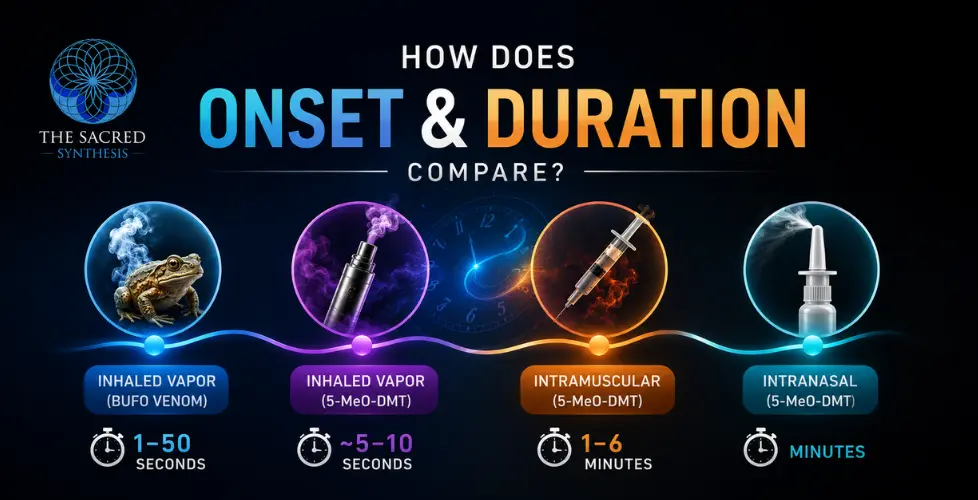
One of the clearest practical differences between Bufo and synthetic 5-MeO-DMT lies in onset timing and duration — particularly when you account for route of administration.
Onset and Duration: Side-by-Side Data
| Route | Source | Onset | Duration |
|---|---|---|---|
| Inhaled vapor | Bufo venom | 1–50 seconds | Investigator mean: 13.5 min (SD 5.8); participant mean: 17.7 min (SD 13.3) |
| Inhaled vapor | Synthetic 5-MeO-DMT | ~5–10 seconds | 5–30 minutes |
| Intramuscular (IM) | Synthetic 5-MeO-DMT | 1–6 minutes | Up to ~60 minutes |
| Intranasal (IN) | Synthetic 5-MeO-DMT | Minutes | Antidepressant effects measurable within 48 hours |
The inhaled Bufo and inhaled synthetic experiences are pharmacokinetically similar — they overlap heavily in timeline. The primary divergence comes with IM and IN administration routes, which are only available with synthetic material and allow a longer, more intentionally structured experience arc.
What Do the Mystical Experience Scores Actually Show?
Most content on this topic describes 5-MeO-DMT experiences as “extremely powerful” without quantifying what that means. Published research provides actual psychometric data.
The MEQ-30 (Mystical Experience Questionnaire) is a validated instrument used consistently across psychedelic research studies. Higher scores indicate stronger and more complete mystical states.
5-MeO-DMT (Dose Equivalent to a Typical Bufo Session: ~5–7 mg)
- Mean MEQ-30 total score: 83.37 / 100 (SD 2.88)
- Complete mystical experience rate: 75% of participants
- Source: Davis et al. (2018), American Journal of Drug and Alcohol Abuse
Psilocybin for Comparison
| Psilocybin Dose | MEQ-30 Score | Complete Experience Rate |
|---|---|---|
| 30 mg / 70 kg | 76.81 | 67% |
| 20 mg / 70 kg | 69.56 | 61% |
The data is clear: 5-MeO-DMT consistently produces higher mystical experience scores and a higher rate of “complete” mystical experiences than even high-dose psilocybin. Whether sourced from Bufo or produced synthetically, the molecule is one of the most potent inducers of full mystical states ever measured in a controlled research context.
What Does the Research Show for Mental Health Benefits?

Naturalistic Survey Data: What Real-World Users Report
A large naturalistic survey of people who used 5-MeO-DMT in ceremonial or group settings — predominantly via Bufo or vaporized synthetic — found the following among those with pre-existing diagnoses:
- 41% had a prior diagnosis of depression; 48% had anxiety
- Among those with depression:
- 80% reported improvement after 5-MeO-DMT
- 17% reported no change
- Only 3% reported worsening
- Among those with anxiety:
- 79% reported improvement
- 19% reported no change
- 2% reported worsening
These are self-reported figures from a naturalistic population — not a controlled trial — but the magnitude and direction of the findings are consistent across the literature.
Clinical Trial Data: Synthetic Intranasal 5-MeO-DMT
GH Research’s Phase 2a clinical trial of intranasal synthetic 5-MeO-DMT (10–12 mg) administered alongside existing SSRI therapy in treatment-resistant depression showed:
- 66.7% responder rate (≥50% reduction in depression scores) at Day 2 post-dose
- 87.5% remission rate in the individualized dosing group by Day 7 in the Phase 1/2 vaporized trial (Reckweg et al., 2023, Frontiers in Psychiatry)
- A 2026 Phase 2a trial adjunctive to SSRIs confirmed “encouraging exploratory evidence for sustained improvement” with acceptable safety and tolerability (CNS Drugs, March 2026)
Additionally, GH Research reported positive Phase 2b trial results in September 2026, meeting the primary endpoint for treatment-resistant depression — a major milestone for pharmaceutical-grade 5-MeO-DMT development.
The convergence between self-report data (~80% improvement rates) and early clinical trial results (~66–87% responder/remission rates) is striking — two completely different methodologies pointing to the same signal.
Safety and Toxicity: Where Bufo and Synthetic Diverge Most Sharply
This is where the distinction between Bufo and synthetic 5-MeO-DMT is sharpest — and where most content in this space is most inadequate.
Bufo’s Unique Cardiac Risk Profile
Bufo venom contains cardiotoxic steroidal compounds — specifically bufagins and bufotoxins (bufadienolides) — that have no equivalent in synthetic 5-MeO-DMT. These compounds can cause:
- Cardiac arrhythmias
- Elevated blood pressure and vasoconstriction
- Cardiac arrest in high-exposure scenarios
A published case series analysis of 180 toad-toxin poisonings (primarily from oral ingestion of toad preparations, not vaporized inhalation) found:
- Deaths: 53 out of 180 → 29.44% mortality rate
- Higher mortality than fish bile poisoning (5.85%) and cantharidism (18.75%)
- 56.75% of fatalities occurred in people over 60 or under 15 years old
- 66.66% of deaths were in males
These cases are from ingestion, not inhalation of vaporized secretion — and that distinction matters. But the figures illustrate the inherent lethality of toad cardiotoxins when concentrated or misused, and they underscore why the bufotoxin load in inhaled Bufo venom is a genuine variable that deserves clinical respect.
Synthetic 5-MeO-DMT carries none of this cardiac toxin load. Its risk profile is driven entirely by the psychedelic intensity of 5-MeO-DMT itself — primarily psychological in nature, not cardiovascular.
Comparative Risk Summary
| Risk Factor | Bufo Alvarius Venom | Synthetic 5-MeO-DMT |
|---|---|---|
| Cardiotoxic steroids present | ✓ Yes | ✗ No |
| Bufotenin exposure | ✓ Yes (0.6–3.5 mg/g) | ✗ No |
| Dose standardization | Low — high variability | High — >99% pure |
| Batch-to-batch consistency | Low | Consistent |
| Cardiac arrhythmia risk | Elevated (bufotoxins) | Baseline (psychedelic only) |
| Psychedelic intensity risk | High | High |
“Natural” does not mean “safer.” Bufo venom is a biologically complex fluid containing compounds with direct cardiovascular effects. Synthetic 5-MeO-DMT is a single, well-characterized molecule. The safety comparison favors the synthetic on cardiac toxicity — full stop.
Bufo vs Synthetic 5-MeO-DMT for Beginners: The Simplified Breakdown
If you are new to this topic and need the clearest possible summary before going deeper, here it is:
Bufo Alvarius Venom
- A complex mixture — 5-MeO-DMT is the main driver but not the only active compound
- Potency varies between toads, sessions, and storage conditions
- Contains cardioactive steroids (bufotoxins) not present in synthetic material
- Impossible to dose precisely without laboratory analysis of each batch
- Raises significant animal welfare and conservation concerns
- Used predominantly in ceremonial and naturalistic settings
Synthetic 5-MeO-DMT
- A single purified molecule at ≥99% purity
- Consistent, measurable dose every time
- No cardiotoxic compounds — risk profile limited to 5-MeO-DMT itself
- Can be administered via multiple routes — inhaled, IM, intranasal
- Currently in active Phase 2b clinical trials for treatment-resistant depression
- The preferred format in research, therapeutic, and clinical contexts
For anyone approaching this field without a background in pharmacology, understanding that these are not the same substance — even if they share the primary psychoactive compound — is foundational to making genuinely informed decisions.
Does the Experience Feel Different: Bufo vs Synthetic 5-MeO-DMT?
This is a question that sits at the intersection of pharmacology and phenomenology, and honest reporting requires acknowledging both dimensions.
From a pharmacokinetic standpoint, when the route is the same — vaporized inhalation — Bufo and synthetic 5-MeO-DMT produce experiences that are nearly indistinguishable in timeline. The onset-to-peak-to-resolution curve is similar, and the primary psychedelic driver (5-MeO-DMT at 5-HT1A and 5-HT2A receptors) is identical.
From a phenomenological standpoint, many experienced practitioners and researchers report subtle qualitative differences — though the scientific evidence for this is limited and largely anecdotal. Some describe Bufo as having a “heavier,” more “somatic” quality, which may relate to the bufotenin and other co-occurring tryptamines creating overlapping receptor effects. Others describe synthetic 5-MeO-DMT as “cleaner” or more “crystalline” in quality.
Whether these reported differences represent genuine pharmacological effects from the co-occurring compounds, or whether they reflect expectation and context effects, is not yet resolved in the literature.
What is resolved: any experience difference between Bufo and synthetic 5-MeO-DMT at matched doses of the primary compound is attributable to the additional compounds in the venom — not to any quality difference in the 5-MeO-DMT molecule itself. The molecule is chemically identical.
How Do Facilitators and Clinicians Navigate This Difference?
For practitioners working in structured therapeutic settings, the case for synthetic 5-MeO-DMT is grounded in clinical necessity:
- Dose precision — You cannot provide informed consent around a dose you cannot measure. Synthetic 5-MeO-DMT allows facilitators to state: “You are receiving X milligrams of 5-MeO-DMT.” Bufo venom does not allow that certainty.
- Reproducibility — Clinical research requires the ability to replicate conditions. Batch-variable Bufo venom cannot meet this standard.
- Cardiac risk reduction — Clinical screening protocols can assess cardiovascular risk, but eliminating the cardiotoxin source entirely (by using synthetic) is a cleaner risk-management approach.
- Legal and regulatory clarity — In several jurisdictions, the legality of Bufo venom and synthetic 5-MeO-DMT differ. The regulatory pathway for synthetic pharmaceutical-grade material is clearer.
For ceremonial and spiritual practitioners, some argue that the full-spectrum complexity of Bufo venom is itself meaningful — that the co-occurring compounds contribute to an experience profile that synthetic cannot replicate. This is a legitimate framing within a ceremonial context, provided participants are aware of and accept the additional risks.
Neither framing is “wrong” — but they reflect different goals: clinical precision vs. full-spectrum ceremonial experience. Understanding which context you are operating in matters enormously for how you evaluate this comparison.
What Are the Common Natural Language Questions People Ask About This Topic?
Voice search, AI assistants, and natural language queries return different results than traditional keyword searches. Here are the most common question-format queries in this topic cluster, with direct answers:
“What is the difference between bufo and 5-MeO-DMT?” Bufo alvarius venom is a mixture; 5-MeO-DMT is one molecule within it. The venom contains cardiotoxic steroids and additional tryptamines that synthetic 5-MeO-DMT does not contain.
“Is bufo stronger than synthetic 5-MeO-DMT?” Not necessarily stronger — synthetic 5-MeO-DMT is 3–4× more concentrated per gram. At equivalent 5-MeO-DMT doses, the primary experience driver is the same molecule.
“How long does bufo last versus synthetic?” Inhaled, both last 5–30 minutes. Bufo mean is 13.5–17.7 minutes via investigator and participant estimates. IM synthetic can reach 60 minutes.
“What else is in bufo besides 5-MeO-DMT?” Bufotenin (0.6–3.5 mg/g), trace DMT, N-methylserotonin, 5-MeO-tryptamine, and cardiotoxic bufogenins/bufotoxins — all absent in synthetic 5-MeO-DMT.
“Is bufo safe?” The 5-MeO-DMT in Bufo carries significant psychedelic intensity risks. Additionally, the cardiotoxic bufotoxins in Bufo venom introduce cardiac risks not present with synthetic 5-MeO-DMT. A case series of 180 toad-toxin poisonings found 29.44% mortality — though primarily from ingestion, not inhalation.
What Is Psilomethoxin, and How Does It Compare to Bufo?
A question that consistently surfaces alongside the Bufo vs synthetic debate is: where does psilomethoxin fit — and how is it different from both?
Psilomethoxin is a novel sacramental compound produced through an alchemical cultivation process in which 5-MeO-DMT is introduced during the growth of psilocybin-containing mushrooms. The result is a compound that combines elements of psilocin and 5-MeO-DMT biosynthesis — producing a gentle, non-visual, serotonin-analog known for emotional balance, mental clarity, parasympathetic activation, and neuroplasticity support.
It is not Bufo venom. It is not pharmaceutical-grade synthetic 5-MeO-DMT. It occupies a distinct category — one designed for daily, low-dose, sustained practice rather than the single high-intensity breakthrough experience that characterizes both Bufo ceremonies and full-dose synthetic 5-MeO-DMT sessions.
How Does Psilomethoxin Compare to Bufo in Practice?
The practical differences between psilomethoxin and Bufo alvarius venom are significant across every relevant dimension:
| Factor | Bufo Alvarius Venom | Psilomethoxin |
|---|---|---|
| Primary use | Single high-dose ceremony | Microdosing, daily ritual, 30-day protocols |
| Onset | 1–50 seconds (inhaled vapor) | Gradual — gentle onset over minutes |
| Duration | 13–30 minutes | Sustained, low-intensity throughout the day |
| Experience intensity | Extreme — full ego dissolution common | Gentle — grounded presence, emotional softening |
| Cardiotoxic compounds | ✓ Yes (bufotoxins) | ✗ No |
| Compound complexity | Multi-alkaloid mixture | Novel biosynthetic compound |
| Ecological impact | High — wild toad harvesting | None |
| Typical format | Vaporized inhalation | Capsule or powder (oral) |
Where Bufo is a single, overwhelming encounter with non-dual consciousness — an experience measured in minutes — psilomethoxin is designed as a steady companion for long-term inner work. Its effects are subtle rather than sudden, integrative rather than cathartic.
Who Is Psilomethoxin For?
Psilomethoxin is particularly well-suited for people who:
- Are new to entheogenic practice and want a gentle, low-risk entry point
- Are looking for a daily microdosing sacrament that supports clarity, emotional regulation, and nervous system regulation without interrupting daily function
- Want to engage with 5-MeO-DMT-related compounds in a sustained, structured protocol — such as a 30-day group practice — rather than a single intense ceremony
- Are working through integration after a high-dose experience and want ongoing support
It is not positioned as a replacement for Bufo or synthetic 5-MeO-DMT. It is a genuinely different tool — one built for depth over time rather than intensity in the moment.
The Three Compounds Side by Side
| Source | Primary Use Case | Intensity | Cardiotoxic Risk |
|---|---|---|---|
| Bufo alvarius venom | Ceremony — single high-dose session | Extreme | ✓ Yes (bufotoxins) |
| Synthetic 5-MeO-DMT | Therapy or ceremony — high-dose or IM | Extreme to high | ✗ No |
| Psilomethoxin | Daily practice — microdosing and protocols | Gentle to moderate | ✗ No |
Understanding which of these three tools aligns with your current goals, preparation level, and practice context is essential — and it is a question worth sitting with carefully before choosing any path forward.
Conservation and Sustainability: The Numbers That Should Change the Conversation
The ecological argument for synthetic 5-MeO-DMT over Bufo venom is not just ethical — it is arithmetic.
How Much 5-MeO-DMT Does One Toad Produce?
Based on research on Bufo alvarius secretion harvesting:
- One milking session yields approximately 0.25–0.50 g of dried secretion per toad
- At 15–30% 5-MeO-DMT content, that equals roughly 37.5–75 mg of 5-MeO-DMT per toad per session
What Does Synthetic Production Look Like?
A single optimized synthetic production run has yielded:
- 136 grams of crystalline 5-MeO-DMT succinate at 99.86% purity — produced for clinical trial use
That single batch is equivalent to the 5-MeO-DMT content of 1,800 to 3,600 individual toad milking sessions — without removing a single animal from its natural habitat.
The Sonoran Desert toad is already under documented pressure from habitat destruction, road mortality, and collection pressure driven by demand for its venom. The arithmetic above makes the conservation argument for synthetic 5-MeO-DMT self-evident. This is not a matter of opinion — it is a matter of scale.
Frequently Asked Questions About Bufo vs 5-MeO-DMT
Q1. Is Bufo the same as 5-MeO-DMT?
No. Bufo venom is a complex mixture — 5-MeO-DMT is its primary psychedelic molecule, but the venom also contains bufotenin, trace DMT, N-methylserotonin, and cardiotoxic bufogenins that are entirely absent in synthetic 5-MeO-DMT.
Q2. How much 5-MeO-DMT is actually in Bufo venom?
Approximately 250–410 mg per gram of dried Bufo secretion (15–30% by dry weight), compared to ~990 mg/g in pharmaceutical-grade synthetic 5-MeO-DMT — a 3–4× concentration difference with far less variability in the synthetic version.
Q3. Is synthetic 5-MeO-DMT safer than Bufo venom?
From a cardiotoxicity standpoint, yes. Synthetic 5-MeO-DMT contains no bufogenins or bufotoxins — the cardioactive steroids unique to Bufo venom associated with arrhythmia risk. A case series of 180 toad-toxin poisonings found a 29.44% mortality rate, largely attributable to these cardiac compounds.
Q4. How long does a Bufo experience last compared to synthetic?
Inhaled Bufo vapor lasts a mean of 13.5–17.7 minutes. Inhaled synthetic 5-MeO-DMT is similar (5–30 minutes); intramuscular synthetic administration can extend the experience arc to approximately 60 minutes.
Q5. Can 5-MeO-DMT help with depression and anxiety?
Early data is consistently promising. Naturalistic surveys show ~80% of participants with depression and ~79% with anxiety reported improvement. GH Research’s Phase 1/2 clinical trial of vaporized synthetic 5-MeO-DMT showed an 87.5% remission rate at Day 7 in the individualized dosing group; Phase 2b trial results in 2026 met the primary endpoint for treatment-resistant depression.
Q6. What is psilomethoxin, and how does it compare to Bufo?
Psilomethoxin is a distinct sacramental compound — not Bufo venom and not synthetic 5-MeO-DMT. Cultivated by introducing 5-MeO-DMT during the growth of psilocybin mushrooms, it is designed for gentle, low-dose daily practice — microdosing and 30-day protocols — rather than single high-intensity ceremonies. Where Bufo produces extreme, 13–30 minute ego dissolution, psilomethoxin offers sustained, grounded clarity throughout the day.
Q7. Why does toad conservation matter for 5-MeO-DMT use?
Because the math is decisive. One synthetic production batch of 136g at 99.86% purity equals the 5-MeO-DMT content of an estimated 1,800–3,600 individual toad milkings. Synthetic production meets therapeutic demand at scale without placing any collection pressure on wild Bufo alvarius populations.
Final Thoughts: Why the Distinction Between Bufo and Synthetic 5-MeO-DMT Matters
The question “Bufo vs 5-MeO-DMT” is not just a chemistry question. It is a question about safety, dosing precision, ethics, ecological responsibility, and the kind of context in which you engage with one of the most powerful psychoactive molecules known.
The data makes the picture clear across every dimension examined here:
- Chemical composition: Bufo is a mixture; synthetic is a single molecule
- Potency: Synthetic delivers 3–4× more 5-MeO-DMT per gram with zero variability
- Safety: Only Bufo carries cardiotoxic steroids — a meaningful clinical difference
- Dosing: Synthetic allows precise, repeatable dosing; Bufo does not without lab analysis
- Mental health outcomes: Both show strong signals; synthetic is now in Phase 2b trials with positive results
- Sustainability: One synthetic batch = thousands of toad milkings without harming a single animal
The 5-MeO-DMT experience — whether accessed through Bufo venom or pharmaceutical-grade synthetic material — consistently produces some of the highest mystical experience scores ever recorded in research settings, and early clinical evidence for mental health benefits is accumulating rapidly.
Ready to Go Deeper? Here Is Where to Start
The Sacred Synthesis Skool Community is a free, active space to ask questions, hear from people who’ve walked this path, and figure out what’s right for you — no commitment required.
Ready to structure your practice?
The 30-Day Sacred Synthesis Program is our guided integration pathway — for people who’ve done their research (like you, reading this) and want a structured container to carry insight into lasting change.