Quick Answer: The right psychedelic ceremony depends on your intention, experience level, and support needs. Look for guided facilitation, transparent sacrament information, health screening, and post-ceremony integration. Community-based models often provide more sustained support than one-time retreats.
Interest in psychedelic ceremonies is growing faster than most people realize. In 2024, an estimated 4.5% of U.S. adults — roughly 12 million people — reported using at least one psychedelic substance in the past year (National Survey on Illicit Drug Use and Health Trends, 2025). By 2025, psilocybin had become the most widely used psychedelic, with approximately 11 million U.S. adults reporting use in the past year alone (PMC, 2025). But growth in interest doesn’t automatically mean clarity about where — or how — to begin.
Choosing the right ceremony is one of the most important decisions on this path, and getting it wrong can mean an experience that leaves you unsupported, overwhelmed, or simply unchanged. This guide breaks down everything you need to know.
What Is a Psychedelic Ceremony?
A psychedelic ceremony is a structured, intentional experience in which participants use one or more entheogenic sacraments within a guided container. Unlike unguided or recreational use, a ceremony holds the experience within a broader framework: spiritual intention, communal support, ritual structure, and post-experience integration.
What makes a ceremony different from simply “taking something” is context. The presence of a trained facilitator, an intentional space, and access to integration support fundamentally changes how participants process and apply what arises. Research published in PLOS ONE (2023) consistently shows that facilitated ceremonial settings produce more stable, positive outcomes than unsupported psychedelic use — with factors like motivation, natural setting, and trusted companionship all contributing to better wellbeing.
Modern psychedelic ceremonies exist across a wide spectrum — from ancient indigenous traditions to regulated clinical models to faith-based entheogenic communities. Understanding that spectrum is the starting point for making an informed choice.
What Types of Psychedelic Ceremonies Exist?
There is no single type of psychedelic ceremony. Each model has its own strengths, trade-offs, and ideal use case. Here’s a breakdown of the main formats available in 2026:
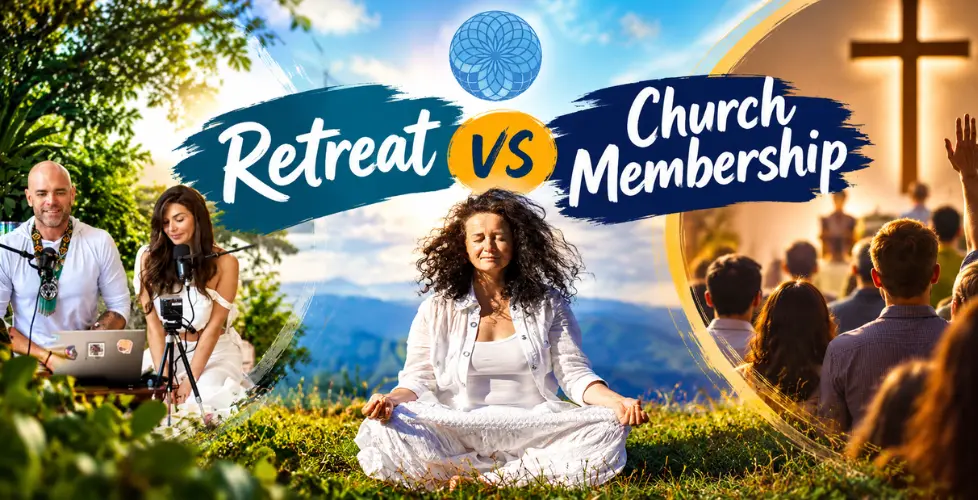
Retreat-Based Ceremonies Multi-day immersions — typically 3 to 7 days — held at a physical location, often in Mexico, the Netherlands, Costa Rica, or increasingly within the United States. These often involve higher-dose experiences with group integration, meals, and accommodation. Weekend psilocybin retreats in Oregon currently range from $2,000 to $4,500; international options vary widely. The Forbes review of psychedelic retreats (April 2026) noted that reputable programs maintain a ratio of one facilitator for every three to five participants — a key quality marker.
Church and Community Ceremony Models Entheogenic churches operate under religious freedom protections and offer ongoing ceremonial access within a sustained community — not a single-session transaction. Members participate in regular ceremonies, educational events, and integration circles. This model treats ceremonial work as a spiritual practice, not a one-time event. The Sacred Synthesis operates within this model, with live ceremonies available monthly to members.
Virtual Group Ceremonies Growing in accessibility since 2020, virtual ceremonies allow participants to work with sacraments at home under real-time guided facilitation. These are especially useful for those unable to travel, prefer privacy, or are working within a home-based practice. The Sacred Synthesis offers virtual ceremonies as a core community offering — structured, low-dose, and designed for nervous system safety.
Clinical and Therapeutic Settings Regulated through frameworks like Oregon’s Measure 109 and Colorado’s Proposition 122, clinical sessions prioritize therapeutic outcomes with licensed practitioners. Less ceremonial in tone, they are more structured around mental health treatment. Ketamine-assisted therapy is also widely available through medical clinics.
Solo Guided Sessions One-on-one facilitation, either virtual or in person, with a guide or integration coach. More personalized but also more costly. This format suits those with specific personal goals or histories that benefit from individual attention.
If you’re specifically weighing the group versus solo question, our deep-dive on Group vs. Solo Psilomethoxin Journeys covers that comparison in detail.
What Sacraments Are Used in a Psychedelic Ceremony?
This is the question most guides avoid answering clearly — and it’s one of the most important. The sacrament used in a ceremony determines its intensity, duration, emotional character, and integration demands. Understanding what’s being offered before you attend is non-negotiable.
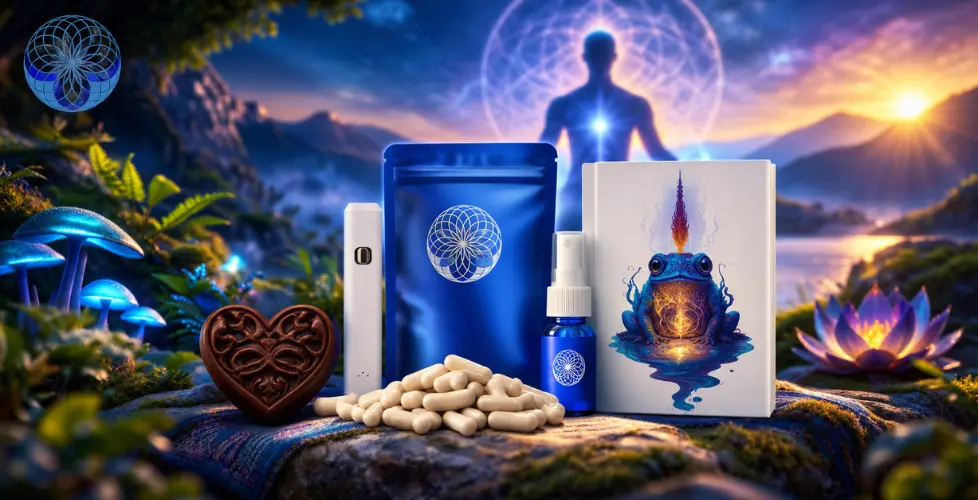
Here is a detailed look at the sacraments used in Sacred Synthesis ceremonies and the broader ceremonial landscape:
Psilomethoxin
Psilomethoxin is a ceremonially cultivated sacrament unique to The Sacred Synthesis. The Sacred Synthesis produces it through an alchemical process that introduces 5-MeO during the growth of psilocybin mushrooms — yielding a gentle, non-visual serotonin-analog known for supporting emotional balance, clarity, parasympathetic activation, and neuroplasticity.
Available in capsule or powder form, people most commonly use it for microdosing, daily ritual, or the structured 30-Day Group Protocol. In ceremony, it contributes a grounded, heart-centered quality that even first-time participants can access easily. It does not produce overwhelming visual or dissociative effects, which makes it a meaningful entry point for those who approach ceremonial work with caution.
Jaguar Light Wand — Low-Dose 5-MeO-DMT Vapor
The Jaguar Light Wand is a handheld vapor device delivering rapid-onset, adjustable low-dose 5-MeO-DMT. Its effects are fast-acting and somatic in nature — supporting ego softening, nervous system relaxation, swift clarity, and expanded awareness — without overwhelming the system or producing full ego dissolution at low doses.
In ceremony, the Jaguar Light Wand is used to support genuine presence and grounded connection. Its short duration — well-suited to real-time facilitation — allows guides to remain fully present throughout the experience. For a comprehensive breakdown of the sacrament and ceremonial protocol.
Read More: Jaguar Light Wand Ritual Guide.
Jaguar Unity Mist — Nasal 5-MeO-DMT
The Jaguar Unity Mist is a nasal sacrament offering a slower, more elongated 5-MeO experience — typically 60 to 90 minutes of emotional softening, grounded presence, and deep inner clarity. It can be used as a standalone sacrament or as energetic scaffolding alongside the Jaguar Light Wand within a ceremony container.
Its nasal delivery is easy to self-administer at home, and its extended duration allows for deeper somatic settling — making it ideal for participants who prefer a slower, more contemplative experience. For a detailed comparison between these two 5-MeO delivery formats.
Read More: Jaguar Unity Mist vs. Jaguar Light Wand: Which 5-MeO Fits You Best?
Coyote Cacao
Indigenous traditions across Mesoamerica have used ceremonial-grade cacao for centuries as a heart-opening plant ally. In its Sacred Synthesis form — Coyote Cacao — The Sacred Synthesis combines ceremonial-grade Ecuadorian cacao with a gentle microdose of Psilomethoxin to create an intentional blend that supports clarity, clean energy, and heart-centered presence.
In ceremony, facilitators often use Coyote Cacao to gently open the emotional field before or alongside other sacraments, providing a warm, accessible entry point into the ceremonial space.
The Sacred Bundle
The Sacred Bundle is a curated constellation of The Sacred Synthesis’s most beloved sacraments — designed together to support deep coherence, emotional liberation, and transformational clarity. It represents the full sacramental toolkit that the community’s ceremonial containers make available.
Who Actually Attends Psychedelic Ceremonies?
One of the most persistent myths about ceremonial psychedelic work is that it’s the domain of the deeply experienced, the spiritually advanced, or the young. Real-world data tells a different story.
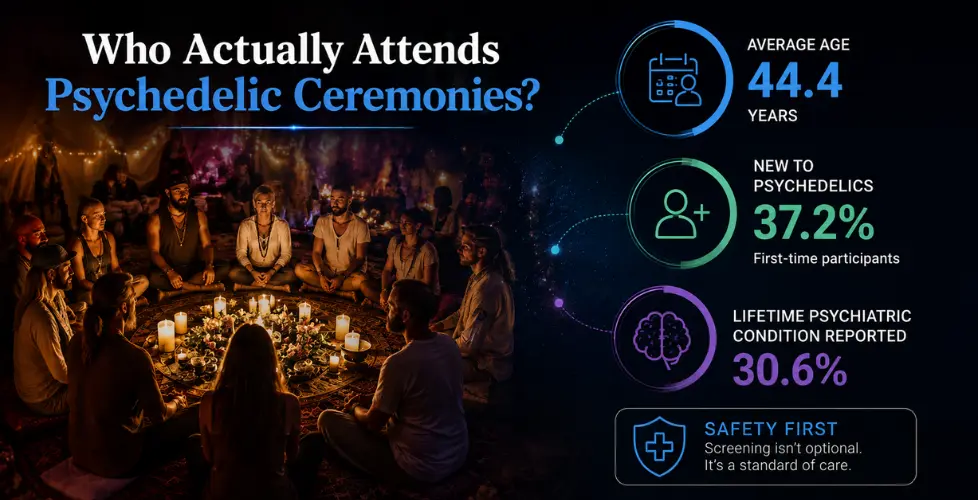
In one of the largest ceremony-based datasets published to date — a 2025 study in Frontiers in Psychology tracking 886 participants across multiple timepoints — the average participant age was 44.4 years. Critically, 37.2% of participants had never used psychedelics before, meaning more than a third of those in ceremony settings were complete newcomers to this kind of work.
That same study found that 60.8% of participants had no lifetime psychiatric diagnosis — but 30.6% did report at least one lifetime psychiatric condition, reinforcing why health screening is not optional. It’s a standard of care.
Who Is Joining Ceremonies?
| Data Point | Finding |
|---|---|
| Average participant age | 44.4 years |
| First-time psychedelic users | 37.2% |
| No lifetime psychiatric diagnosis | 60.8% |
| Prior psychedelic experience | 55.2% |
This data matters because it grounds the conversation in reality. Ceremonies are not exclusive clubs for veterans. They are increasingly drawing thoughtful adults — professionals, parents, seekers — who are approaching this work for the first time, with care and intention.
How Does Set, Setting, and Support Shape Your Experience?
Ask any experienced ceremonial facilitator and you’ll hear the same thing: the sacrament matters far less than the container around it.
Set refers to your mindset — your intentions, expectations, emotional state, and what you bring to the experience. Research from the Center for Healthy Minds found that a negative mindset measurably increased the likelihood of challenging experiences in ceremony contexts, while positive motivation consistently predicted better outcomes. Arriving without a clear intention isn’t fatal, but arriving with unexamined fear, resistance, or expectation of failure creates real risk.
Setting is the physical, social, and energetic environment around you. Natural settings and the presence of trusted companions have both been associated with significantly better wellbeing outcomes in ceremonial research (PubMed, 2023). Whether you’re joining a guided virtual ceremony at home or an in-person container, how physically and emotionally safe you feel in the space shapes everything.
Support is the most undervalued element of the three. This includes the training and experience of the facilitating team, their capacity to respond to difficult psychological states (not just guide smooth experiences), and the integration support available after the ceremony ends. The Forbes review of retreat quality in 2026 noted that integration support is “equally important” to the ceremony itself — a point most providers underemphasize.
What Shapes a Good Ceremony?
| SET | SETTING | SUPPORT |
| Mindset | Location | Facilitator training |
| Intention | Social safety | Real-time guidance |
| Emotional state | Physical environment | Integration follow-up |
| Expectations | Natural vs. built space | Safety & reassurance |
Why Some Experiences Feel Easier
| Factor | Effect on Experience |
|---|---|
| Positive motivation | Better outcomes and longer-lasting insight |
| Natural or safe setting | Greater wellbeing, reduced psychopathology |
| Trusted companions present | Less distress, more openness |
| Negative mindset | Significantly higher odds of challenging experiences |
What Makes a Psychedelic Ceremony Safe?
Safety in a ceremonial context is not one thing — it’s a layered system of practices that responsible providers build in from the start.
A 2025 analysis of publicly advertised psychedelic retreat organizations found that all 49 organizations surveyed collected participant medical histories before ceremony, and 73.5% maintained active exclusion criteria based on specific health conditions (PMC, 2025). This is the baseline minimum for any provider operating with integrity.
Safety Screening in the Real World
| Safety Practice | Adoption Rate |
|---|---|
| Medical history collected | 100% of surveyed organizations |
| Condition-based exclusion rules | 73.5% |
| Contraindication screening | Standard among established providers |
A trustworthy ceremony provider will always screen for:
- Medications: SSRIs and MAOIs interact directly with serotonergic sacraments and can create dangerous combinations. Anticoagulants and some cardiac medications also require careful evaluation.
- Psychiatric history: Schizophrenia, active psychosis, and certain bipolar presentations are contraindications for most ceremonial settings. A 30.6% rate of lifetime psychiatric diagnosis among ceremony participants (Frontiers in Psychology, 2025) shows why screening cannot be bypassed.
- Pregnancy: Universally contraindicated for sacrament use in any ceremonial context.
- Cardiovascular conditions: Particularly relevant for tryptamine-class sacraments.
At The Sacred Synthesis, all ceremonies maintain clear contraindications. We ask participants to avoid sacrament use if they are pregnant, currently taking SSRIs or MAOIs, or navigating acute mental health conditions. Participants must never mix sacraments. This is not bureaucratic caution — it is the foundation of responsible practice.
Beyond screening, safety also means having an experienced facilitation team present when things get difficult. Benjamin Moore and Cynthia Cramblett guide The Sacred Synthesis ceremonies — their combined experience in entheogenic facilitation, somatic healing, and ceremonial leadership creates a container that participants describe as genuinely steady and safe.
What Should You Look For in a Ceremony Provider?
Choosing a provider is consequential. Here’s a clear framework for evaluating any ceremony you’re considering:
1. Facilitator experience — specifically in difficulty The most important question isn’t “how many ceremonies has this person led?” It’s “how experienced are they in holding difficult psychological states?” A guide who has only seen smooth experiences is a guide still in training. Look for facilitators who can articulate how they work with fear, grief, or resistance — not just expansion.
2. Transparent sacrament information Does the provider clearly disclose what sacrament they use, its source or cultivation method, delivery format, and how they approach dosing? Vague or evasive answers about what they’re offering are a significant red flag. Compare this to the complete sacrament transparency that a community like The Sacred Synthesis maintains as a standard.
3. Health screening before every ceremony Any provider that skips health intake and contraindication screening is not operating safely — regardless of how they frame it. This step is non-optional.
4. Integration support built in Research is consistent: transformation doesn’t happen during the ceremony. It happens in the integration that follows. A provider who doesn’t address what comes after is offering an incomplete experience. Look for providers who include integration circles, coaching, or peer support as a standard part of their model.
Read More: What Is Psychedelic Integration and Why Does It Matter?
5. Community or one-time? A powerful single-session retreat has its place. But an ongoing ceremonial community provides something a retreat fundamentally cannot: continuity, relationships, and a living framework for growth. The Sacred Synthesis membership model gives members access to monthly live ceremonies, integration support, educational conclaves, and a genuine community — a full path, not a single event.
6. Dose philosophy aligned with your readiness High-dose approaches pursue peak experiences; low-dose ceremonial containers, like those offered by The Sacred Synthesis, prioritize nervous system safety, somatic awareness, and accessible participation for all experience levels. Neither philosophy is inherently superior — but your goals, readiness, and support structure should align with the approach you choose.
How Do You Prepare for a Psychedelic Ceremony?
Preparation begins weeks before the ceremony, not the morning of. The quality of your preparation directly affects the quality of your experience.
Set a clear intention. What are you bringing to the ceremony? What do you hope to understand, release, or open toward? You don’t need a perfect answer — “I want to listen” is a complete intention. Clarity of direction allows the experience to have somewhere to go.
Review your physical preparation honestly. For most sacrament-based ceremonies, a 2–4 hour fast beforehand is recommended. Avoid alcohol and cannabis for at least 24 hours prior. If you are currently taking any medications — especially SSRIs, MAOIs, blood thinners, or cardiovascular medications — consult your physician before attending and be fully transparent with your ceremony provider. Do not mix sacraments.
Prepare your environment. If attending a virtual ceremony, create a clean, uninterrupted space before the session begins. Have water, a blanket, and if helpful, an eye mask nearby. Many participants find it valuable to have a journal available for post-ceremony reflection.
Hydrate consistently in the days leading up to and on the day of the ceremony. This is consistently underemphasized.
Release performance pressure. You are not required to “feel something profound.” The experiences that arise when you arrive with genuine openness and without expectation are often the most meaningful. For detailed preparation guidance specific to psilomethoxin sessions.
Read More: How to Prepare for a Psilomethoxin Session
What Is Integration and Why Does It Matter After a Ceremony?
Integration is what transforms a powerful ceremony into lasting change. Without it, even the most profound experience fades into a memory that slowly loses its meaning. With it, the ceremony becomes a reference point — something you continue drawing from months and years later.
Integration is the active process of making sense of what arose. What feelings, images, realizations, or questions came up? What do they point toward in your life? What needs to change, be expressed, or be released? These are not questions with immediate answers — they unfold over time, through reflection, conversation, and lived practice.
Integration takes many forms: journaling, somatic movement, time in nature, creative expression, conversations with a guide or peer, or participation in integration circles. At The Sacred Synthesis, the ceremonial model builds in integration — it’s not an add-on. Every ceremony offers participants access to group integration calls, peer community support, and for VIP members, monthly group coaching.
For those who want the full immersive experience of ceremony and deep integration woven together, the Unity Immersion is a nine-week container that combines ceremony, education, and structured integration into a sustained program. It’s the difference between a single powerful moment and a genuine transformation arc.
The Microdosing Path: When a Full Ceremony Isn’t the Right Starting Point
Not every seeker is ready for a full ceremonial experience — and that’s not a failing, it’s discernment.
For those newer to this work, or those who want a more gradual on-ramp, microdosing within a structured protocol can serve as both an entry point and a practice in its own right. In 2025, an estimated 10 million U.S. adults microdosed psilocybin, MDMA, or LSD, reflecting how broadly accepted low-dose intentional use has become (PMC, 2025).
The Sacred Synthesis offers a 30-Day Group Protocol — a structured community-based microdosing program using Psilomethoxin that builds familiarity with the sacrament, nervous system attunement, and ceremonial readiness over time. Think of it as preparation for ceremony that is also a practice in itself.
Frequently Asked Questions
Q1: What is a psychedelic ceremony?
A structured, guided experience using entheogenic sacraments within an intentional container of facilitation, intention, and integration support.
Q2: What sacraments are used in Sacred Synthesis ceremonies?
The Jaguar Light Wand, Jaguar Unity Mist, Coyote Cacao, and Psilomethoxin — all low-dose, all used within guided facilitation.
Q3: Do I need prior psychedelic experience to attend a ceremony?
No — research shows 37.2% of ceremony participants have never used psychedelics before; ceremonies are designed to meet you where you are.
Q4: Is sacrament use required to participate in a ceremony?
No — all Sacred Synthesis ceremonies are open to participants whether or not they choose to work with the sacrament.
Q5: What are the key contraindications for ceremony participation?
Pregnancy, current SSRI or MAOI use, and active mental health crises are primary contraindications; full medical history disclosure is always required.
Q6: How long does a psychedelic ceremony typically last?
It depends on format — Sacred Synthesis virtual ceremonies typically run 1–2 hours; multi-day retreat formats span 3–7 days.
Q7: What should I do immediately after a ceremony?
Rest, hydrate, journal, and engage with integration support — avoid major decisions or overstimulating environments for at least 24 hours.
Ready to Find the Right Ceremony for You?
The Sacred Synthesis offers something different from a typical retreat or clinical session. Our ceremonies are intentionally designed around nervous system safety, low-dose sacraments, experienced facilitation, and ongoing community integration. We hold a virtual and occasional in-person container that is accessible to first-time participants and seasoned practitioners alike.
If you’re ready to explore what ceremonial work looks like within a community built for the long term:
Final Thoughts
Choosing the right psychedelic ceremony is not about finding the most intense experience available. It’s about finding the container that genuinely fits who you are, what you need, and what you’re ready for right now.
The research is clear: mindset, setting, and support matter more than any single substance or dose. A ceremony with a negative mindset and no integration is far less valuable — and can be genuinely harmful — compared to a low-dose, well-facilitated experience within a trusted community.
Look for full transparency about sacraments. Look for providers who screen seriously and integrate genuinely. Look for a container that treats you as a person on a meaningful path — not a customer at a checkout. And look for continuity: the most significant transformations from ceremonial work tend to happen not in a single session, but over time, within a community that holds you accountable and supports your growth.
The right ceremony meets you where you are. The right community helps you move toward where you’re meant to be.