Hero’s Conclave: Doped Mushrooms
What happens when you introduce new compounds into a living system that already knows how to produce its own medicine?
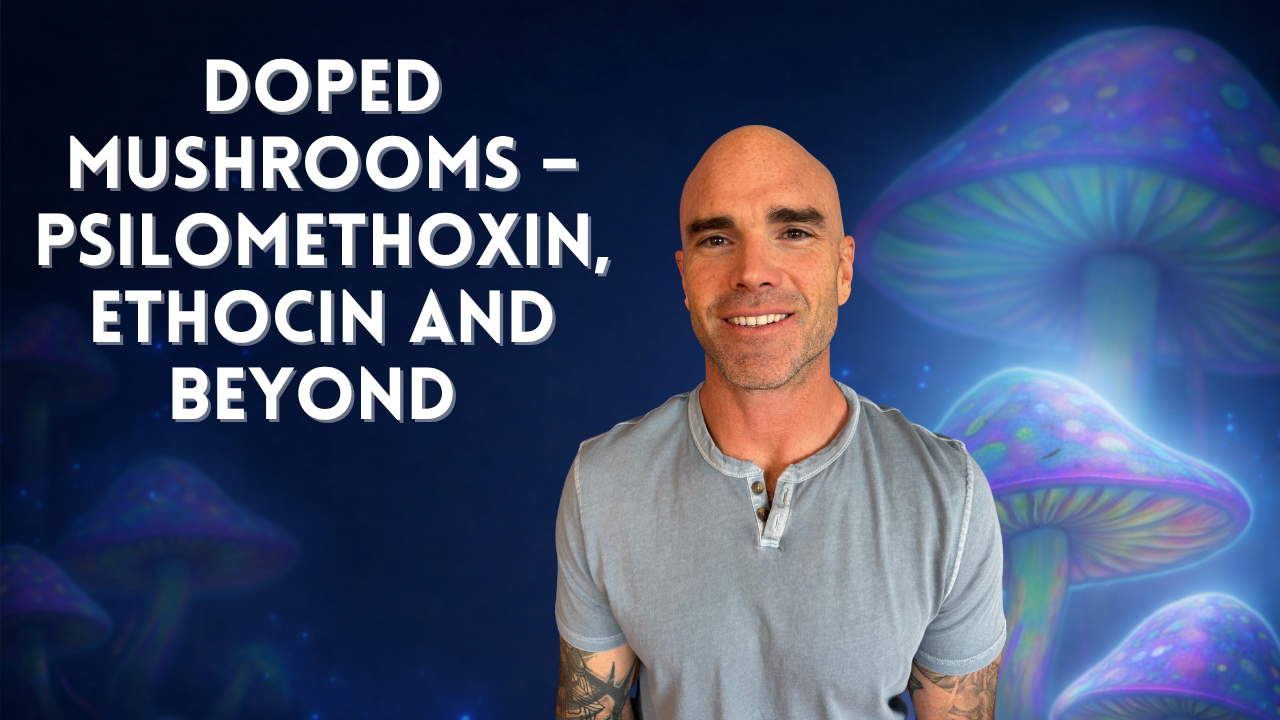
In this Hero’s Conclave, Benjamin Moore opens a fascinating window into the world of “doped mushrooms.” This emerging concept explores how adding exogenous tryptamines to the growing substrate of psilocybe cubensis can alter, enhance, and even entirely reshape the compounds these mushrooms produce.
Understanding the Foundation: The Mushroom’s Natural Intelligence
At its core, psilocybe cubensis produces psilocybin and psilocin through a precise biochemical pathway governed by four key enzymes. Each enzyme performs a specific transformation, step by step, converting simple building blocks into psychoactive compounds.
What makes this system remarkable is its flexibility.
These enzymes are not limited to a single input. When introduced to structurally similar molecules, they can process them in new ways. This opens the door to a powerful idea: by feeding different tryptamines into the substrate, the mushroom can create compounds it would never produce on its own.
This process is what we call “doping.”
What Is Mushroom Doping?
Doping refers to introducing external tryptamines into the mushroom’s growing environment. If these molecules are compatible with the mushroom’s enzymatic system, they enter the biochemical pathway and are transformed into new compounds.
The outcome depends on several factors:
- Which enzymes the molecule interacts with
- Which steps are bypassed due to the molecule’s structure
- How efficiently the enzymes process the new compound
In simple terms, the mushroom becomes a kind of biochemical collaborator, working with what it is given to produce something new.
Real-World Examples: From Theory to Practice
This is not just theoretical.
In 1989, researcher Jochen Gartz demonstrated that adding compounds like diethyltryptamine (DET) to mushroom substrates could result in the production of new, hydroxylated compounds such as 4-HO-DET. These compounds share similarities with psilocybin but differ in duration, intensity, and experiential qualities.
Other examples include:
5-MeO-DMT Doping
Introducing 5-MeO-DMT creates the potential for compounds like psilomethoxin. This process reduces the biochemical steps required and may produce substances that engage multiple serotonin receptors in a more balanced way.
The Role of Enzymes: Nature’s Precision Tools
The success of doping depends largely on how the mushroom’s enzymes respond.
Some enzymes are highly selective, while others are more flexible. The most critical enzyme in this process is responsible for hydroxylation, which determines whether a compound becomes psychoactive in a familiar way.
Interestingly, research suggests that even molecules with slight structural differences can still be processed successfully, though sometimes with lower yields. This points to a dynamic system that is both precise and adaptable.
Beyond the Lab: The Evolution of Living Systems
One of the most important considerations in this work is that mushrooms are living organisms.
They evolve. They adapt. They respond to their environment.
A substrate that produces a certain result in one growth cycle may produce something different in the next. Small changes in conditions, concentrations, or cofactors can shift the outcome significantly.
This means that working with doped mushrooms is not just chemistry. It is a relationship with a living system.
The Experiential Dimension
While the science is compelling, the deeper question remains: what do these compounds feel like?
Traditional psychedelics like psilocybin and DMT are often associated with strong visual effects, altered perception, and immersive journeys.
In contrast, compounds like psilomethoxin may offer something different.
Rather than amplifying sensory input, they appear to:
- Reduce overstimulation
- Support calm, grounded awareness
- Enhance presence without overwhelming the system
This is thought to be related to how these compounds interact with different serotonin receptors. Some pathways increase stimulation and transformation, while others promote relaxation and acceptance.
The result is a more balanced experience, one that allows for active participation rather than surrendering completely to the experience.
A New Frontier in Psychedelic Exploration
Doped mushrooms represent a new frontier where biology, chemistry, and consciousness intersect.
They challenge the idea that psychedelic compounds are fixed and unchanging. Instead, they suggest that these substances can be co-created through intentional interaction with living systems.
This opens up new possibilities:
- Tailored experiences based on specific compounds
- More balanced and regulated states
- Expanded approaches to healing, creativity, and self-exploration
A Grounded Approach
With all of this innovation, one principle remains essential: safety and intention.
Exploring altered states requires preparation, awareness, and respect for both the substances and the body. Having a supportive environment, clear intentions, and integration practices in place is key to meaningful experiences.
Doped mushrooms are not just a scientific curiosity. They represent a shift in how we think about psychedelics.
Rather than passive consumers of these compounds, we become participants in their evolution.
As this field continues to unfold, one thing is clear. We are only beginning to understand what is possible when we collaborate with nature at this level.
And as always, the invitation is to explore with curiosity, responsibility, and an openness to what these living systems can teach us.
Watch the Full Video and meet like-minded individuals by joining our community on Skool : https://www.skool.com/thesacredsynthesis