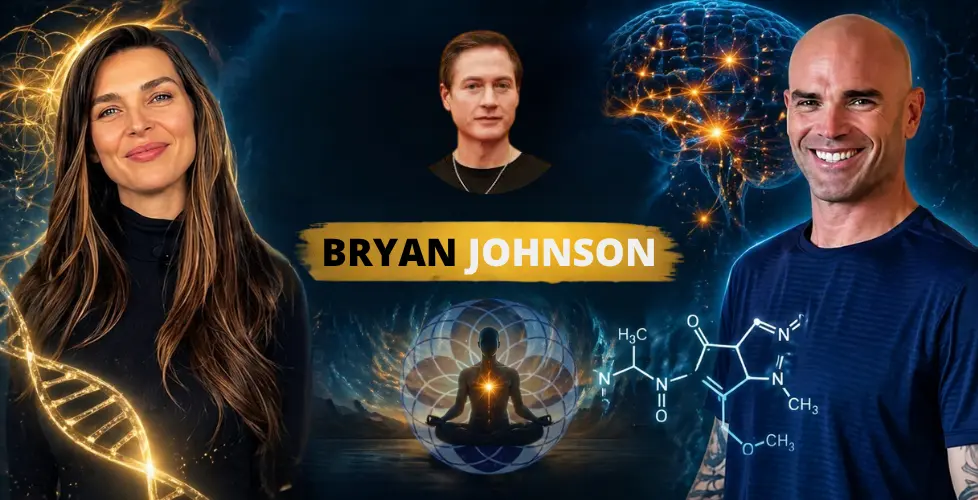
In a world increasingly obsessed with optimization—of time, health, productivity, even sleep—few figures embody this ethos more completely than Bryan Johnson. Known for his radical longevity experiment, Blueprint, Johnson has turned his body into a living laboratory, meticulously tracking biomarkers and striving toward a singular, almost audacious goal: not to die.
But beneath the sterile precision of algorithms, supplements, and biometric dashboards lies a deeper question—one that cannot be quantified in blood panels or sleep scores. What does it mean to be alive? And more provocatively: can consciousness itself be optimized?
It is here, at the edge of science and spirituality, that Johnson’s reported engagement with 5-MeO—the so-called “God Molecule”—becomes not just intriguing, but profoundly symbolic.
The Man Who Wants to Outrun Death
Bryan Johnson’s 5-meo journey into biohacking is well documented. After selling his company for hundreds of millions, he redirected his life toward an ambitious experiment: reversing biological aging. His daily routine is governed by data—strict diets, regimented sleep, dozens of supplements, and constant monitoring of organ function.
Every decision is filtered through one lens: does this increase longevity?
Yet longevity, taken to its logical extreme, raises uncomfortable philosophical questions. If we extend life indefinitely, what becomes of meaning? If death is the boundary that gives life urgency, what happens when that boundary dissolves?
It’s perhaps no coincidence that someone pushing so aggressively against biological limits would eventually encounter the limits of identity itself.
Read More: A 5-MeO Church on Bryan Johnson’s God Molecule Journey
Enter 5-MeO: The “God Molecule”

5-MeO is not your typical psychedelic. Unlike substances such as psilocybin or LSD, which often create vivid visuals and altered perceptions, 5-MeO unity brings something far more radical: the complete dissolution of the self.
Users frequently describe experiences of:
- Total ego loss
- A sense of merging with an infinite, boundless awareness
- A “white-out” state beyond thought, image, or narrative
There are no colorful hallucinations to interpret—only an overwhelming encounter with what many describe as pure consciousness.
For someone like Bryan Johnson—whose identity is built on control, measurement, and optimization—this represents the ultimate paradox.
Control Meets Surrender
At its core, biohacking is about control. It’s about bending biology to human will, refining systems, eliminating inefficiencies, and mastering the body through data.
5-MeO, by contrast, is about surrender.
It does not optimize the self; it obliterates it.
This tension is what makes Johnson’s exploration so fascinating. On one hand, he represents the pinnacle of modern scientific ambition—the belief that with enough data, we can solve any problem, even death. On the other hand, 5-meo mystical unity invites an entirely different realization: that the “self” we are trying to preserve may be an illusion to begin with.
So which is it?
Can transcendence be engineered? Or is it only accessible when we relinquish control entirely?
The Experience Beyond Experience
Descriptions of 5-MeO often strain the limits of language. Unlike other altered states that can be narrated or visualized, this experience is frequently described as “content-free.” There are no stories, no images—just an all-encompassing awareness that dissolves the boundary between observer and observed.
Some report:
- A sense of becoming everything and nothing simultaneously
- The disappearance of time and space
- An encounter with what feels like ultimate reality
For a biohacker, this presents an unusual challenge. How do you measure something that erases the one doing the measuring?
There are no metrics for ego death. No wearable device can track the moment when identity dissolves into pure awareness.
And yet, for many, this is precisely the point.
Biohacking’s Final Frontier?
As Silicon Valley increasingly turns its attention toward psychedelics, a new question emerges: are these substances the next frontier of optimization?
Microdosing for productivity is already a familiar concept in certain circles. But 5-MeO is not about marginal gains. It is not a tool for improving focus or creativity.
It is, in many ways, the opposite of optimization.
Rather than enhancing performance, it dismantles the very framework through which performance is understood.
And yet, this may be exactly why it appeals to figures like Bryan Johnson. After optimizing sleep, diet, and cellular health, what remains? Perhaps only consciousness itself—the final domain that resists quantification.
Spiritual Awakening or Technological Curiosity?
There is a temptation to interpret Johnson’s engagement with 5-MeO as a form of spiritual seeking. After all, the experience aligns closely with descriptions found in mystical traditions:
- Non-duality in Advaita Vedanta
- Ego dissolution in Buddhism
- Unity with the divine in various contemplative practices
But Johnson’s approach is not that of a traditional seeker. He does not retreat into monasteries or renounce the material world. Instead, he brings the same experimental mindset to consciousness that he applies to his body.
This raises an intriguing possibility: what happens when spirituality is approached not as a path of devotion, but as a system to be tested?
Can enlightenment be replicated, studied, even optimized?
Or does the attempt to systematize it fundamentally miss the point?
Read More: Navigating Ego Softening with Low-Dose 5-MeO
Risks, Responsibility, and the Public Eye
While the conversation around psychedelics is becoming more mainstream, substances like 5-MeO remain incredibly powerful—and potentially overwhelming.
The intensity of the experience can lead to:
- Psychological distress
- Difficult integration afterward
- A profound destabilization of one’s sense of self
When high-profile figures engage with such substances, it inevitably shapes public perception. This brings ethical considerations into focus.
Is it responsible to normalize experiences that are so extreme and context-dependent?
Should these substances be framed as tools, sacraments, or something else entirely?
And perhaps most importantly: who is qualified to guide such journeys?
A Cultural Shift: Tech Meets Transcendence
Bryan Johnson is not alone. Across Silicon Valley and beyond, there is a growing interest in the intersection of technology, wellness, and consciousness, including emerging frameworks like the 30-Day Group Protocol.
This convergence reflects a broader cultural moment:
- Dissatisfaction with purely material definitions of success
- A search for meaning beyond productivity and accumulation
- A recognition that mental and emotional well-being cannot be reduced to data points
People once pushed psychedelics to the fringes, but now many reconsider them as tools for exploring the mind. As they enter mainstream discourse, companies may commodify them by packaging, branding, and optimizing them like any other product.
This raises a critical question: can something as profound as transcendence survive the logic of optimization?
The Paradox at the Heart of It All
Bryan Johnson’s journey sits at a fascinating crossroads.
On one side, there is the relentless pursuit of control:
- Extending lifespan
- Eliminating biological uncertainty
- Perfecting the human system
On the other, there is the invitation to surrender:
- Letting go of identity
- Embracing uncertainty
- Experiencing consciousness without a self
These two paths seem, at first glance, incompatible.
And yet, perhaps they are not.
Perhaps the drive to control and the urge to surrender are two expressions of the same deeper impulse: the desire to understand what it means to exist.
Read More: Medicine Conclave: 5-MeO & Harm Reduction
Final Reflection: Optimize or Surrender?
In the end, the Bryan Johnson 5-meo experience represents far more than a personal experiment in consciousness—it embodies a deeper cultural crossroads where control meets surrender, and where human ambition encounters the unknown. In The Sacred Synthesis, this journey becomes a powerful reflection of humanity’s enduring tension: between mastery and mystery, science and spirituality, optimization and awakening. It invites us to consider a profound question that no algorithm or biometric tracker can fully resolve: Is enlightenment something we engineer through relentless self-optimization, or is it something we uncover only when we finally release the need to optimize? As biohacking continues to expand the limits of human performance, psychedelics like 5-MeO offer an equally vital reminder—not just of what the body can achieve, but of what it truly means to be human. Perhaps it is within this delicate balance between precision and surrender, explored through Bryan Johnson 5-meo experience, that The Sacred Synthesis reveals the possibility of not only extending life, but enriching it with deeper purpose and meaning.