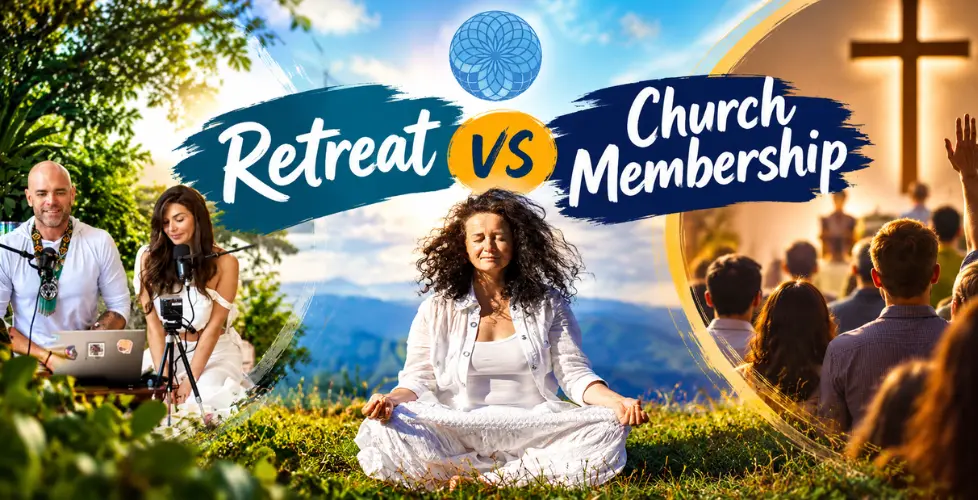
One of the most meaningful decisions you will make as you begin or deepen your relationship with psilomethoxin is a surprisingly simple-sounding one: do you journey in a group, or do you go alone?
It sounds like a logistical question. It is actually a spiritual and psychological one — and getting it right can be the difference between a profound, well-integrated experience and one that leaves you feeling confused, unmoored, or unsupported.
Upcoming Retreat · Sept 7 – Nov 4
Ready to Experience the Power of Group Ceremony?
Unity Immersion is a 9-week container for 12 participants — preparing, retreating, and integrating together in Austin, Texas.
4 weeks of preparation · 5 days of deep ceremony · 4 weeks of integration — one complete container to shed, unify, and launch as your Unified Self. Early Bird pricing available until August 14.
This guide breaks down everything you need to know about both paths. You will find honest comparisons, practical checklists, safety guidance, integration strategies, and a clear decision framework. By the end, you will know exactly which setting fits your experience level, your intentions, and your nervous system — and how to prepare for whichever path you choose.
Key Takeaways
- Group psilomethoxin journeys offer external support, a held container, and shared energy — ideal for newcomers and those navigating difficult material.
- Solo psilomethoxin journeys offer personal freedom, deep introspection, and privacy — better suited for experienced practitioners with a strong integration foundation.
- Neither path is inherently superior. The right choice depends on your experience, intentions, support system, and current emotional state.
- Preparation and integration matter as much as the journey itself. Both group and solo practitioners must attend to all three phases.
- The Sacred Synthesis’s 30-Day Group Protocol, monthly ceremonies, and the Sacred Synthesis Skool community provide structured, supported pathways for both group and self-led journeys.
Read More: What to Expect in a Psilomethoxin Ceremony: Before, During, After
What Are Psilomethoxin Journeys?
A psilomethoxin journey is a structured, intentional experience using the sacramental compound offered by The Sacred Synthesis — a unique preparation created through an alchemical cultivation process that introduces 5-MeO-DMT into the growth of psilocybin-containing mushrooms. The compound is known within the church community for producing a heart-opening, emotionally grounding experience that blends the clarity of 5-MeO-DMT with the introspective depth of psilocybin mushrooms.
Unlike recreational psychedelic use, psilomethoxin journeys within The Sacred Synthesis are approached as spiritual sacraments — with intention, preparation, ceremonial structure, and post-journey integration at the core of the practice. The experience can range from a subtle daily microdose to a deeper ceremonial macrodose, and is always framed within the community’s educational and support ecosystem.
Whether you journey in a group ceremony held by experienced facilitators or in the quiet of your own home in a self-led practice, the three-phase framework remains the same: prepare, journey, integrate.
Unity Immersion: The Deepest Group Container We Offer

For those who feel called to go beyond monthly ceremony — to fully commit to the process of shedding, transformation, and integration — Unity Immersion is The Sacred Synthesis’s most immersive offering.
Running September 7 through November 4, 2026, Unity Immersion is a 9-week container built around 5 days of in-person retreat in Austin, Texas. It is designed for experienced practitioners who are ready to move through the kind of sustained, deep work that a single ceremony cannot hold.
The container runs in three phases:
- Preparation Month (September 7 – October 1): Weekly group calls, breathwork, Kundalini kriyas, and daily psilomethoxin microdosing to prepare your vessel before the retreat.
- 5-Day Retreat (October 2–6, Austin, Texas): Sacred medicine ceremonies including 5-MeO, psilomethoxin, and DMT — held by a devoted team of healers and ceremonial guides. Somatic practices, sound healing, movement, organic meals, and villa accommodations are all included.
- Integration Month (October 7 – November 4): Four weeks of accountability calls, continued microdosing, and community support to anchor your revelations into aligned daily life.
Unity Immersion is limited to 12 participants, and applications are reviewed individually. Early Bird pricing of $4,444 is available until August 14, 2026 — after which the standard investment is $5,151.
If you’ve read this far and recognized yourself in the group journey profile — someone who values the held container, real-time facilitation, shared energy, and deep integration support — this retreat was designed for you
The Two Paths: An Overview
When people ask about psilomethoxin journeys, the group-versus-solo question almost always follows. Both paths are valid. Both can be profound. But they are fundamentally different experiences, and understanding those differences is essential before you choose.
A group journey takes place within a held ceremonial container — typically led by an experienced facilitator or priestess, alongside other participants who share the experience simultaneously. There is structure, shared energy, real-time support, and a sense of collective intention that shapes the experience in ways that solo practice simply cannot replicate.
A solo journey is exactly what it sounds like: you, your sacrament, and your inner world — without external facilitation. It offers complete autonomy, deep personal privacy, and the unfiltered mirror of your own consciousness. It demands more self-knowledge, more preparation, and more independent integration capacity.
Neither is better. Both are tools. The right tool depends on who you are, where you are in your practice, and what you are asking the sacrament to help you explore.
Group Psilomethoxin Journeys: What to Expect
The Structure of a Group Ceremony
At The Sacred Synthesis, group psilomethoxin journeys — including the community’s monthly virtual ceremonies — follow a deliberate ceremonial arc. Sessions typically open with grounding, intention-setting, and an invocation that orients participants to the sacred nature of the work. The journey period follows, with facilitators present to hold the space and support anyone who needs guidance. The ceremony closes with group sharing, grounding practices, and initial integration reflection.
What Makes Group Journeys Unique
Group ceremonies carry a quality of energy that is difficult to describe until you have felt it. When multiple people journey simultaneously within a held container, there is a kind of resonance — a shared field of consciousness — that can amplify the depth and coherence of individual experiences. Many practitioners describe feeling less alone in the experience, more open to emotional release, and more anchored by the presence of others who are genuinely committed to the same work.
Group journeys also provide a natural accountability structure. You show up, you commit, and the ceremonial container does much of the work of keeping you present. For those who struggle with self-discipline or who find that anxiety rises in solitude, this structure can be exactly what allows the experience to unfold fully.
Facilitation and Safety in Group Settings
Within The Sacred Synthesis community, group journeys are led by experienced ceremonial facilitators who have dedicated years to this work. They manage the container, monitor participants, and offer real-time support — whether that means guiding someone through a moment of difficulty, holding space for emotional release, or gently redirecting someone whose experience is becoming dysregulated.
This level of facilitation represents a significant safety advantage, particularly for newer practitioners and for anyone working with emotionally charged material.
Solo Psilomethoxin Journeys: What to Expect
The Nature of Solo Practice
A solo psilomethoxin journey places you fully in the driver’s seat. You choose the time, the setting, the dose, the music, the lighting — every variable is yours to set. This autonomy can be deeply empowering for experienced practitioners. It allows for a level of personal specificity that group ceremony, by design, cannot offer.
In a solo journey, there is no shared energy to lean on. What arises is entirely yours — the full spectrum of your inner landscape, unmediated by the presence of others. For many practitioners, this is exactly the point. The aloneness becomes a kind of mirror, reflecting with unusual clarity what is most alive in your consciousness at that moment.
Self-Led Ceremony at The Sacred Synthesis
The Sacred Synthesis specifically supports self-led ceremony as a dimension of its members’ practice. The Sacred Synthesis Skool community provides education, dosing protocols, preparation guides, and integration support that allow members to engage with the sacrament at home with a strong knowledge foundation beneath them.
The community’s free 30-Day PsiloCap Microdose Guide — available to all members — is one of the most accessible entry points to solo self-led practice, offering a structured daily rhythm for those who want the autonomy of solo use with the guardrails of a proven protocol.
When Solo Journeying Is Most Powerful
Solo journeys tend to be most valuable when you have already established a relationship with the sacrament through group ceremony, when you have a stable integration practice in place, when your life circumstances are relatively stable, and when the question or intention you are exploring is deeply personal — something you may not wish to process in front of others.
Group vs Solo Psilomethoxin Journeys: Side-by-Side Comparison
| Factor | Group Journey | Solo Journey |
| Setting | Ceremonial container held by facilitator | Self-chosen, typically home or nature |
| Support Available | Real-time facilitation and peer presence | None during journey; arranged post-journey |
| Privacy | Shared space; limited personal privacy | Fully private |
| Structure | Ceremonial arc with opening and closing | Self-determined from start to finish |
| Energy Field | Collective resonance with other participants | Purely individual |
| Accountability | Built into the group container | Self-generated |
| Flexibility | Fixed schedule; limited dosage customization | Full autonomy over timing, dose, setting |
| Best For | Beginners, emotional processing, community connection | Experienced practitioners, personal inquiry, introspection |
| Integration Support | Available immediately post-ceremony | Must be arranged independently |
| Community Connection | Strong — shared experience builds bonds | Indirect — community accessed before/after |
| Risk Level | Lower — facilitated safety net present | Higher — self-reliance required |
| Depth of Personal Insight | Strong — group energy can amplify openness | Very strong — full interior focus |
Read More: Microdosing Psilocybin: Benefits, Dosage & Guide
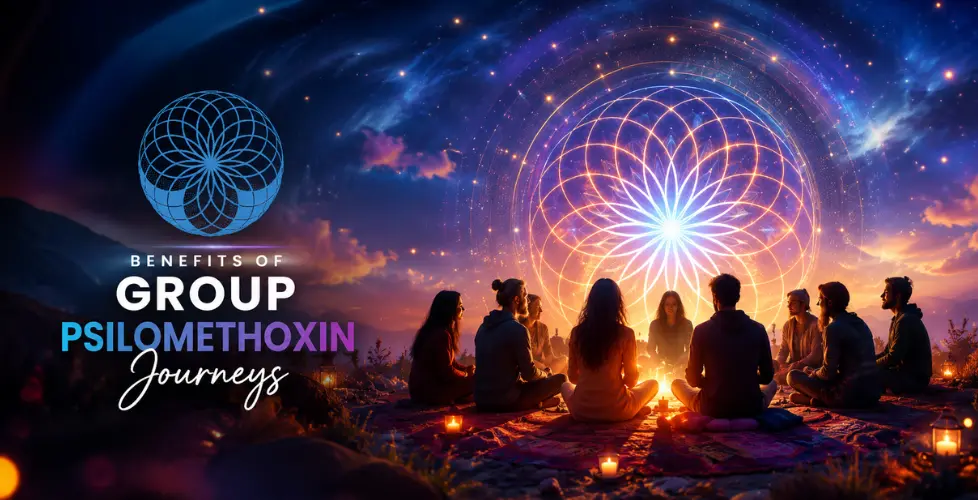
Benefits of Group Psilomethoxin Journeys
1. A Held Container Creates Safety
The word “container” in ceremonial contexts refers to the intentional structure that holds the experience — the facilitation, the agreement between participants, the ritual opening and closing. A well-held container is one of the most protective factors in any entheogenic journey. It gives the nervous system permission to soften because there is something trustworthy holding the edges of the experience.
2. Shared Energy Amplifies Openness
Research on social context in psychedelic settings consistently points to the importance of the relational field. A 2021 study published in Frontiers in Psychiatry noted that social support and relational warmth significantly influenced the quality and depth of psychedelic experiences, with participants in supported settings reporting higher rates of positive, meaningful outcomes. Group ceremony at The Sacred Synthesis draws on this principle intentionally.
3. Real-Time Support If Challenges Arise
Difficult moments during a journey — moments of emotional intensity, confusion, or disorientation — are not uncommon and are not inherently harmful. What determines the outcome is often whether adequate support is available. In a group ceremony, facilitators are trained to recognize these moments and provide grounding, reassurance, and skilled guidance in real time.
4. Community and Post-Journey Integration
The relational dimension of group ceremony does not end when the ceremony closes. Participants often form meaningful connections with one another and with the facilitation team — connections that naturally become part of the integration process. The monthly integration circles offered by The Sacred Synthesis extend this relational support well beyond the ceremony itself.
5. Accountability and Follow-Through
Showing up for a scheduled group ceremony creates a natural accountability structure. Many practitioners find that without external commitment, solo practice drifts or is abandoned during busy or difficult periods. The discipline of showing up for the group helps establish the practice as a genuine, sustained priority.
Benefits of Solo Psilomethoxin Journeys
1. Complete Autonomy Over Every Variable
In a solo journey, you control everything: timing, dose, music, lighting, environment, pace, and how you move through the experience. For practitioners who have done substantial preparation work and have a clear, personal intention, this level of control allows the journey to be precisely calibrated to what is most alive for them.
2. Deep Personal Privacy
Some of what the sacrament illuminates is deeply personal — grief, sexuality, family wounds, spiritual crisis. For many practitioners, the presence of others, however supportive, creates a subtle self-consciousness that limits how fully they can surrender to the experience. Solo practice removes that constraint entirely.
3. Unmediated Introspection
Without the shared energy of a group, your inner world fills the entire field of awareness. This can produce extraordinary clarity, depth of insight, and a kind of unfiltered self-honesty that group dynamics sometimes soften. Many of the most transformative reports from experienced practitioners come from solo sessions.
4. Flexibility and Timing
Life does not always align with a fixed ceremony schedule. Solo practice allows you to engage with the sacrament on your own timeline — when you feel genuinely ready, when circumstances support it, and when the integration window that follows can be honored without competing demands.
5. Builds Practitioner Confidence and Self-Knowledge
Over time, consistent solo practice builds a practitioner’s capacity to navigate altered states with skill and equanimity. This self-knowledge — the ability to trust oneself, to recognize what is arising, to move through difficulty without external assistance — is itself a form of spiritual development.
Risks and Challenges: Group vs Solo
| Risk / Challenge | Group Journey | Solo Journey |
| Difficult emotional content | Managed by facilitators; support available | Must be self-navigated; can feel isolating |
| Privacy and self-disclosure | Shared space may inhibit full openness | No inhibition; full privacy available |
| Dose management | Guided by facilitator recommendations | Fully self-determined; error possible |
| Group dynamics | Others’ energy may affect your experience | Not applicable |
| No immediate support | Not applicable — support is present | No one available if challenges arise |
| Integration gaps | Immediate circle available; well supported | Must proactively seek integration support |
| Overstimulating environment | Possible if group energy is dysregulated | Fully controllable |
| Medical emergency response | Facilitator present; response faster | Delayed without sober support person nearby |
Who Should Choose a Group Psilomethoxin Journey?
A group journey is likely the right choice if:
- You are new to psilomethoxin or entheogenic practice and have not yet developed a personal relationship with the sacrament.
- You are working with significant trauma, grief, depression, or anxiety, and would benefit from skilled facilitation and real-time support.
- You value the presence of community and find that being witnessed deepens your capacity for openness and vulnerability.
- You struggle with discipline in self-led practices and benefit from the accountability of a committed schedule.
- You are exploring the sacrament with a clear but broad intention — something like “clarity” or “healing” — where the group field may amplify the work.
- You want the reassurance of experienced facilitators nearby, especially if you have any concerns about how you might respond to an altered state.
- You are drawn to the spiritual and relational dimensions of ceremonial practice and want to experience the sacrament within its full sacred context.
Recommended starting point: The Sacred Synthesis’s monthly virtual ceremonies and the 30-Day Group Protocol are ideal first steps. New Member Orientations are also held regularly to prepare you before you step into ceremony.
Who Should Choose a Solo Psilomethoxin Journey?
A solo journey is likely the right choice if:
- You have completed multiple group ceremonies and have a stable, felt relationship with the sacrament.
- You have a clear, specific, deeply personal intention that you feel safer exploring in privacy.
- You have a reliable integration practice — journaling, somatic work, trusted community — that you will engage after the journey.
- Your life circumstances are currently stable, with no acute emotional crisis or major life transitions that would make solo navigation more difficult.
- You have a sober, trusted person who knows you are journeying and is available if needed.
- You have reviewed any relevant contraindications and are not on medications that interact with entheogenic sacraments.
- You are drawn to microdosing as a daily or near-daily practice and want the flexibility to engage with it on your own schedule.
Recommended starting point: Download the free PsiloCap Microdose Guide available to Sacred Synthesis members, and engage the Sacred Synthesis Skool community for preparation resources and post-journey integration support.
Preparation Checklist: Group vs Solo
| Preparation Step | Group Journey | Solo Journey |
| Set a clear intention | ✅ Essential | ✅ Essential |
| Review contraindications with healthcare provider | ✅ Essential | ✅ Essential |
| Attend New Member Orientation (if first ceremony) | ✅ Recommended | Attend educational conclaves instead |
| Avoid alcohol 24–48 hours prior | ✅ Essential | ✅ Essential |
| Eat lightly on day of journey | ✅ Recommended | ✅ Recommended |
| Prepare your physical environment | Handled by ceremony team | ✅ Essential — your full responsibility |
| Create a playlist or choose silence | Typically provided | ✅ Your choice to prepare |
| Inform a sober support person | Facilitators fulfill this role | ✅ Essential — inform a trusted person |
| Block your schedule afterward | ✅ Essential | ✅ Essential |
| Review dosing guidance | Provided by facilitators | ✅ Essential — review protocol carefully |
| Journal current intentions and baseline state | ✅ Recommended | ✅ Essential |
| Arrange post-journey integration support | Built into ceremony structure | ✅ Essential — arrange independently |
Safety Considerations for Psilomethoxin Journeys
Know Your Contraindications
Entheogenic sacraments are not appropriate for everyone. Individuals with a personal or family history of psychosis, schizophrenia, or bipolar disorder with psychotic features should consult a qualified psychiatrist before engaging with any entheogenic practice. Those currently taking MAOIs, lithium, or certain antidepressants should also seek professional guidance, as interactions can be unpredictable and potentially serious.
Set and Setting Are Not Optional
The concept of “set and setting” — popularized by psychedelic researcher Timothy Leary and later validated through clinical research — refers to the importance of your mindset (set) and your physical and social environment (setting) in shaping the outcome of an entheogenic experience. A 2020 study in Drug and Alcohol Dependence found that set and setting variables accounted for a significant proportion of the variance in psychedelic experience outcomes. Both group and solo practitioners must attend to both carefully.
Do Not Journey Alone in an Unstable State
If you are in the middle of an acute mental health crisis, a major life disruption, or a period of extreme stress, this is not the time for a solo journey. The sacrament tends to amplify what is already present. In unstable states, amplification without support can escalate distress rather than resolve it. Group ceremony — where experienced facilitators are present — is far more appropriate during these periods.
Have a Sober Support Person Nearby (Solo Journeyers)
Even if you do not need assistance, having a trusted, sober person who knows you are journeying and can be reached by phone is a non-negotiable safety measure for solo practice. This does not have to be someone in the room — it simply needs to be someone who can respond if needed.
Know When to Pause
If at any point during preparation you feel a persistent sense of dread, a strong internal “no,” or a clear intuition that the timing is not right — trust that. The sacrament will be available another day. Forcing a journey against your body’s wisdom is one of the most common avoidable mistakes practitioners make.
Read More: Unity Consciousness: Dissolving Self With Psilomethoxin
Integration After a Psilomethoxin Journey
Integration is where transformation becomes lasting change. The insights, emotions, and openings that arise during a psilomethoxin journey do not automatically translate into changed behavior or lasting well-being — they require intentional processing to anchor into daily life.
The Integration Window
The 24–72 hours following a journey are often described as a period of heightened neuroplasticity — a window during which the mind is more receptive to new patterns and perspectives. Research from Johns Hopkins and other leading institutions has pointed to post-psychedelic neuroplasticity as one of the key mechanisms through which these experiences produce lasting change. Whether you journeyed in a group or alone, the integration window is precious and should be protected.
Core Integration Practices
- Journaling: Write down what arose — feelings, images, insights, questions — while they are still vivid. Do not try to interpret immediately; just capture.
- Rest: Sleep is itself integration. Protect your sleep in the days following the journey.
- Somatic movement: Gentle walking, stretching, or yoga helps the body process what arose emotionally during the journey.
- Conversation: Sharing your experience with someone who understands the context — an integration circle, a trusted community member, or a coaching call — helps crystallize insights and reveals blind spots.
- Avoid rushing back to normal: Jumping immediately back into a demanding work schedule or chaotic social obligations interrupts the integration process. Build in buffer time.
Integration Support at The Sacred Synthesis
The Sacred Synthesis holds monthly integration circles open to members, along with group coaching calls and private integration support. VIP members receive priority access to these resources, including monthly group coaching. The Sacred Synthesis Skool community is also a continuous integration resource — a living community where members share, ask questions, and support one another between ceremonies.
Integration Checklist
| Integration Practice | When | Group Journeyers | Solo Journeyers |
| Journal your experience | Within 24 hours | ✅ | ✅ |
| Rest and protect sleep | 1–3 days | ✅ | ✅ |
| Attend integration circle | Within 1 week | ✅ Built in | ✅ Arrange independently |
| Somatic movement | Daily, 1 week post-journey | ✅ | ✅ |
| Avoid alcohol and stimulants | 3–7 days minimum | ✅ | ✅ |
| Share with integration partner or coach | Within 1 week | ✅ Available through church | ✅ Arrange via Skool community |
| Identify one concrete action from insights | Within 2 weeks | ✅ | ✅ |
The 30-Day Group Protocol: A Structured Path for Both Approaches

For practitioners who want the best of both worlds — the structure and support of a group framework combined with the flexibility of daily self-led practice — the 30-Day Group Protocol from The Sacred Synthesis is one of the most powerful available entry points.
The protocol runs over 30 consecutive days and works on multiple levels simultaneously: neurochemical, emotional, somatic, and energetic. At its core, it combines daily microdosing with Psilocap, breathwork, ceremony, and structured daily inquiry — all within a group container that provides accountability, education, and community integration support.
What the 30-Day Protocol Includes
- Daily Psilocap microdosing — the foundational sacrament taken at consistent, low doses to support clarity, emotional regulation, and nervous system presence.
- Breathwork practices — to support somatic release and nervous system regulation throughout the protocol.
- Structured ceremony — group ceremonial experiences integrated into the protocol at key intervals.
- Daily inquiry prompts — to keep attention focused on the inner work and track shifts over time.
- Community integration — access to the Sacred Synthesis Skool community for real-time support and shared learning.
Participants consistently report clearer thinking, deeper emotional presence, more intuitive decision-making, and a replacement of reactivity with genuine equanimity. The protocol is equally suited to newcomers looking for a structured, supported first experience and to established practitioners who want to deepen their daily practice within a community container.
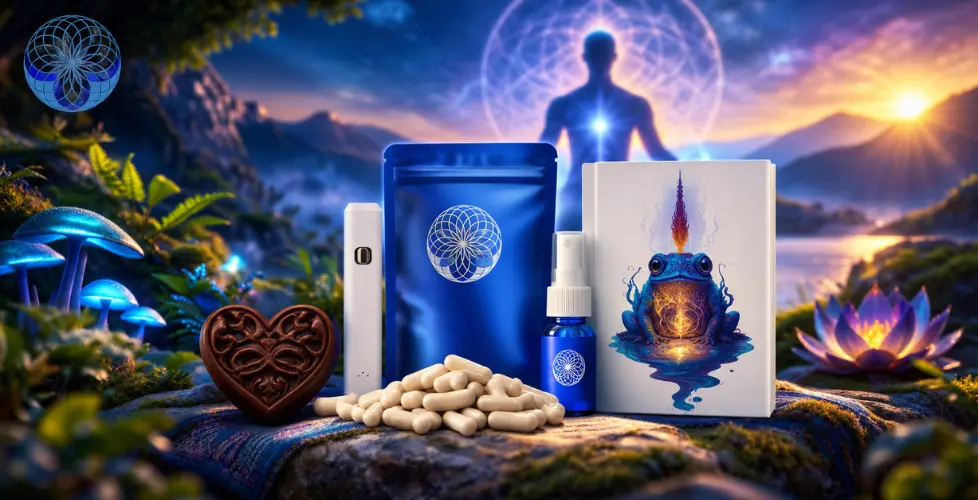
The Sacred Bundle — a curated collection of the church’s most beloved sacraments — is often recommended as a complementary resource for practitioners undertaking the 30-Day Protocol, providing access to multiple sacramental tools designed to work in coherence with one another.
Common Mistakes to Avoid on Psilomethoxin Journeys
1. Skipping Preparation
Preparation is not a formality — it is the foundation the entire journey rests on. Entering a journey without a clear intention, without reviewing contraindications, and without preparing your environment is like entering surgery without a surgical plan. Do the preparation. Every time.
2. Journeying During an Acute Crisis
If you are in the middle of an acute mental health episode, an active trauma response, or a period of significant instability, a macrodose journey — solo or group — is not appropriate. Seek qualified support first, stabilize, and then return to the sacrament when you are in a place of greater foundation.
3. Choosing the Wrong Setting for Your Experience Level
Attempting a solo macrodose journey without prior group ceremony experience is one of the most common mistakes. Conversely, experienced practitioners who have outgrown the need for group support sometimes feel unnecessarily constrained by group ceremony. Know where you are. Choose accordingly.
4. Neglecting Integration
A journey without integration is a story without a conclusion. The insights that arise must be met with intentional reflection, embodied practice, and concrete application to daily life. Practitioners who skip integration often feel a gradual fading of the experience’s benefits over time — and sometimes a frustrating sense of not being able to “hold” what they were shown.
5. Comparing Your Experience to Others
In group ceremonies especially, it is tempting to compare what you experienced to what others share. Your journey is not a performance — it is a personal encounter with your own consciousness. There is no hierarchy of experiences. What arose for you is exactly what you needed.
6. Starting Too High on Dose
More is not always more. Starting at a lower dose — especially for first-time practitioners or anyone trying a new form of the sacrament — allows you to establish your baseline response before adjusting. This is especially important with the Psilocap microdose capsules, where consistent low-dose use produces its own distinct and valuable form of transformation.
Expert Tips for Both Settings
For Group Journeyers
- Arrive early, settle in. The pre-ceremony period is part of the ceremony. Use it to ground, breathe, and connect with your intention before the formal opening.
- Let go of outcome expectations. The group container creates its own intelligence. Trust the process rather than directing it.
- Stay in your own field. Even in a group journey, the most important thing happening is inside you. Resist the pull to monitor others or compare experiences.
- Use the closing circle generously. Post-ceremony sharing is where integration begins. Speak what is true for you, even if it is incomplete or confusing.
For Solo Journeyers
- Create a physical anchor before you begin. A meaningful object, a written intention visible in your space, or a brief grounding ritual signals to the nervous system that this is intentional, sacred time.
- Prepare your music with care. Music is one of the most powerful setting variables in entheogenic experiences. Curate a playlist in advance that moves through distinct phases — opening, peak, integration, return.
- Don’t fight what arises. The common instruction to “surrender” is often misunderstood as passive. Active surrender means bringing your full attention to what is present, without resistance — even when what is present is difficult.
- Journal before you analyze. In the immediate post-journey window, write freely without trying to make sense of what arose. Analysis can come later. First, just capture.
The Decision Matrix: Which Journey Is Right for You?
Use this framework to guide your decision. Rate yourself honestly in each area.
| Question | → Choose Group If… | → Choose Solo If… |
| Experience with psilomethoxin? | None or limited (fewer than 5 journeys) | Established (5+ journeys, stable relationship) |
| Current emotional state? | Significant distress, grief, or instability | Stable, grounded, clear-headed |
| Primary intention? | Healing, community, emotional processing | Deep personal inquiry, spiritual exploration |
| Privacy needs? | Comfortable being witnessed | Strong need for complete privacy |
| Integration support available? | Prefer built-in, immediate support | Have reliable independent support network |
| Self-discipline in solo practice? | Struggle without external accountability | Consistent, reliable self-directed practice |
| Response to altered states? | Unknown or unpredictable | Well-known; navigate with confidence |
| Sober support available? | Not necessary — facilitators present | Trusted person available if needed |
If you answered mostly left column: start with a group journey. The Sacred Synthesis’s monthly ceremonies and the 30-Day Group Protocol are ideal first steps.
If you answered mostly right column: a solo journey may be appropriate. Engage the Sacred Synthesis Skool community for preparation resources, and ensure your integration support structure is in place before you begin.
If your answers are mixed: begin with group, move to solo as your foundation develops. This is the most common and most recommended progression within the Sacred Synthesis community.
Frequently Asked Questions About Psilomethoxin Journeys
Q1. What is a psilomethoxin journey?
A ceremonial or intentional experience using The Sacred Synthesis’s sacrament — a compound made by combining psilocybin mushrooms with 5-MeO-DMT. It follows a prepare-journey-integrate structure, done either in a group ceremony or solo.
Q2. Is a group or solo journey better for beginners?
Group journeys are strongly recommended for beginners — they offer guided support, a held container, and real-time help. The monthly virtual ceremonies and 30-Day Group Protocol are ideal starting points.
Q3. How long does a psilomethoxin journey last?
Microdoses are subtle and unfold throughout the day. Macrodoses bring a deeper altered state, so keep the full day free. Integration can extend for days to weeks after.
Q4. What is the 30-Day Group Protocol?
A structured program combining daily Psilocap microdosing, breathwork, ceremony, and daily inquiry within a community container — suited to both newcomers and experienced practitioners.
Q5. Can I journey alone if I’m experienced?
Yes, if you have a solid preparation and integration foundation. Still inform a trusted sober person, set a clear intention, and arrange integration support in advance.
Q6. What is the Sacred Bundle?
A curated set of The Sacred Synthesis’s core sacraments designed to work together for coherence and emotional clarity. Available to members, with VIP members getting it as part of their annual membership.
Q7. How do I prepare for my first group ceremony?
Set a clear intention, check contraindications with a doctor, avoid alcohol 24–48 hours prior, eat lightly, and attend New Member Orientation if it’s your first time.
Q8. What does integration mean after a journey?
Turning insights into lasting change through journaling, somatic movement, rest, and conversation with a trusted circle. Monthly integration circles and coaching support this.
Q9. Is it safe to journey alone?
It carries more risk than group settings and isn’t recommended for beginners, trauma histories, or anyone without support arranged. Always inform a trusted person and check contraindications first.
Q10. Who should NOT journey with psilomethoxin?
Anyone with a personal/family history of psychosis or bipolar disorder with psychotic features, those on MAOIs or lithium, pregnant/nursing individuals, or anyone in acute mental health crisis — consult a healthcare professional first.
Read More: What is Psychedelic Integration and Why Does It Matter?
Final Thoughts
There is no single right answer to the group-versus-solo question. The right psilomethoxin journey is the one that meets you where you are — with honesty about your experience level, your intentions, your support needs, and your nervous system’s current capacity.
What matters most is that you do not default to one path simply out of habit or convenience. Every journey is a deliberate act of attention. Choose your container as deliberately as you choose your intention. Prepare as thoroughly as you show up. Integrate as consistently as you explore.
Whether you are stepping into your first group ceremony through The Sacred Synthesis’s monthly virtual gatherings, following the structured arc of the 30-Day Group Protocol, or establishing a daily microdose practice at home with the support of the Sacred Synthesis Skool community — the sacrament meets genuine intention with genuine depth.
The work is real. The support is here. The path is yours to choose.