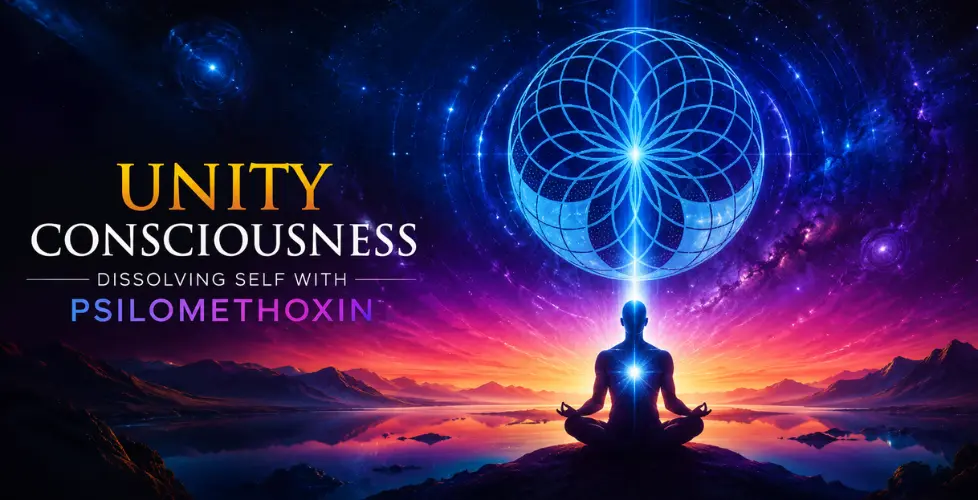
What if the sense of separation you feel — from other people, from nature, from life itself — is not a fundamental truth, but a story your brain tells you? What if beneath every individual experience lies a single, unified field of awareness?
These are not merely poetic questions. They sit at the heart of one of humanity’s oldest and most pressing inquiries: the nature of consciousness itself. And today, as neuroscience converges with ancient wisdom traditions, a new chapter in consciousness exploration is opening — one that includes a remarkable compound called Psilomethoxin.
Unity Consciousness — the direct experience of being interconnected with all of existence — has been documented across cultures, centuries, and spiritual traditions. Mystics, meditators, and modern researchers alike describe encounters with a state beyond ordinary selfhood, where the boundaries of the individual dissolve and something vast and undivided is revealed.
This article is your comprehensive guide to understanding Unity Consciousness: what it is, where it comes from, how the brain generates it, why humans are conscious at all, and how intentional practices — including Psilomethoxin and structured community protocols — may help cultivate this profoundly transformative state.
What Is Unity Consciousness?
Quick Answer: Unity Consciousness is a state of awareness where the perceived separation between self and world dissolves, revealing interconnectedness, wholeness, and non-dual awareness — characterized by a sense of oneness with all existence.
At its core, Unity Consciousness is a direct experiential recognition, not a philosophy. All phenomena — thoughts, people, objects, the cosmos — are felt to arise from a single field of awareness. It is vivid, undeniable, and often life-altering.
Every major tradition has named it: Advaita in Hinduism, Buddha-nature in Buddhism, divine union in Christian mysticism, fanāʾ in Sufism. The phenomenological core is consistent across all of them — the dissolution of the ordinary self and recognition of a unified, aware presence.
Scientifically, researchers at Johns Hopkins use the Mystical Experience Questionnaire (MEQ) to measure its features: sacredness, noetic quality, positive mood, and transcendence of time and space. In contemplative neuroscience, it is studied as non-dual awareness — a mode of cognition where the observer and observed collapse into pure, open awareness witnessing itself.
Read More: 5 MeO DMT vs DMT: Effects, Differences & What to Expect
How Is Consciousness Formed?
Consciousness formation remains one of science’s greatest unsolved mysteries — philosopher David Chalmers called it “the hard problem.” While we can map neural activity in detail, explaining why physical brain processes produce subjective experience still eludes us.
Leading Theories:
- Integrated Information Theory (IIT) — Giulio Tononi proposes consciousness corresponds to the degree of integrated information in a system, measured by a value called Φ (phi)
- Global Workspace Theory (GWT) — Bernard Baars argues consciousness arises when information is “broadcast” across a global neural workspace, making it available to multiple cognitive processes at once
- Predictive Processing Theory — Karl Friston and Andy Clark view the brain as a prediction machine, where consciousness is the experience of a self-model navigating probabilistic inference
Key Neural Systems Involved:
- Thalamocortical system — the dynamic relay between thalamus and cortex; disrupting it (via anesthesia or deep sleep) reliably extinguishes conscious experience
- Default Mode Network (DMN) — governs self-referential thought, mind-wandering, and the continuous narrative sense of a separate self
- Neuroplasticity — the brain’s ability to rewire means consciousness formation isn’t fixed; practices like meditation and compounds like Psilomethoxin can shift the habitual modes through which consciousness constructs experience
Where Did Consciousness Come From?
The origins of consciousness are debated across evolutionary biology, philosophy, and physics — and no single answer has won consensus. Here are the four leading perspectives:
1. Emergentism (Mainstream Science)
Consciousness emerged gradually as nervous systems grew more complex over evolutionary time. Simple organisms have rudimentary environmental sensitivity; as brains developed, richer inner experience presumably followed. Complexity itself gave rise to awareness.
2. Panpsychism (Philosophical Revival)
Championed by thinkers like Philip Goff, this view holds that consciousness is a fundamental property of reality — present in some basic form even at the level of elementary particles. What evolved isn’t consciousness itself, but the sophisticated forms it takes in complex nervous systems.
3. Integrated Information Theory (IIT)
Any system with integrated information has some degree of experience, however minimal. Human consciousness is simply a particularly rich instance of a property distributed throughout the natural world — not a threshold event, but a spectrum.
4. Spiritual and Perennial Traditions
Many traditions hold that consciousness never evolved at all — it is the ground of being, the primordial awareness from which the physical world arises. The universe isn’t matter that accidentally produced consciousness; it is consciousness expressing itself through matter.
Why Are Humans Conscious?

Consciousness is evolutionarily expensive — yet it persists because it delivers powerful adaptive advantages. Here’s why it evolved:
- Flexible Decision-Making — Handles novel, complex problems that unconscious processes can’t; brings diverse knowledge sources together for creative solutions
- Social Intelligence — Enables “theory of mind” — the ability to model what others know, believe, and intend — essential for cooperation, culture, and civilization
- Metacognition — The ability to think about thinking; allows humans to recognize errors, revise beliefs, and learn at an exceptional level
- Language & Narrative — Humans weave experiences into coherent life stories, creating identity and meaning through the DMN’s self-referential architecture
But the deeper question remains: Why does all this processing feel like anything at all? Functional cognition doesn’t obviously require subjective experience — this is the hard problem. And it’s precisely what makes Unity Consciousness so revealing: when the narrative self dissolves, what remains is awareness itself, stripped of its story — suggesting consciousness may be something far more fundamental than evolution alone can explain
Read More: What is Psychedelic Integration and Why Does It Matter?
The Evolution of Consciousness
The evolution of consciousness is not simply the story of bigger brains — it encompasses language, culture, symbolic thought, and a uniquely human capacity for self-transcendence.
| Era / Domain | Key Development | Significance for Consciousness |
| 200,000 Years Ago | Prefrontal cortex expansion in Homo sapiens | Enhanced executive function, long-range planning, and impulse control |
| 50,000–70,000 Years Ago | The Cognitive Revolution | Explosion of symbolic behavior — cave paintings, ritual burial, ornamentation, trade networks |
| Language Evolution | FOXP2 gene variations; Broca’s and Wernicke’s areas develop | Consciousness gains symbolic dimension, freeing thought from immediate sensory experience |
| Cultural Evolution | Emergence of narrative, metaphor, and abstract thought | Birth of the distinctly modern human mind capable of self-reflection |
| Philosophical View | Hegel’s theory of historical consciousness | Consciousness evolves toward greater self-awareness and freedom over time |
| Integral Theory | Ken Wilber’s pre-personal → personal → transpersonal stages | Unity Consciousness positioned as an advanced developmental attainment, not regression |
| Neurophilosophy | Thomas Metzinger’s “phenomenal self-model” | Consciousness constructs a transparent first-person self-representation |
| Unity Consciousness | Dissolution of the phenomenal self-model | Background awareness revealed when the self-model temporarily relaxes or dissolves |
Ego Dissolution and Unity Consciousness
Quick Answer: Ego dissolution is the temporary loss of the ordinary sense of a separate self — where boundaries between self and world break down, leaving open, unified awareness. Reported in deep meditation, mystical experiences, and psychedelic states, it is often described as profoundly liberating rather than frightening.
The ego is the brain’s continuous construction of a bounded self — “I am this person, with this history.” This self-model is generated moment by moment through the default mode network. Ego dissolution happens when that construction is interrupted, and what remains is spacious, undivided awareness — present and clear.
Key facts:
- Not psychosis — In supported contexts, ego dissolution consistently produces positive, transformative outcomes; participants often rank it among the most meaningful experiences of their lives
- Neuroscience — fMRI studies show psilocybin (structurally related to Psilomethoxin) reduces DMN activity and connectivity, directly correlating with ego dissolution and mystical experience scores
- Natural outcome — The less the DMN dominates, the more unified the experiential field becomes, giving rise to self-transcendence — awareness expanding beyond the personal self into greater presence, connection, and Unity Consciousness
Unity Consciousness and Psilomethoxin

Psilomethoxin (4-phosphoryloxy-5-methoxytryptamine) is a naturally occurring tryptamine produced when certain fungi are grown on a 5-methoxytryptamine substrate. Sharing structural features with both psilocybin and 5-MeO-DMT, it interacts primarily with serotonergic 5-HT2A receptors — the same systems centrally involved in altered states of consciousness and neuroplasticity.
What makes Psilomethoxin distinctive is its experiential character. Unlike classical psilocybin, which can produce intense ego dissolution, practitioners report a gentler softening of self — marked by deep emotional openness, heightened presence, and a warm, heart-centered sense of interconnectedness. Many describe it as a more accessible and integrable entry point into Unity Consciousness, particularly within a supportive community framework.
Neuroscientifically, Psilomethoxin likely works by modulating the default mode network through serotonin receptor agonism — reducing habitual self-referential processing and temporarily opening awareness into more unified, non-dual modes of experience. The result mirrors what meditation research identifies as the neural signature of Unity Consciousness: quieted DMN activity, reduced rumination, and dissolved subject-object boundaries.
It is important to note that clinical research on Psilomethoxin remains in early stages. Anecdotal reports are compelling but should be distinguished from peer-reviewed evidence. Responsible exploration within well-structured, community-supported frameworks — grounded in both scientific understanding and experiential wisdom — is strongly recommended.
Read More: How Psilocybin Works in the Brain: Serotonin Pathways Explained
The Role of Community in Consciousness Growth
One of the most underappreciated dimensions of consciousness exploration is the role of community. Individual experiences — however profound — require context, integration, and accountability to translate into lasting transformation.
This is precisely the value of structured group approaches like the 30-Day Group Protocol offered within intentional consciousness communities. The protocol creates a container in which participants can engage with practices — including Psilomethoxin, meditation, journaling, and embodied inquiry — within a framework of shared intention and mutual support.
Research on behavior change consistently shows that community accountability is one of the strongest predictors of long-term integration. When individuals navigate challenging inner experiences alongside others who share similar intentions, the capacity for genuine transformation multiplies. Insight gained in isolation can remain abstract; insight metabolized in community tends to become embodied, lived, and durable.
Our Community on Skool offers exactly this kind of supported ecosystem. Members gain access to structured learning, group sessions, experienced facilitation, and a living network of peers who are genuinely committed to consciousness growth. The platform enables both synchronous and asynchronous engagement — making it accessible across time zones and life circumstances.
Key elements that make community-based consciousness exploration effective:
- Integration support: Helping participants make sense of and embody insights from expanded states.
- Accountability structures: Shared commitments that sustain practice beyond initial enthusiasm.
- Collective intelligence: The group’s combined experience and wisdom exceeds what any individual can access alone.
- Relational healing: Unity Consciousness explored in community becomes not just a private insight but a lived, relational reality — dissolving separation not in abstract experience alone, but in the actual encounter with other human beings.
The communal dimension of Unity Consciousness is, in many ways, its most practical fruit. When the insight of interconnectedness is not merely a peak experience but becomes the foundation of how one relates — to oneself, to others, to the world — genuine transformation is possible.
Scientific Research on Unity Consciousness
The scientific study of Unity Consciousness and related states has accelerated dramatically over the past two decades. Here is a synthesis of key findings from consciousness research, neuroscience, and contemplative science:
Neuroscience Findings
Studies from Imperial College London, Johns Hopkins University, and NYU show that psilocybin reduces default mode network activity by 20–30%, correlating strongly with mystical experience scores (r = 0.65–0.79). Participants with high scores show lasting improvements in wellbeing, openness, and psychological flexibility. EEG studies further reveal that non-dual awareness states produce increased gamma wave synchrony across long-range cortical networks — a neural signature distinct from ordinary relaxation.
Meditation Research
Sara Lazar’s 2011 Harvard study found long-term meditators show structural brain changes in attention and sensory regions, including the insula and prefrontal cortex. Clifford Saron’s Shamatha Project demonstrated that three months of intensive meditation improved attention, emotional regulation, and telomerase activity. Judson Brewer’s research confirmed that mindfulness training reduces DMN self-referential processing — mirroring the same neural shift produced by psilocybin.
Both pharmacological and contemplative pathways appear to access the same underlying mechanism: a quieting of the self-referential mind that opens the door to Unity Consciousness.
Key Research Summary
| Domain | Key Finding | Source/Context |
| Psilocybin + DMN | 20–30% reduction in DMN activity; correlates with mystical experience | Imperial College London |
| Meditation + Brain Structure | Increased cortical thickness in attention regions | Harvard/Lazar et al. |
| Mystical Experiences + Wellbeing | High MEQ scores predict long-term positive change | Johns Hopkins |
| Gamma Synchrony | Non-dual awareness states show long-range cortical integration | EEG contemplative research |
| Psilocybin + Openness | Significant increases in trait openness 1 year post-experience | MacLean et al., 2011 |
| Mindfulness + DMN | Reduced self-referential processing with training | Brewer et al., Harvard |
Key Insights and Emerging Trends
As consciousness research matures, several important patterns are emerging that have significant implications for how we understand and cultivate Unity Consciousness:
1. The Convergence of Pharmacological and Contemplative Pathways: Research increasingly shows that meditation and psychedelic compounds like Psilomethoxin modulate overlapping neural mechanisms — particularly DMN suppression and increased brain-wide integration. This suggests that Unity Consciousness is a genuine neurological state, accessible through multiple entry points.
2. Integration Is the Work: The scientific evidence consistently shows that the benefit of peak consciousness experiences is not the experience itself but what is done with it afterward. Structured integration practices — journaling, somatic work, community dialogue, ongoing contemplative practice — transform temporary insights into durable psychological change.
3. The Importance of Set and Setting: Decades of psychedelic research confirm that the quality of the context in which altered states are entered — one’s mindset (set) and the physical, relational, and intentional environment (setting) — is the primary determinant of whether expanded consciousness experiences are beneficial. Community protocols directly address this by creating intentional, supported containers.
4. Neuroplasticity Windows: There is growing evidence that psychedelic experiences open “critical periods” of neuroplasticity — windows of enhanced neural malleability in which new learning, healing, and pattern change occur more readily. Maximizing these windows requires deliberate post-experience practice.
5. Democratization of Consciousness Exploration: Historically, deep states of Unity Consciousness were the province of dedicated monastics or rare natural mystics. Emerging research and community-based protocols are making intentional consciousness exploration accessible to sincere practitioners without decades of monastic training — a remarkable democratization of inner inquiry.
Benefits and Challenges of Unity Consciousness
Honest engagement with Unity Consciousness requires acknowledging both its documented benefits and its genuine challenges.
Benefits
Psychological: Research consistently links mystical and unity experiences with long-term reductions in depression, anxiety, and addiction. A 2016 Johns Hopkins study found that a single psilocybin session produced significant, lasting decreases in depression and anxiety in cancer patients facing existential distress. Increased trait openness, compassion, and psychological flexibility are among the most replicated long-term outcomes.
Relational: Practitioners of Unity Consciousness frequently report improved relationships — increased empathy, reduced reactivity, greater patience, and a natural orientation toward kindness and service. When the experiential boundary between self and other softens, the instinctual basis of compassion deepens.
Existential: Many people emerge from Unity Consciousness experiences with a profound reduction in death anxiety, an increased sense of meaning and purpose, and a felt sense of belonging within the larger fabric of existence. The experience can recontextualize suffering without trivializing it.
Cognitive: Enhanced cognitive flexibility, creativity, and the capacity for novel perspective-taking are commonly reported. The default mode network’s habitual narrative loops become less tyrannical, allowing more fluid, open-minded engagement with experience.
Challenges
Integration Difficulty: Profound experiences of Unity Consciousness can be disorienting when encountered without adequate preparation and support. The gap between the expanded state and ordinary consciousness can produce confusion, spiritual bypassing, or what researchers call an “integration crisis.”
Bypassing Risk: There is a real danger of using Unity Consciousness frameworks to avoid rather than engage psychological and relational challenges. Genuine integration requires bringing the insights of unity experience into contact with the full complexity of one’s inner and relational life — not using “oneness” as an escape hatch from difficult emotions or responsibilities.
Context and Safety: Expanded states of consciousness require appropriate set, setting, and support. Without proper preparation and a trustworthy container, challenging experiences can be destabilizing. Community-based protocols are specifically designed to address this.
Practical Ways to Cultivate Unity Consciousness
Unity Consciousness is not exclusively the product of extraordinary experiences. It can be cultivated gradually through sustained, intentional practice. The following approaches are well-supported by research and contemplative tradition:
Meditation: Specifically, open awareness or “choiceless awareness” meditation practices — in which attention rests openly with all arising experience without fixating on any particular object — most directly cultivates the non-dual awareness associated with Unity Consciousness. Regular formal meditation practice, combined with informal mindfulness throughout daily life, progressively loosens the DMN’s habitual self-referential grip.
Self-Inquiry: The practice of genuinely investigating the nature of the one who seems to be having experiences — “Who or what is aware right now?” — is a direct pointer to the non-dual awareness that underlies ordinary selfhood. Rooted in the Advaita tradition and the teachings of teachers like Ramana Maharshi, this approach requires no special equipment, only sincere attention.
Journaling and Reflection: Structured reflective writing that explores one’s assumptions about the self, one’s sense of separateness, and the quality of one’s connections helps translate expanded states into integrated understanding.
Somatic and Embodied Practices: Yoga, breathwork, and body-centered awareness practices anchor consciousness exploration in the body — preventing the spiritual bypassing that can accompany purely conceptual approaches to Unity Consciousness.
Community Engagement: Participating in sincere community dialogue — especially within structured protocols like the 30-Day Group Protocol — creates the relational context in which Unity Consciousness becomes not just a private event but a lived reality.
Intentional Psilomethoxin Practice: When approached within a well-structured ceremonial and community context — with clear intention, proper preparation, and committed integration — Psilomethoxin can serve as a catalyst for direct encounters with expanded awareness and Unity Consciousness. It is best understood not as a shortcut but as an accelerant: one that works most powerfully when combined with genuine contemplative practice and integrative support.
Read More: Neuroplasticity: Rewiring the Soul with Psilomethoxin
Frequently Asked Questions
Q1. What is Unity Consciousness in simple terms?
Unity Consciousness is the direct experience of being connected with everything — people, nature, and existence itself. The usual sense of being a separate individual dissolves, leaving a vast, peaceful awareness that feels fundamentally whole. It is not a concept but a lived experience reported across cultures and throughout history.
Q2. What is ego dissolution and how does it relate to Unity Consciousness?
Ego dissolution is the temporary breakdown of the ordinary sense of a separate self. When it occurs in a supported context, it is deeply liberating rather than frightening. Neuroscience links it to reduced default mode network activity — the same neural shift associated with Unity Consciousness. Research shows it produces lasting improvements in wellbeing and psychological flexibility.
Q3. What is Psilomethoxin?
Psilomethoxin is a naturally occurring tryptamine produced when certain fungi are grown on a 5-methoxytryptamine substrate. Structurally related to both psilocybin and 5-MeO-DMT, it is reported to produce emotional openness, expanded awareness, and states resonant with Unity Consciousness. Clinical research is early-stage; structured, community-supported use is strongly recommended.
Q4. How does the default mode network relate to Unity Consciousness?
The DMN continuously generates the brain’s narrative of a separate self. Unity Consciousness emerges when DMN activity quiets — whether through deep meditation or consciousness-expanding compounds like Psilomethoxin. The less the DMN dominates, the more unified, open, and present awareness becomes.
Q5. Can Unity Consciousness be cultivated without plant medicines?
Yes. Long-term meditation, non-dual awareness practices, self-inquiry, somatic work, and community engagement all cultivate the neural conditions associated with Unity Consciousness. Psilomethoxin is best understood as a potential accelerant within a broader integrative practice — not a substitute for it.
Q6. What is the 30-Day Group Protocol?
The 30-Day Group Protocol is a structured, community-supported program combining Psilomethoxin practice, meditation, integration exercises, and group dialogue over 30 days. It creates the accountability, shared intention, and supportive container that research consistently shows enhances the long-term benefits of expanded consciousness experiences.
Q7. Is Unity Consciousness the same as spiritual awakening?
They overlap but are not identical. Spiritual awakening implies a lasting shift in identity — from personal self to broader, inclusive awareness. Unity Consciousness can catalyze or express awakening, but a single experience rarely stabilizes it. Sustained practice and genuine integration are what transform peak experiences into enduring transformation.
Conclusion: The Unity That Was Always Here
What if the sense of separation is a story, not a truth? Unity Consciousness — whether glimpsed in meditation, catalyzed by Psilomethoxin, or cultivated through intentional practice — doesn’t merely suggest that separation is an illusion. It allows you to feel, directly and unmistakably, that something larger and more whole underlies ordinary selfhood.
Neuroscience is catching up. The default mode network’s habitual narratives are not consciousness itself — they are one mode of it, one that tends toward anxiety and division. When that mode quiets, something else shines through.
Psilomethoxin, approached with care and community support, is a genuine tool for this inquiry. The 30-Day Group Protocol and Our Community on Skool exist to provide exactly that structure — combining Psilomethoxin’s catalytic potential with the depth of meditation, integration, and shared practice.
Unity Consciousness is not a foreign state imposed from outside. It is what awareness discovers when it stops mistaking its own stories for its own nature.
The journey inward is, ultimately, the journey toward what was always here.