Microdosing psilocybin is the practice of consuming very small, carefully measured amounts of psilocybin mushrooms (Psilocybe cubensis or related species) at regular intervals. Unlike a full psychedelic dose — which can produce profound perceptual distortions, mystical experiences, and altered states of consciousness — a microdose is intentionally sub-perceptual. You go about your day. You function. You observe.
A typical psilocybin microdose falls between 1/10th and 1/20th of a recreational dose. Where a recreational or therapeutic macrodose might range from 2–5 grams of dried mushrooms, a microdose sits closer to 0.05–0.3 grams.
Interest in psilocybin microdosing has grown substantially. A 2023 nationally representative survey found that roughly 47% of people who used psilocybin mushrooms in the past year reported microdosing the last time they used the substance — a figure that reflects how mainstream the practice has become even within a constrained legal landscape.
This guide explores what the current science says, what practitioners report, how to approach microdosing thoughtfully, and how emerging conversations around compounds like Psilomethoxin and 5-MeO-DMT are pushing the edges of psychedelic wellness.
A Brief History of Psilocybin Microdosing
Psilocybin mushrooms have been used in ceremonial, healing, and spiritual contexts for thousands of years. Indigenous Mazatec traditions in Mexico, documented most notably through the work of ethnomycologist R. Gordon Wasson in the 1950s, introduced psilocybin mushrooms to Western awareness.
The modern framework of microdosing, however, began with Albert Hofmann, the Swiss chemist who discovered LSD and later documented his personal experiments with sub-perceptual psychedelic doses. Hofmann described micro-quantities of LSD as potentially offering mental clarity without disrupting daily life — a seed idea for what would follow.
The movement accelerated in 2011 when Dr. James Fadiman, a transpersonal psychologist and psychedelic researcher, began collecting practitioner reports from people who were self-experimenting with low doses. His 2011 book The Psychedelic Explorer’s Guide outlined what would become the most widely referenced microdosing protocol in both public use and scientific literature. Fadiman’s work transformed microdosing from a fringe curiosity into a structured, trackable practice.
The Silicon Valley connection — popularized around 2015–2016 — brought the practice to a broader audience. Tech workers and entrepreneurs began reporting improved creative output, focus, and emotional resilience. The conversation then expanded into the broader wellness and mental health communities, eventually drawing the attention of major research institutions including Johns Hopkins University and Imperial College London.
Today, psilocybin microdosing sits at the intersection of psychedelic science, mental wellness culture, and consciousness exploration — a space that continues to evolve rapidly.
Read More: How Psilocybin Works in the Brain: Serotonin Pathways Explained
How Microdosing Psilocybin Works in the Brain
Quick Answer: Psilocybin converts to psilocin in the body, which binds to serotonin 5-HT2A receptors in the brain. At microdose levels, this interaction gently modulates the Default Mode Network and may promote neuroplasticity — without triggering the full psychedelic experience.
Understanding how psilocybin microdosing works begins with basic pharmacology. Psilocybin is a prodrug — meaning the compound itself is inactive until the body metabolizes it. Within 20–40 minutes of ingestion, the liver converts psilocybin into psilocin, the active molecule that crosses the blood-brain barrier and engages with the nervous system.
Psilocin works primarily as an agonist at serotonin 5-HT2A receptors, particularly in the prefrontal cortex — the region of the brain associated with executive function, decision-making, mood regulation, and self-reflection. The 5-HT2A receptor family is also centrally implicated in depression, anxiety, and OCD, and it is the same receptor system targeted, indirectly, by many SSRI antidepressants.
What makes psilocin unusual is that it also interacts with additional serotonin receptor subtypes — including 5-HT1A, 5-HT2B, and 5-HT2C — which may further explain its antidepressant and anxiolytic properties. Emerging research from Trends in Pharmacological Sciences (2025) also suggests that psilocin directly binds to TrkB receptors in the presence of BDNF (Brain-Derived Neurotrophic Factor), potentiating BDNF signaling through allosteric modulation — a mechanism that may underlie psilocybin’s durable neuroplastic effects.
The Default Mode Network
One of the most well-studied effects of psilocybin is its modulation of the Default Mode Network (DMN) — a set of interconnected brain regions most active during self-referential thought, rumination, and mind-wandering. The DMN is often described as the seat of the “narrative self” — the mental chatter that loops through past regrets and future anxieties.
In full psychedelic doses, psilocybin dramatically disrupts DMN activity, producing the dissolution of the ego-boundary and the profound sense of interconnectedness reported in mystical experiences. At microdose levels, the effect is subtler — a gentle dampening rather than a full disruption — which may reduce ruminative thought patterns without destabilizing daily function.
PET imaging studies have confirmed that even moderate psilocybin doses produce measurable occupancy of 5-HT2A receptors in key DMN nodes, including the subgenual anterior cingulate cortex and bilateral angular gyri. At microdose levels, the pharmacodynamic effects are attenuated, but receptor engagement still occurs.
Neuroplasticity and the Psilocybin Connection
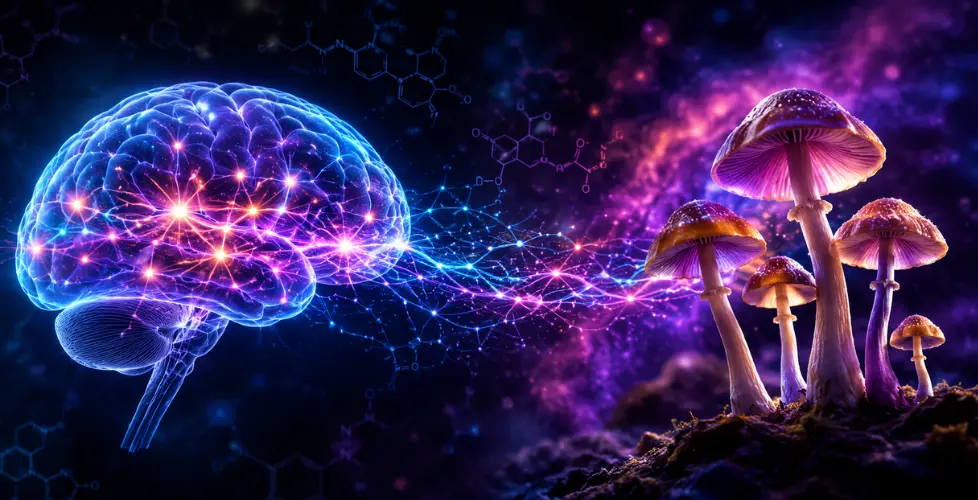
Neuroplasticity refers to the brain’s ability to reorganize itself — forming new neural connections, strengthening underused pathways, and pruning patterns that no longer serve. It is the biological foundation of learning, adaptation, and recovery from trauma.
Psilocybin has attracted significant scientific attention for its apparent ability to promote neuroplasticity through multiple mechanisms. Research published in Trends in Pharmacological Sciences (September 2025) highlighted that psilocin’s neuroplastic effects involve not only 5-HT2A receptor activation but also the TrkB-BDNF signaling axis — a pathway directly involved in dendritic spine growth and synaptic remodeling.
This is particularly significant in the context of conditions like depression, where reduced neuroplasticity and shrunken dendritic branching in the prefrontal cortex are well-documented biological features.
Neuroimaging studies have also demonstrated that psilocybin increases global brain network integration — effectively increasing the crosstalk between brain networks that don’t ordinarily communicate. This increased connectivity is hypothesized to be one reason why people report novel insights, creative breakthroughs, and perspective shifts during and after psychedelic experiences.
At the microdose level, whether these neuroplastic effects are clinically significant remains an open question — but it is one that active research is beginning to address.
Research and Emerging Trends in Psilocybin Microdosing
This is the area where the science is most nuanced, and where honesty matters most.
What the Research Currently Shows
The evidence base for psilocybin microdosing is growing but remains early-stage. A 2024 systematic review published in Primary Care Companion for CNS Disorders examined the existing literature and found that most evidence comes from observational studies and self-reports rather than rigorous placebo-controlled trials. Users reported improved mood, increased focus, and better daily function — but the review noted that “the causal relationship between microdosing and mental health improvement remains uncertain.”
A 2024 review of 19 placebo-controlled studies (Murphy et al.) found mixed results: most studies focused on LSD, with only two examining psilocybin directly. Psilocybin studies suggested subtle effects on cognition and brain activity, but consistent, statistically robust benefits over placebo have not yet been established.
One critical methodological challenge is expectancy effects. Because people entering microdosing studies generally expect positive outcomes, placebo effects are powerful and difficult to isolate. Placebo-controlled trials using “self-blinding” methods have shown that much of the reported benefit may be partly attributable to this expectation.
Active Clinical Trials (2025–2026)
Despite these limitations, the research pipeline is active:
- A Phase II randomized controlled trial at the University of Toronto (2026) is studying psilocybin microdosing (2 mg fixed dose) for major depressive disorder, measuring effects on mood, suicidal ideation, and safety over an 8-week period.
- A clinical trial through the PSYCHED-PAL-RCT is investigating psilocybin microdosing for psychological and existential distress in palliative care patients, following preliminary findings that psilocybin microdose improved psychological distress in most participants with advanced illness.
- A study by Optimi Health is examining mood and cognitive effects of pharmaceutical-grade psilocybin mushroom powder at low and microdose levels in healthy participants.
Key Statistics
- ~47% of psilocybin mushroom users in the U.S. reported microdosing on their most recent use (nationally representative survey, 2023).
- ~20% of microdosers in observational studies report side effects, including anxiety, focus issues, and physical discomfort.
- Psilocybin’s active metabolite psilocin has a half-life of approximately 3 hours and is cleared renally with minimal accumulation.
What Remains Unknown
- Long-term effects of repeated microdosing on serotonin receptor density and cardiovascular health
- Optimal dosage ranges across different populations
- Whether benefits are sustained after stopping a microdosing protocol
- Interaction profiles with common medications at sub-perceptual doses
The picture that emerges is of a practice with genuine theoretical plausibility, compelling anecdotal support, and a research base that is promising — but not yet conclusive. This makes informed self-education and community guidance especially important.
Benefits of Microdosing Psilocybin
Quick Answer: People who microdose psilocybin commonly report improvements in mood, reduced anxiety, enhanced creative thinking, better focus, greater emotional awareness, and reduced rumination. These benefits are primarily supported by observational and self-report data rather than controlled clinical trials.
Mental Wellness and Mood Support
The most consistently reported benefit of psilocybin microdosing is mood improvement. Across multiple large-scale observational studies and surveys, microdosers describe feeling less anxious, less depressed, and more emotionally resilient. Some report a reduction in the “mental weight” that accompanies chronic low-level anxiety or dysthymia.
The potential mechanism aligns with what is known about psilocybin’s pharmacology: 5-HT2A receptor activation in the prefrontal cortex can modulate negative emotional processing, reduce DMN-driven rumination, and engage BDNF pathways associated with improved mood.
It is important to note that while these reports are promising, psilocybin microdosing is not an approved treatment for any mental health condition. Individuals experiencing clinical depression, anxiety disorders, or other mental health conditions should work with qualified healthcare professionals.
Creativity and Cognitive Function
One of the more popular claims around psilocybin microdosing is enhanced creativity. Practitioners report increased associative thinking, greater fluency of ideas, reduced cognitive rigidity, and a heightened ability to make novel connections — qualities that have made microdosing appealing to artists, designers, and problem-solvers.
Scientifically, these effects align with psilocybin’s capacity to increase global brain network integration, temporarily reducing the “topographical” boundaries between neural networks and enabling more fluid cross-network communication.
Controlled studies on cognitive enhancement at microdose levels have been mixed, with some showing modest benefits in certain cognitive domains and others finding no difference from placebo. The evidence supports cautious optimism, not certainty.
Focus and Productivity
Many microdosers report improved ability to enter flow states — periods of deep, absorbed attention that are associated with high-quality work. Some describe a reduction in internal distraction and improved task completion.
At the same time, some individuals experience the opposite effect — increased distractibility, mild anxiety, or cognitive overstimulation on dosing days. Individual response to psilocybin microdosing appears to vary significantly based on dose, neurobiological factors, mindset, and context.
Emotional Awareness and Integration
Perhaps the most underappreciated benefit reported by long-term microdosers is increased emotional sensitivity and self-awareness. People describe greater access to emotions they had been avoiding, more nuanced empathy in relationships, and a subtle but meaningful shift in perspective on longstanding personal patterns.
This aspect of psilocybin microdosing intersects with the broader practice of psychedelic integration — the process of making meaning from psychedelic experiences (at any dose level) and translating insights into lasting behavioral change. Integration is increasingly recognized as one of the most important factors in determining outcomes from psychedelic use.
Read More: Ayurveda and Plant Medicine With David Blood
Risks, Side Effects, and Safety Considerations
Responsible discussion of psilocybin microdosing requires honest engagement with the risks. These are real, they vary by individual, and they deserve serious attention.
Reported Side Effects
According to the National Center for Complementary and Integrative Health (NCCIH), microdosing psilocybin can lead to:
- Insomnia or disrupted sleep (especially if taken later in the day)
- Increased anxiety or emotional volatility
- Gastrointestinal discomfort
- Headaches
- Reduced focus or cognitive fog on some dosing days
- Temperature sensitivity or dysregulation
- Impaired social calibration in some cases
Approximately 20% of microdosers in observational studies report experiencing some form of negative side effect.
Cardiovascular Considerations
One area of emerging concern is the 5-HT2B receptor. Psilocin binds to this serotonin receptor subtype, and chronic activation of 5-HT2B has been associated with valvular heart disease in the context of other serotonergic drugs (such as fenfluramine). While direct evidence of this risk at microdose levels is limited, researchers have flagged it as a concern worth monitoring — particularly for individuals who microdose frequently over long periods.
Drug Interactions
- SSRIs/SNRIs: These medications downregulate 5-HT2A receptor sensitivity over time, which can blunt or eliminate the effects of psilocybin microdosing. Changing psychiatric medications should only be done under medical supervision.
- MAOIs: Monoamine oxidase inhibitors can potentiate psilocybin effects significantly, making a microdose feel overwhelming or producing serotonin-related complications.
- Stimulants: Combining psilocybin with stimulant medications adds unpredictability to both compounds.
Psychological Risk
The most significant psychological risk is destabilization in individuals predisposed to psychosis or mania. Even sub-perceptual doses of serotonergic psychedelics can aggravate psychotic symptoms in vulnerable individuals.
There is also the risk of psychological dependency — not physiological addiction in the traditional sense (psilocybin has a very low addiction potential), but a pattern of relying on microdosing to manage mood or function, which can prevent development of other coping skills and obscure the need for professional support.
Who Should Avoid Microdosing
Certain individuals should not microdose psilocybin without direct medical supervision, or should avoid it altogether:
- Anyone with a personal or family history of psychosis, schizophrenia, or schizoaffective disorder
- Individuals with severe bipolar disorder or borderline personality disorder
- People currently taking MAOIs (risk of serotonin-related complications)
- Pregnant or breastfeeding individuals (no safety data exists)
- Anyone with serious cardiovascular conditions
- Individuals in acute mental health crisis or with active suicidal ideation
- People with neurological conditions where serotonergic activity could cause complications
This is not an exhaustive list. When in doubt, consultation with a knowledgeable healthcare professional is the safest first step.
Psilocybin Microdosing Dosage: What the Evidence Says
Quick Answer: A typical psilocybin microdose is 0.1–0.3 grams of dried psilocybin mushrooms (Psilocybe cubensis). Beginners are advised to start at the lowest end — 0.05–0.1 grams — to assess individual sensitivity before titrating up.
Dosage in psilocybin microdosing is complicated by several factors:
Potency variability. Psilocybin content in dried mushrooms varies significantly by species, growing conditions, and batch. Psilocybe cubensis is the most commonly referenced species, but potency can range widely even within this species.
Individual sensitivity. Body weight, neurobiological factors, tolerance history, and concurrent medications all influence how a given dose is experienced.
Measurement precision. A standard kitchen scale is insufficient for microdosing. A milligram-accurate (0.01g) digital scale is necessary to ensure consistency across doses.
General Dosage Reference
| Experience Level | Dried Mushroom Dose | Notes |
| First-time/Test dose | 0.05–0.1 g | Assess sensitivity, take on non-work day |
| Standard microdose | 0.1–0.2 g | Most common practitioner range |
| Higher end microdose | 0.2–0.3 g | May produce mild perceptual effects in sensitive individuals |
| Mini-dose (threshold) | 0.3–0.5 g | No longer truly sub-perceptual for most people |
Clinical research uses fixed doses — a 2026 RCT at the University of Toronto standardized at 2 mg of purified psilocybin, which approximates the lower range of a mushroom microdose in terms of psilocybin content.
How to Microdose Psilocybin: Step-by-Step
If you’re considering psilocybin microdosing and it is legal in your jurisdiction, here is a structured approach drawn from practitioner best practices:
Step 1 — Educate yourself first. Understand the pharmacology, legal status in your location, risks, and realistic expectations before you begin. This guide is a starting point, not a comprehensive substitute for broader education.
Step 2 — Prepare your source material carefully. If using dried mushrooms, grind and blend them thoroughly to homogenize psilocybin distribution, then weigh individual doses using a milligram-accurate scale. Pre-weighing multiple doses into capsules ensures consistency.
Step 3 — Start with a test dose. On a free day with no obligations, take 0.05–0.1 grams. Observe your response over the next 4–6 hours. If effects remain fully sub-perceptual, you have your baseline.
Step 4 — Choose a protocol (see next section) and follow it consistently for 4 weeks minimum before evaluating outcomes.
Step 5 — Keep a daily log. Record mood, energy, focus, sleep, anxiety, and any side effects on both dosing and non-dosing days. This data is essential for evaluating whether the protocol is working.
Step 6 — Integrate, don’t isolate. Microdosing works best as part of a broader approach to wellbeing — not as a standalone solution. Pairing it with sleep hygiene, exercise, meditation, therapy, or community engagement amplifies its potential benefits.
Step 7 — Take scheduled breaks. After 4–8 weeks, take a break of 2–4 weeks minimum. This prevents tolerance accumulation and allows you to assess your baseline without the compound.
Step 8 — Consult a professional. A physician, psychiatrist, or knowledgeable integration therapist who is familiar with psychedelics can provide guidance appropriate to your individual health profile.
Popular Microdosing Protocols
Two protocols dominate the microdosing landscape.
The Fadiman Protocol
Structure: 1 day on / 2 days off / repeat
Developed by Dr. James Fadiman and referenced in the most published microdosing research, this protocol creates a repeating three-day cycle:
- Day 1: Dose
- Day 2: Transition day (observe residual effects, no dose)
- Day 3: Normal baseline day (no dose)
- Day 4: Dose again
The two rest days serve a dual purpose: they allow serotonin receptors to reset (preventing tolerance), and they create contrast data — clear differences between dose-day and non-dose-day experience that make self-assessment more meaningful.
Recommended cycle: 4–8 weeks of active dosing, followed by 2–4 weeks off.
The Stamets Stack Protocol
Structure: 4 days on / 3 days off, with additional supplements
Developed by renowned mycologist Paul Stamets, this protocol pairs psilocybin microdosing with:
- Lion’s Mane mushroom (NGF support and neuroprotection)
- Niacin / Vitamin B3 (flush form, theorized to aid distribution)
The rationale is that lion’s mane provides neurotrophin support that may synergize with psilocybin’s neuroplastic effects. This stack has a substantial anecdotal following but has not been validated in randomized controlled trials.
Note on variations: Some sources describe the Stamets protocol as 5 days on / 2 days off. The core principle — more dosing days per week, longer weekend break — is consistent across descriptions.
Choosing a Protocol
For most beginners, the Fadiman Protocol is the recommended starting point. It is better characterized, includes built-in baseline days for self-assessment, and is the reference protocol for most published research. Introduce the Stamets Stack only after completing at least one full Fadiman cycle with tracked results.
Read More: What is Psychedelic Integration and Why Does It Matter?
Tracking Progress During Microdosing
Intentional tracking transforms microdosing from a passive habit into an active self-experiment. Effective journals include:
- Morning mood rating (1–10) before dosing or upon waking
- Energy and motivation at midday
- Focus quality — hours of concentrated work completed
- Anxiety or emotional volatility — any spikes or unusual states
- Sleep quality and duration
- Social interactions — warmth, connection, ease
- Side effects — any physical discomfort, GI symptoms, headaches
Review your journal at the end of each week. Look for patterns across dose days vs. non-dose days. If you cannot identify any meaningful difference after 4 weeks, the dose may need adjustment or the protocol may not be the right fit.
Common Mistakes Beginners Make
Dosing too high. The most common error. If you feel altered, it is not a microdose. Start lower than you think you need to.
Inconsistent measurement. Eyeballing or using imprecise scales leads to wildly variable experiences. Invest in a 0.01g digital scale.
Skipping rest days. Tolerance builds quickly with psilocybin. Consecutive daily dosing leads to diminishing returns and may increase side effects.
Ignoring integration. Microdosing without reflection or support is like exercising without rest — you miss the adaptation window. Build in time for journaling, meditation, or conversation.
Treating it as a fix. Psilocybin microdosing is a tool, not a cure. Expecting it to resolve deep-seated issues without parallel personal work sets unrealistic expectations.
Combining with incompatible substances. Especially with MAOIs. Research drug interactions before you begin.
Not checking legal status. Psilocybin remains a Schedule I controlled substance federally in the United States and is illegal in most countries. Legal landscapes are evolving — check your specific jurisdiction.
Microdosing vs. Macrodosing: Key Differences
| Factor | Microdosing | Macrodosing |
| Dose | 0.05–0.3 g dried mushrooms | 2–5+ grams dried mushrooms |
| Perceptual effects | Sub-perceptual (none intended) | Profound visual, emotional, and sensory alterations |
| Duration | 4–6 hours subtle effect | 4–8 hours full psychedelic experience |
| Frequency | Regular scheduled protocol | Single sessions with integration periods |
| Clinical context | Exploratory/wellness | Studied for PTSD, depression, end-of-life care |
| Integration requirement | Moderate | High — dedicated professional support recommended |
| Risk profile | Lower but not absent | Higher — requires careful screening and set/setting |
Full-dose or macrodose psilocybin therapy has attracted the most clinical research attention, with landmark studies at Johns Hopkins University and Imperial College London demonstrating rapid, clinically meaningful reductions in treatment-resistant depression and end-of-life anxiety. Microdosing occupies a different space — lower risk, lower intensity, integrated into daily life — but the two approaches are not mutually exclusive.
Psilomethoxin, 5-MeO-DMT, and the Frontier of Psychedelic Exploration

Psilomethoxin — chemically described as 4-HO-5-MeO-DMT — sits at the theoretical intersection of psilocybin and 5-MeO-DMT. The concept, rooted in the work of chemist Alexander Shulgin and mycologist Joachim Gartz, proposes that psilocybin mushrooms grown on a 5-MeO-DMT substrate could biosynthesize this novel compound.
5-MeO-DMT itself is a powerful tryptamine under active study for depression, PTSD, and addiction — producing experiences of extraordinary intensity in 15–45 minutes rather than psilocybin’s 4–8 hour arc. Psilomethoxin’s appeal lies in theoretically bridging both: psilocybin’s grounded cognitive clarity with 5-MeO-DMT’s heart-opening depth.
At The Sacred Synthesis, Psilomethoxin is explored primarily through microdosing as a pathway to presence, integration, and spiritual reconnection. The scientific conversation is ongoing — independent analyses have produced mixed results on detection, and the biosynthetic chemistry remains under study. That transparency is part of the practice here.
Community, Integration, and the 30-Day Group Protocol
Research consistently shows that set, setting, and support shape psychedelic outcomes as much as the compound itself. The Sacred Synthesis 30-Day Group Protocol puts this principle into practice — offering a guided, accountable framework for exploring microdosing with psilocybin or Psilomethoxin alongside others on the same path.
The community on Skool extends this integration further: members share experiences, ask questions, and build the relational accountability that makes personal growth stick. In a space where psychedelic wellness can easily become an isolated experiment, structured community is not a supplement to the practice — it is the point.
Frequently Asked Questions
Q1. How to microdose psilocybin?
Start with 0.05–0.1 grams of dried psilocybin mushrooms measured on a milligram-accurate scale. Follow the Fadiman Protocol: dose on Day 1, rest on Days 2 and 3, repeat. Take the dose in the morning. Keep a daily journal of mood, energy, focus, and side effects. Evaluate after 4 weeks.
Q2. How much is a microdose of psilocybin?
A standard psilocybin microdose is 0.1–0.3 grams of dried Psilocybe cubensis mushrooms — approximately 1/10th to 1/20th of a recreational dose. Beginners should start at 0.05 grams to assess individual sensitivity. Clinical studies typically use 1–2 mg of purified psilocybin.
Q3. What are the benefits of microdosing psilocybin?
People commonly report improved mood, reduced anxiety, enhanced creativity and associative thinking, better focus and flow states, increased emotional awareness, and reduced ruminative thought. Observational data primarily supports these claims, while controlled clinical trials show mixed but promising results.
Q4. Is psilocybin microdosing safe?
For most healthy adults without contraindications, psilocybin microdosing appears to carry a relatively low risk profile at standard doses. However, it is not safe for individuals with a history of psychosis, schizophrenia, severe bipolar disorder, or those taking MAOIs. Long-term cardiovascular effects require further study. It is not an approved medical treatment.
Q5. Can beginners microdose psilocybin?
Yes, but with care. Beginners should start with a very low test dose (0.05 grams), choose a non-work day, follow a structured protocol like the Fadiman Protocol, keep a detailed journal, and ensure they have no contraindications. Community support and integration practices significantly improve outcomes for first-timers.
Q6. How often should you microdose psilocybin?
Most practitioners follow the Fadiman Protocol — one dose every three days (Day 1 on, Days 2–3 off). Daily dosing is not recommended as psilocybin tolerance builds rapidly. Most protocols suggest 4–8 active weeks followed by a 2–4 week break.
Q7. Is microdosing psilocybin legal?
In most countries and U.S. states, psilocybin is a controlled substance and its possession or use is illegal. Oregon and Colorado have established legal frameworks for supervised psilocybin therapy. Legal status is evolving — always research the specific laws in your jurisdiction before considering microdosing.
Read More: Neuroplasticity: Rewiring the Soul with Psilomethoxin
Conclusion
Microdosing psilocybin is neither a cure-all nor a fringe curiosity. It is a serious practice with real pharmacological mechanisms, a growing body of research, meaningful anecdotal support, and genuine risks that require honest acknowledgment.
Current evidence shows this: psilocybin, even at sub-perceptual doses, engages the brain’s serotonin system, gently modulates the Default Mode Network, and may promote neuroplasticity through BDNF-TrkB signaling. Many people who follow structured microdosing protocols report meaningful improvements in mood, emotional awareness, creativity, and focus. The compound’s known mechanisms support these benefits as plausible — but controlled clinical trials have not yet confirmed them as definitive medical facts.
The most honest framing is that psilocybin microdosing is a structured, intention-driven practice that works best when approached with education, honest self-observation, appropriate caution about contraindications, and integration into a broader framework of personal wellness and community.
For those exploring the frontier of psychedelic wellness — including related conversations around Psilomethoxin, 5-MeO-DMT, and the deeper territory of consciousness exploration — community, education, and informed practice are not luxuries. They are the foundation.