Quick Answer: Music in Psilomethoxin ceremonies anchors the nervous system, guides emotional depth, and elevates spiritual intention. Sacred Synthesis members use ambient, devotional, and indigenous-inspired soundscapes to hold the ceremonial container with safety and intention.
What Is a Psilomethoxin Ceremony, and Why Does It Need Music?
A Psilomethoxin ceremony brings together members of The Sacred Synthesis — a non-dogmatic spiritual community — in a structured, intentional gathering where participants work with their sacrament inside a supported, sacred container. Whether virtual or in-person, The Sacred Synthesis designs each ceremony to facilitate emotional regulation, nervous system opening, and spiritual expansion.
The ceremony is not simply about the sacrament itself. It is about everything that holds the experience — the breath, the intention, the facilitator, the community, and perhaps most powerfully, the music.
Music is not background decoration in these spaces. It is an active, living element of the ceremony. It shapes the emotional arc, guides the mind when language fails, and provides a path through non-ordinary states without forcing them into structure. Understanding what members play — and why — opens the door to a far deeper ceremony experience.
Why Does Music Matter in Entheogenic Ceremonies?
Direct Answer: Music functions as a navigational guide through altered states. It reduces anxiety, supports mystical experience, and holds participants in emotional safety when the internal journey becomes challenging.
This is not a spiritual claim alone. It is increasingly well-documented in research.
A 2024 comparative review published in Psychedelic Medicine (Efthimiou et al., King’s College London and Columbia University) concluded that music plays a central role in both therapeutic and ceremonial psychedelic experiences — influencing emotion, memory, meaning-making, and the overall trajectory of the experience itself.
A 2024 clinical study published in Frontiers in Psychiatry analyzed 494 ketamine and esketamine sessions across 37 patients. Participants who received music during their sessions showed anxiety scores averaging 0.4, compared to 1.4 in the no-music group. That is a 72% reduction in session anxiety — simply from the presence of music.
Anthropologists Marlene De Rios and Fred Katz described music in ceremony as a “jungle gym of consciousness” — providing the structural pathways for participants to move through an altered state with agency and safety, based on decades of ethnographic fieldwork across Amazonian ceremonies. Their framework, originally published in Ethos (1975), continues to be cited in contemporary entheogenic research.
A 2026 scoping review in Brain and Behavior reviewed 10 studies across 330 adult participants and confirmed that music remains one of the most under-studied yet consistently influential variables in psychedelic session outcomes.
For Psilomethoxin ceremonies, where The Sacred Synthesis describes the sacrament as a gentle, non-visual serotonin analog supporting parasympathetic activation and emotional balance, music is not there to amplify intensity — it is there to deepen presence.
What Types of Music Are Played in Psilomethoxin Ceremonies?
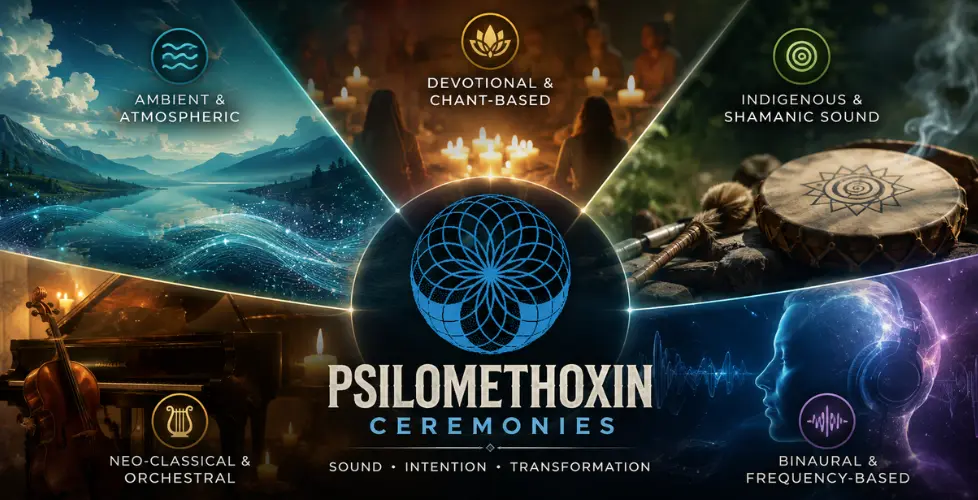
Direct Answer: Members of The Sacred Synthesis use a layered blend of ambient, devotional, neo-classical, indigenous-inspired, and silence-anchored soundscapes. No single genre dominates — the intention and emotional arc of the ceremony guides the selection.
Here is a breakdown of the core music categories members work with:
1. Ambient and Atmospheric Music
Ambient music — spacious, tonal, and free of rhythmic urgency — forms the backbone of most Sacred Synthesis ceremony playlists. Artists like Brian Eno, Carbon Based Lifeforms, and Moby’s late catalog are referenced regularly in ceremony spaces. The goal is to provide a sonic field that holds the listener without demanding attention.
Ambient tracks reduce cognitive load during the early phase of a ceremony, allowing the nervous system to settle before the sacrament deepens.
2. Devotional and Chant-Based Music
Devotional music — particularly Sanskrit mantras, Sufi zikr, and kirtan-style chanting — carries a different function. It connects participants to a felt sense of the sacred. The repetition of sacred sound patterns creates what researchers describe as a “sonic container” — a vibrational field that frames the ceremony as holy rather than recreational.
Members often report that devotional music bridges the individual inner journey with a sense of larger unity — aligning well with The Sacred Synthesis’s stated focus on Unity Consciousness.
3. Indigenous and Shamanic Sound
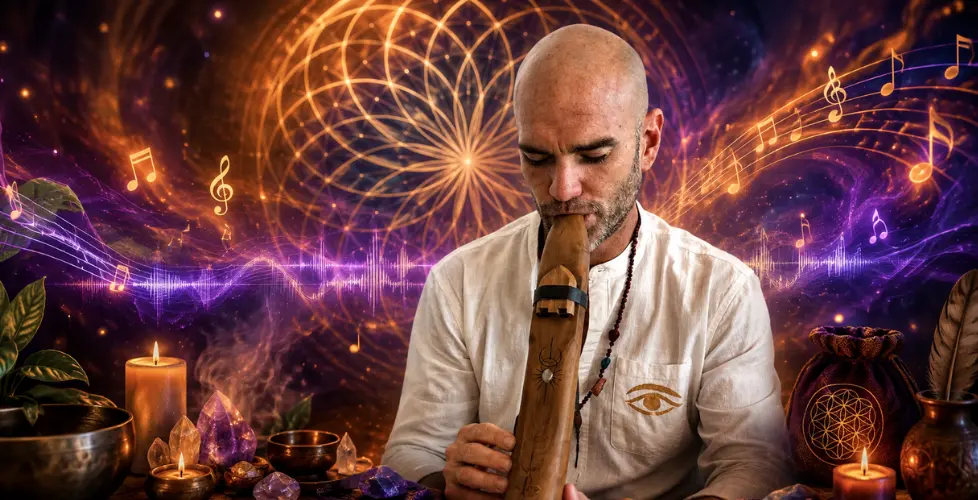
Many members weave in elements of traditional shamanic music — particularly icaros (sacred songs from South American plant medicine traditions), Native American flute, and Tibetan singing bowls. These instruments carry centuries of ceremonial intention and are considered by many indigenous traditions to communicate directly with the spirit world.
Importantly, this music is used with respect and cultural awareness, not appropriation. The Sacred Synthesis community encourages members to approach indigenous sounds with gratitude and proper context.
4. Neo-Classical and Orchestral
At deeper stages of the ceremony, richer orchestral textures — composers like Max Richter, Johann Johannsson, and Ólafur Arnalds — can help participants navigate emotional complexity without overwhelming them. The movement from quiet to grand, from sparse piano to full strings, mirrors and supports the natural emotional waves of the Psilomethoxin experience.
5. Binaural and Frequency-Based Music
Some members use binaural beats (typically Theta range, 4–8 Hz) layered beneath ambient music. While rigorous clinical evidence for binaural beats in entheogenic contexts remains limited as of 2026, multiple members in The Sacred Synthesis Skool community report them as supportive of deeper meditative states during ceremony.
How Does Music Influence the Psilomethoxin Experience Neurologically?
Direct Answer: Music activates the same neural reward pathways engaged by the sacrament itself — amplifying emotional resonance, reducing amygdala reactivity, and increasing the likelihood of meaningful, integrated insights.
Mendel Kaelen, a researcher at Imperial College London’s Centre for Psychedelic Research, found in his studies with psilocybin that the quality of a participant’s musical experience during a session was more predictive of therapeutic and mystical breakthrough than the dose of the substance alone. The depth of engagement with the music predicted improvements in depression one week post-session.
A 2025 study in Frontiers in Neuroscience demonstrated that combined music and mindfulness interventions significantly modulated Heart Rate Variability (HRV) — a key marker of parasympathetic nervous system activation. This is particularly relevant for Psilomethoxin, which The Sacred Synthesis describes as a sacrament known for supporting parasympathetic activation, emotional balance, and nervous system regulation.
A 2025 phenomenological study on psilocybin-assisted therapy found that participants frequently stopped experiencing music as external sound — instead becoming fully immersed within it, losing the boundary between self and sound. This dissolution of the listener-music boundary is a marker of the depth of the ceremonial state.
For Psilomethoxin ceremonies, practitioners use this neurological amplification intentionally. Music does not enter the ceremony by chance — The Sacred Synthesis chooses each track to match and support the specific emotional and spiritual arc the ceremony seeks to create.
How Is Sacred Synthesis Ceremony Music Structured from Opening to Close?
Direct Answer: Ceremony music follows a four-phase arc — Opening, Deepening, Peak, and Integration/Return — with each phase serving a specific emotional and spiritual function.
Well-structured ceremony music follows a predictable emotional architecture that experienced facilitators call the ceremonial arc. Here is how it typically unfolds in a Sacred Synthesis ceremony:
Phase 1 — Opening
Music here is soft, spacious, and minimally rhythmic. The goal is to signal safety to the nervous system and ease the transition from everyday consciousness into sacred space. Sparse piano, gentle drone, or simple acoustic guitar are common choices. Silence between tracks is intentional.
The ceremonial opening music tells the body: this is a different kind of time.
Phase 2 — Deepening
As the sacrament begins to establish itself, the music gently grows in emotional depth. Layers are added. Orchestral textures emerge. Devotional vocals may appear. The music begins to guide rather than simply hold.
This phase mirrors the increasing openness of the participant’s inner state — creating an emotional resonance that amplifies connection rather than directing it.
Phase 3 — Peak
At peak depth, the music may become more expansive and complex — or, intentionally, may reduce to near-silence. Both serve a purpose. Rich orchestral pieces can help participants navigate profound emotional terrain; silence at the peak invites full internal surrender.
Some facilitators and members report that the peak phase responds most powerfully to indigenous and devotional music — songs that carry an innate spiritual vocabulary of surrender, love, and dissolution.
Phase 4 — Integration and Return
The closing arc of the ceremony calls for music that gently re-anchors the participant in the body and in time. Acoustic instruments, gentle rhythms, nature sounds, and familiar melodic patterns support grounding without rupturing the sacred space.
This phase is considered as important as any other. Poor closing music can leave participants feeling fragmented rather than integrated.
What Is the Role of Silence in Psilomethoxin Ceremonies?
Direct Answer: Silence is one of its most powerful instruments.
Within Sacred Synthesis ceremonies, intentional silence is used as a sonic instrument in its own right. Experienced facilitators know that the pause between tracks — when done with awareness — creates a moment of pure internal listening that no external sound can replicate.
Silence at the peak of a Psilomethoxin ceremony invites full surrender. It signals to the participant: the only thing left to hear is what is already within you.
Research from a 2026 ScienceDirect study on music and silence in psychedelic-assisted therapy confirmed that silence holds a distinct therapeutic function — it creates space for the mind to process emotional content without the scaffolding of sound. The study noted that in indigenous ayahuasca ceremonies, practitioners adapt icaros (sacred songs) in real-time based on both individual and collective needs — meaning the decision not to sing carries as much intention as the song itself.
Sacred Synthesis members are encouraged to sit with silence without rushing to fill it. The ability to be present in silence during ceremony is itself a marker of inner steadiness.
How Do Virtual Psilomethoxin Ceremonies Use Music Differently?
Direct Answer: Virtual ceremonies rely on each participant curating their own sonic environment, making pre-ceremony music guidance essential. The Sacred Synthesis monthly virtual ceremonies provide playlist recommendations and ceremonial framing so members are acoustically aligned even across distance.
The Sacred Synthesis holds monthly virtual psychedelic ceremonies as part of its membership offerings — connecting thousands of members across the Skool community in shared ceremonial time, each from their own space.
Virtual ceremony introduces a unique musical challenge: without a shared room, the sonic container must be built individually. This is why music preparation is a key part of The Sacred Synthesis’s preparation and integration support framework.
Members are encouraged to:
- Use quality over-ear headphones or speakers to create immersive sound
- Prepare their playlist in advance, aligning it with the ceremony phases outlined above
- Remove any notification sounds or interruptions from their listening environment
- Use music volume that feels immersive without overwhelming — the goal is to be held, not dominated
For those new to virtual ceremony, the community on Skool is a rich resource for playlist sharing, music discussions, and member-tested recommendations.
How Does Music Support Integration After Psilomethoxin Ceremonies?
Direct Answer: Music heard during ceremony can serve as an integration anchor — replaying specific tracks post-ceremony reactivates the emotional and somatic states accessed during the sacred space.
Integration is the work of translating what happened inside the ceremony into daily life. Music ranks among the most effective integration anchors available, precisely because the brain processes sound more rapidly than any other sense.
A specific piece of music heard at a moment of deep insight during a ceremony can, when a member replays it days or weeks later, re-access the emotional and somatic state from that moment. This is not nostalgia — it is neurological. The hippocampus and amygdala process music memory through overlapping pathways with emotional memory, meaning the brain stores music and experience together.
Members working with The Sacred Synthesis 30-Day Group Protocol often use their ceremony playlists during daily reflection practices, breathwork sessions, and morning rituals in the weeks following ceremony. The cohort experience includes three virtual ceremonies, each with musical structure that supports not just the ceremony itself but the integration rhythm of the 30-day arc.
This is why music selection is not just a preference — it is a therapeutic and spiritual tool.
What Music Should You Choose for a Self-Led Psilomethoxin Ceremony?
Direct Answer: Choose music that is instrumental, emotionally spacious, and free of jarring transitions. Build a playlist that mirrors the four ceremonial phases and lasts 2–4 hours.
For members working with the self-led option of the 30-Day Group Protocol or exploring self-ceremony alongside their sacramental practice, here are the community-informed principles for choosing your ceremonial music:
Do choose:
- Instrumental pieces (vocals can be used in devotional form but avoid songs with narratively complex lyrics)
- Music you find emotionally resonant but not triggering — the goal is openness, not arousal
- A gradual emotional arc from quiet to deep to expansive and back to grounded
- Familiar pieces in the opening and closing phases to anchor the nervous system
- Indigenous or devotional music that you approach with respect and intention
Avoid:
- Music with strong personal narrative associations (an ex-partner’s favorite song, for example)
- Abrupt tempo or genre changes mid-ceremony without intentional reason
- Lyric-heavy pop or hip-hop in earlier phases — these demand cognitive engagement the ceremony should bypass
- Music that is overly dramatic or emotionally manipulative at opening — build gradually
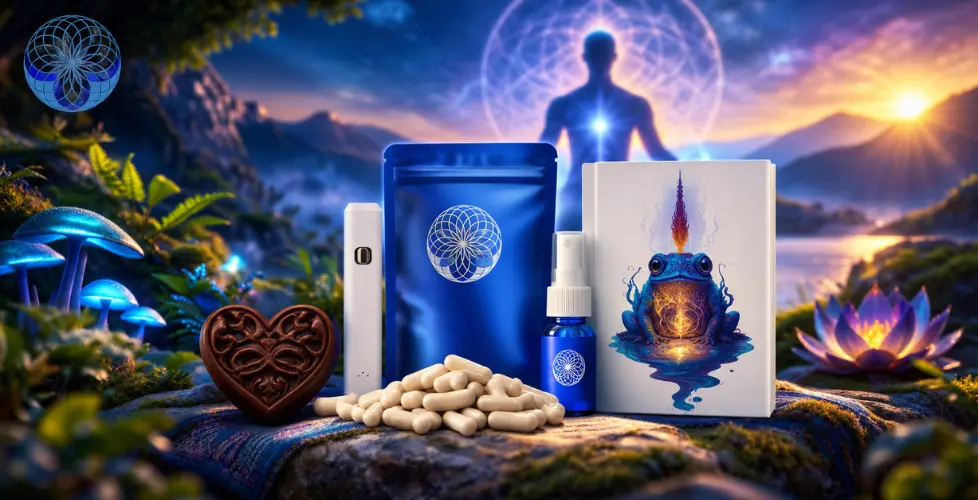
The Sacred Bundle — which includes Psilomethoxin capsules, the Jaguar Light Wand, and Jaguar Unity Mist — supports the full ceremonial arc, from microdose ritual entry to deeper somatic and spiritual opening. Pairing these sacramental tools with intentional music creates a ceremony that is layered, complete, and personally sovereign.
What Does the Sacred Synthesis Community Share About Ceremony Music?
Original Community Insight: Members inside The Sacred Synthesis Skool community — regularly share ceremony playlists, music reflections, and post-ceremony integration music practices. Key patterns that emerge from community discussions include:
- Ambient and orchestral music is the most consistent recommendation across member experience levels
- Devotional music (Sanskrit kirtan, Sufi chanting, Native American flute) is described as the most emotionally activating when introduced at the right ceremonial moment
- Members who prepare music in advance report more cohesive, less fragmented ceremony experiences compared to spontaneous selection
- Silence between tracks is consistently described as one of the most powerful ceremonial moments when held with awareness
- Post-ceremony re-listening to ceremony playlists is the most commonly reported integration practice, alongside journaling
These patterns align with broader research on music in entheogenic contexts. A 2025 review published in Frontiers in Psychiatry noted that while only three empirical studies have directly examined which music types best support psychedelic sessions, practitioner consensus and participant reports consistently favor gradual, emotionally intelligent arc-based playlist design.
Note: Specific playlist titles and full member research within The Sacred Synthesis community are proprietary to members. To access ceremony music resources, community playlists, and member discussions, join the community on Skool.
How Does the 30-Day Protocol Incorporate Sound and Ceremony Music?
The 30-Day Group Protocol offered by The Sacred Synthesis integrates ceremony music at multiple levels across its 30-day arc:
Three virtual live ceremonies are embedded within the cohort experience, each held with a curated ceremonial container that includes musical guidance. These ceremonies are not standalone events — they are designed to build on each other, with music serving as a through-line of the transformational arc.
Daily reflection practices in the protocol are paired with sound recommendations to help members anchor their daily inquiry into the nervous system rather than keeping it purely cognitive. Music here functions as somatic support — helping the body feel the reflection, not just think it.
Weekly protocol guidance from facilitators includes music support cues — when to listen, what genres serve what phase of the 30-day journey, and how to use specific sonic environments to deepen integration between ceremony dates.
Members use The Sacred Bundle — including PsiloCap, Jaguar Light Wand, and Jaguar Unity Mist — across the 30 days in conjunction with these sonic environments, creating a multi-layered transformation protocol that addresses neurochemistry, somatics, spirituality, and community simultaneously.
Participants who complete the cohort experience consistently describe the combination of sacrament, ceremony, sound, and community as more transformative than any single element alone.
What Is the Psilomethoxin Sacrament Used in Sacred Synthesis Ceremonies?
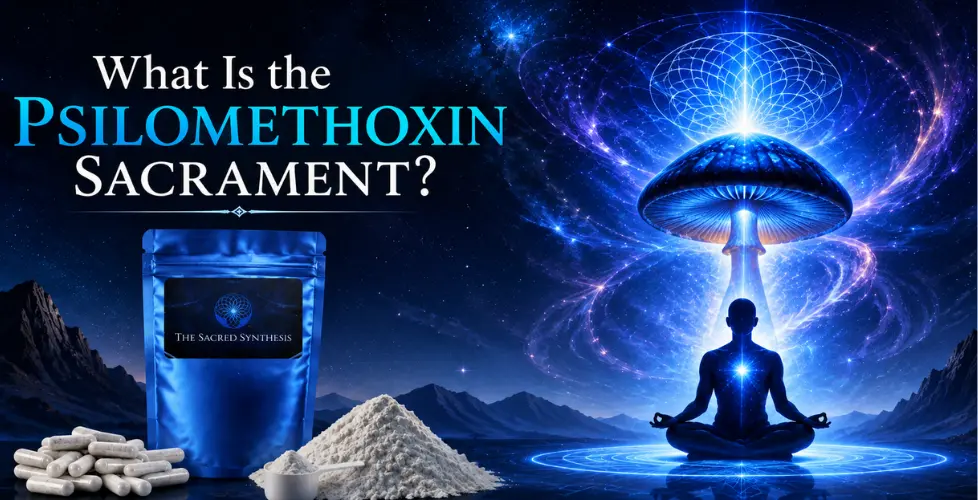
Direct Answer: Psilomethoxin is a novel entheogenic sacrament that The Sacred Synthesis cultivates through an alchemical process — introducing 5-MeO-DMT during the growth of psilocybin-containing mushrooms — yielding a gentle, non-visual compound that supports emotional balance, nervous system regulation, and expanded awareness.
Understanding the sacrament itself is essential context for understanding why music plays such a defining role in the ceremony. Psilomethoxin does not produce intense visual hallucinations. It works at a subtler, more interior level — dissolving the noise of the conditioned mind and opening space for what is genuinely present beneath it. This is precisely why the sonic environment matters so profoundly: the medicine creates space, and the music guides what fills it.
What Makes Psilomethoxin Unique as a Ceremonial Sacrament?
The Sacred Synthesis describes Psilomethoxin as a sacramental compound that results from the synthesis of psilocin and 5-MeO-DMT — creating what members and facilitators characterize as a gentle serotonin analog. Unlike high-dose psychedelic compounds, Psilomethoxin is designed for conscious, intentional use — not overwhelming experience, but deep presence.
Its effects, as described by The Sacred Synthesis, include:
- Emotional balance and regulation — a softening of reactive emotional patterns without sedation
- Clarity of mind — reduced mental noise and enhanced inner quiet
- Parasympathetic nervous system activation — the body’s rest-and-restore state, supporting safety and openness during ceremony
- Neuroplasticity support — the compound is associated with an increased capacity for new insight, perspective-taking, and integration
- Grounded presence — expanded awareness that remains body-connected rather than disembodied
It is available in capsule and powder form, commonly used for microdosing, daily ritual, or the full ceremonial arc of the 30-Day Group Protocol.
Why Does Psilomethoxin’s Profile Make Music So Important?
Because Psilomethoxin operates at this depth of nervous system and emotional access — without the overwhelming visual intensity of higher-dose psychedelics — the quality of the sonic environment becomes the primary vehicle for guiding the experience. The medicine opens the door; the music determines what the participant walks toward once inside.
Members of The Sacred Synthesis consistently report that the ceremony experience with Psilomethoxin is more emotionally responsive to music than to any other environmental variable. A poorly chosen playlist creates fragmentation. A well-crafted sonic arc creates coherence, depth, and lasting integration.
This is not incidental. It reflects the specific neurological mechanism of the compound. With parasympathetic activation as a primary effect, the nervous system is in its most receptive state — and music is received differently in a regulated nervous system than in a hypervigilant one. Sound goes deeper. Resonance becomes genuine rather than surface-level.
Frequently Asked Questions
Q1. What type of music is played in Psilomethoxin ceremonies?
Sacred Synthesis members primarily use ambient, devotional, indigenous-inspired, and neo-classical music that supports emotional regulation and spiritual depth without demanding cognitive engagement.
Q2. Why is music so important in Psilomethoxin ceremonies?
Music is a psychological anchor and emotional guide. A 2024 study found it reduces in-session anxiety by up to 72%, and research from Imperial College London links music quality to mystical experience and lasting therapeutic improvement.
Q3. Can I choose my own music for a self-led Psilomethoxin ceremony?
Yes. Self-led members are encouraged to curate intentional playlists that follow the four ceremonial phases — Opening, Deepening, Peak, and Integration — using instrumental and devotionally resonant music.
Q4. How long should ceremony music be?
A complete ceremony playlist runs 2–4 hours, mirroring the natural arc of the sacramental experience from entry through peak to integration and return.
Q5. Does The Sacred Synthesis use live music in ceremonies?
Some in-person Sacred Synthesis gatherings have featured live ambient and devotional music. Monthly virtual ceremonies use curated recorded soundscapes that facilitate a shared ceremonial container across participants at different locations.
Q6. What is the role of silence in Psilomethoxin ceremonies?
Silence is used as an intentional sonic instrument — particularly at the peak — to invite full internal surrender. It is not an absence of ceremony; it is one of its most powerful moments.
Q7. Where can I find ceremony music guidance from the community?
The Sacred Synthesis community on Skool hosts member playlist discussions, ceremony music recommendations, and integration music sharing. It is the most active resource for community-tested ceremonial soundscapes.
Final Thoughts: Sound, Sacrament, and the Sacred Synthesis Path
Every Psilomethoxin ceremony is an act of intentionality. The sacrament you take, the music you play, the community you hold it with, and the integration practices you commit to afterward — all of these are variables in a larger equation whose answer is transformation.
Music is not the ceremony’s decoration. It is one of its primary instruments.
Research is increasingly confirming what indigenous ceremonial traditions have known for centuries: sound shapes the psychedelic journey in ways that are measurable, reproducible, and deeply meaningful. The quality of your musical container will shape the quality of what you access inside ceremony — and what you are able to carry back out of it.
At The Sacred Synthesis, this understanding shapes everything — from the structure of monthly virtual ceremonies to the three live ceremony experiences that anchor the 30-Day Group Protocol. The community holds every element, including music, with care and intention — and a growing membership serious about intentional transformation continues to deepen the work.
If you are ready to experience what a properly held Psilomethoxin ceremony — with the right sound, the right sacrament, and the right community — actually feels like, the path is open.
Ready to Step Into Ceremony? Here Is How to Begin
Step 1 — Join the Community Join over 800 members inside The Sacred Synthesis community on Skool. Access ceremony music resources, integration discussions, playlist sharing, and live monthly virtual ceremonies — all inside one supported community.
Step 2 — Access the Sacrament The Psilomethoxin sacrament — available in capsule and powder form — is accessible to members of The Sacred Synthesis. It is the ceremonial foundation that, paired with intentional music and community support, makes genuine inner work possible.
Step 3 — Explore The Sacred Bundle The Sacred Bundle brings together PsiloCap, the Jaguar Light Wand, and Jaguar Unity Mist — a curated constellation of sacramental tools designed to guide you through the full ceremonial arc. Deep coherence, emotional liberation, and transformational clarity. Together.
Step 4 — Join the 30-Day Protocol The 30-Day Group Protocol is where sacrament, sound, ceremony, and community converge into a structured 30-day transformation practice. Three live virtual ceremonies. Daily reflection. Weekly facilitation. A community traveling the same arc alongside you. New cohorts begin on the first of every month.
Music is the invisible architecture of every great ceremony. What you choose to play shapes what you are willing to feel. And what you are willing to feel is what you are capable of transforming.
The Sacred Synthesis holds the container. The Psilomethoxin opens the space. The music guides the journey. Your willingness is all that remains.