Two words — psilomethoxin and ayahuasca — are appearing together in more and more conversations about plant medicine, healing, and conscious exploration. They represent genuinely different approaches to inner work, yet seekers often compare them because both inhabit the space of sacred, serotonergic, ceremonially oriented experience. Are they rivals? Alternatives? Complements? The honest answer is: they are distinct tools, serving different purposes, carrying different risk profiles, and suited to different stages of a person’s path.
This guide breaks the comparison down completely — pharmacology, effects, duration, preparation, safety, ceremony style, therapeutic potential, and spiritual orientation — so you can make an informed, grounded decision about what may be appropriate for you.
Understanding the true psilomethoxin vs ayahuasca difference starts not with opinion, but with science — and it starts with what each compound actually is.
Quick Answer: Psilomethoxin vs Ayahuasca Psilomethoxin (4-OH-5-MeO-DMT) is a novel tryptamine produced via an alchemical cultivation process, blending the emotional warmth of psilocin with elements of 5-MeO-DMT. It produces a 4–8 hour experience marked by emotional openness, mental clarity, and moderate ego softening. Ayahuasca is a traditional Amazonian brew containing DMT combined with beta-carboline MAO inhibitors from the Banisteriopsis caapi vine, producing a 4–6 hour intensely visionary, often physically cathartic journey. Ayahuasca carries more research evidence and stronger ego dissolution, but also greater physiological intensity and significant medication contraindications. Psilomethoxin is gentler and more accessible but lacks peer-reviewed clinical trial data. Both require preparation, experienced support, and integration.
What Is Psilomethoxin?
Psilomethoxin — chemically identified as 4-hydroxy-5-methoxytryptamine (4-OH-5-MeO-DMT) — is a rare tryptamine compound first described by Alexander Shulgin in TiHKAL. Structurally, it occupies a unique position between two well-studied psychedelics: psilocin (the active metabolite of psilocybin) and 5-MeO-DMT (found in the Sonoran Desert toad and various plant species).
Its creation at The Sacred Synthesis and the Church of Psilomethoxin involves cultivating Psilocybe mushrooms on substrates containing 5-methoxytryptamine, with the hypothesis that this alchemical process produces psilomethoxin within the fruiting bodies. It is important to note that while this method has been practiced within the Church community and documented experientially. The compound remains under community-level access and is still in early scientific exploration.
What makes psilomethoxin experientially distinct is the combination of two structural features:
- A 4-hydroxy group — shared with psilocin — which modulates receptor binding toward the grounded, introspective, emotionally warm qualities of psilocybin experiences.
- A 5-methoxy group — shared with 5-MeO-DMT — which enhances 5-HT1A activity, associated with anxiolytic, empathogenic, and non-dual awareness properties.
The result, according to community reports and structural pharmacological reasoning, is an experience that bridges the two parent compounds: more heart-centered than classic psilocybin, more navigable than 5-MeO-DMT, and carrying a quality of presence and openness that practitioners describe as distinctive in its own right.
At Sacred Synthesis, psilomethoxin is available as a sacrament within a structured church context, supported by education, ceremony, and integration resources including the 30-Day Group Protocol and the Sacred Synthesis community on Skool.
Read More: How to Prepare for a Psilomethoxin Session | The Sacred Synthesis
What Is Ayahuasca?
Ayahuasca is a psychoactive brew with roots stretching back centuries in Amazonian indigenous traditions. It is typically prepared by combining two plants: Banisteriopsis caapi (a vine containing beta-carboline alkaloids — harmine, harmaline, and tetrahydroharmine — which function as monoamine oxidase inhibitors, or MAOIs) and Psychotria viridis (a leaf containing N,N-dimethyltryptamine, or DMT).
Taken separately, DMT is orally inactive because the enzyme MAO-A breaks it down in the gut before it reaches the brain. The genius of ayahuasca as a medicine is the synergistic pairing: the beta-carbolines in the vine inhibit MAO-A long enough for the DMT in the leaves to pass into systemic circulation and produce its profound psychological effects.
This pharmacological mechanism — MAOI + DMT — is both the source of ayahuasca’s therapeutic power and the root of most of its significant risks. It is what makes certain medication combinations genuinely dangerous.
Ayahuasca has been studied with growing rigor over the past decade. A 2019 randomized placebo-controlled trial published in Psychological Medicine (Palhano-Fontes et al.) found rapid and significant antidepressant effects. Observational research by Uthaug et al. (2019) in Frontiers in Psychiatry found reductions in depression, anxiety, and PTSD following naturalistic ceremonial use. Work from Johns Hopkins and the Beckley Foundation has documented long-term positive psychological change associated with mystical-type experiences induced by ayahuasca.
Cultural and Spiritual Origins
Ayahuasca comes from an unbroken lineage of indigenous practice. Curanderos and shamans across Peru, Colombia, Brazil, and Ecuador have used it for healing, divination, and communication with spirit realms for generations. The brew carries specific ceremonial protocols — the dieta, the icaros (healing songs), the presence of a trained facilitator — that have evolved over centuries to hold the space safely for participants.
Psilomethoxin was developed and brought into ceremonial use by the Church of Psilomethoxin — a modern, non-dogmatic spiritual community. Its significance for those who work with it continues to be shaped by the accumulated knowledge of the wider psychedelic and entheogenic community, and by the developing practices of communities like The Sacred Synthesis.
Pharmacology and Chemistry Compared
| Property | Psilomethoxin | Ayahuasca |
| Primary Active Compound(s) | 4-Hydroxy-5-methoxytryptamine (4-OH-5-MeO-DMT) | DMT + harmine, harmaline, tetrahydroharmine (beta-carbolines) |
| Contains MAOI? | No | Yes (reversible MAO-A inhibitors) |
| Primary Receptor Targets | 5-HT2A (partial agonist, hypothesized); 5-HT1A; possibly 5-HT2C | 5-HT2A (DMT agonist); 5-HT1A; 5-HT2C; sigma-1 |
| Route of Administration | Oral (capsule or powder) | Oral (brewed tea) |
| Psychedelic Class | Tryptamine (hydroxymethoxytryptamine) | Tryptamine brew (DMT + harmala alkaloids) |
| Natural Source | Biosynthesized in cultivated Psilocybe mushrooms (alchemical process) | Psychotria viridis (DMT) + Banisteriopsis caapi (MAOI) |
Effects and Subjective Experience: What Does Each Feel Like?
The Psilomethoxin Experience
Those who have worked with psilomethoxin through the Church of Psilomethoxin and Sacred Synthesis community commonly describe an experience characterized by:
- Emotional warmth and heart-opening — a quality reminiscent of entactogenic compounds, promoting feelings of connection, compassion, and inner softness.
- Mental clarity — unlike high-dose psilocybin experiences, which can feel cognitively overwhelming, psilomethoxin is frequently described as clear-headed and navigable.
- Mild to moderate visual phenomena — subtle shifts in perception, enhanced color and pattern awareness, but without the elaborate visual narratives of ayahuasca.
- Gradual, gentle unfolding — the experience builds softly rather than arriving abruptly, allowing for a conscious, intentional relationship with the unfolding state.
- Grounded expansiveness — a sense of expanded awareness that retains enough grounding to allow integration of insights during the experience itself.
- Emotional release — tears, laughter, gratitude, and catharsis arise naturally, without dramatic confrontation.
These qualities make psilomethoxin particularly suited to group ceremonial settings, where emotional safety and collective coherence matter — as in the Sacred Synthesis group ceremonies.
The Ayahuasca Journey

Ayahuasca experiences are qualitatively different — more turbulent, more visually elaborate, and more physically demanding:
- Vivid, complex visionary content — geometric patterns, symbolic imagery, entity encounters, and narrative “journeys” are common, particularly at ceremonial doses.
- Profound ego dissolution — the boundary between self and world can dissolve significantly, with some participants reporting complete dissolution of personal identity.
- Physical catharsis (the purge) — vomiting, trembling, sweating, and diarrhea frequently occur and are considered by indigenous traditions to be part of the healing process, releasing physical and emotional material.
- Confrontational emotional terrain — repressed trauma, shadow material, and difficult psychological content often surfaces, sometimes abruptly.
- Oceanic mystical states — at peak intensity, ayahuasca can produce experiences of cosmic unity, communication with intelligences or entities, and encounters with what participants describe as fundamental truth.
Ayahuasca demands a certain preparedness and resilience. While ultimately reported as deeply beneficial by many participants, the journey can feel terrifying, disorienting, or destabilizing during the experience — particularly for those without adequate preparation.
Psilomethoxin vs Ayahuasca: Full Comparison
| Category | Psilomethoxin | Ayahuasca |
| Onset | 30–90 min | 20–60 min |
| Duration | 4–8 hrs | 4–6 hrs (5–8 hrs total ceremony) |
| Intensity | Mild–moderate | High–very high |
| Visuals | Mild–moderate | Intense, symbolic |
| Ego Dissolution | Partial/moderate | Significant–complete |
| Physical Load | Light | Heavy (nausea, purging) |
| Emotional Tone | Warm, heart-centered | Intense, cathartic |
| Ceremony Style | Group/solo; structured protocol | Shaman-led; traditional |
| Pre-Ceremony Dieta | Mindful prep; no MAOI restriction | Strict tyramine-free dieta |
| SSRI Interactions | Serotonin risk; review needed | High-risk MAOI interactions |
| Contraindications | Psychosis history; some meds | Psychosis, cardiac, pregnancy, many meds |
| Cultural Background | Contemporary | Centuries-old Amazonian |
| Clinical Research | None as of 2026 | RCTs + growing evidence |
| Integration Ease | Generally easier | More demanding |
| Legal Status | Complex, jurisdiction-dependent | Schedule I (US); some exemptions |
Safety Profiles and Contraindications
Medical Disclaimer: This article is for educational purposes only. Neither psilomethoxin or ayahuasca is approved by the FDA for medical use. Legal status varies by jurisdiction. Consult a licensed healthcare provider before making decisions about either substance.
Ayahuasca Safety Profile
Ayahuasca’s safety profile is significantly shaped by its MAOI component. A 2024 systematic review published in the Journal of Psychoactive Drugs (White et al.) catalogued adverse events from clinical trials and naturalistic use. Common adverse events included nausea and vomiting (expected and considered part of the therapeutic process), transient anxiety, headache, elevated blood pressure, and in rare cases more serious cardiovascular events. No fatal outcomes were recorded in supervised clinical trial settings reviewed by the authors.
The more significant concern lies in drug interactions. Ayahuasca’s beta-carboline MAOIs — while reversible and MAO-A selective, which is somewhat safer than classic MAOIs — can still cause dangerous or life-threatening interactions with:
- SSRIs and SNRIs (risk of serotonin syndrome)
- Tricyclic antidepressants
- Lithium
- Tramadol and other opioids
- MDMA and stimulants
- Tyramine-rich foods (aged cheese, cured meats, fermented products, alcohol)
- Numerous other medications — this list is not exhaustive
A strict tyramine-free dieta — typically beginning 2–4 weeks before a ceremony — is not merely cultural tradition; it is a medical necessity for participants taking ayahuasca.
Additionally, ayahuasca is contraindicated for individuals with a personal or family history of psychosis, schizophrenia spectrum disorders, or bipolar disorder with psychotic features. Cardiovascular screening is advisable given the hemodynamic changes the brew can produce.
Psilomethoxin Safety Profile
Psilomethoxin does not contain MAOIs. This significantly reduces the dietary and drug interaction complexity compared to ayahuasca. However, as a serotonergic compound — hypothesized to act at 5-HT2A, 5-HT1A, and possibly 5-HT2C receptors — it can still interact with serotonergic medications and should not be combined with SSRIs, SNRIs, or other serotonin-active drugs without medical guidance.
The safety data currently available is anecdotal and community-reported. While reports within the Sacred Synthesis community and Church of Psilomethoxin suggest a relatively gentle physiological profile, the absence of clinical data means unknown risks cannot be ruled out. Responsible use, appropriate spacing between sessions, and qualified medical screening remain important.
Contraindications for psilomethoxin, based on conservative serotonergic compound guidance, include: history of psychosis or schizophrenia spectrum disorder, concurrent use of serotonergic medications without physician clearance, pregnancy, and unmanaged cardiovascular conditions.
Read More: Group vs Solo Psilomethoxin Journeys: What’s Right for You?
Ceremony Preparation: Dieta vs. Mindful Readiness
One of the most practical and consequential differences in the psilomethoxin vs ayahuasca comparison involves how you prepare.
For ayahuasca, the dieta is a core part of the medicine tradition. Participants are typically asked to avoid tyramine-rich foods (aged cheese, red wine, fermented foods, cured meats), alcohol, recreational drugs, and sexual activity for a period before ceremony — often 2–4 weeks. They may also be asked to simplify diet to light, fresh foods. Specific medications must be discontinued well in advance, under medical supervision. Facilitators and retreat centers routinely conduct intake screenings to evaluate medication history and health status. This preparation is not optional; it is part of both the safety protocol and the traditional framework through which ayahuasca is meant to be received.
For psilomethoxin, there is no MAOI-related dietary restriction. Preparation is encouraged to be intentional and mindful rather than restrictive — light eating on the day of ceremony, minimizing alcohol in the preceding days, prioritizing sleep, setting a clear intention, and approaching the experience with openness. Community members in the Sacred Synthesis 30-Day Group Protocol are guided through structured preparation as part of an ongoing ceremonial journey, not as a one-time isolated event.
Therapeutic and Spiritual Potential
Ayahuasca: What the Research Shows
Ayahuasca’s therapeutic potential is the most rigorously documented of the two compounds. Key findings from the research literature include:
- A landmark 2019 randomized, double-blind placebo-controlled trial (Palhano-Fontes et al., Psychological Medicine) found significant antidepressant effects in treatment-resistant depression patients within days of a single ayahuasca session.
- Observational research (Uthaug et al., 2019, Frontiers in Psychiatry) found reductions in depression, anxiety, and PTSD severity following naturalistic ceremonial use, with effects maintained at 4-week follow-up.
- Long-term studies suggest reductions in alcohol and substance misuse in regular ceremonial users (Bouso et al., Drug and Alcohol Dependence).
- Johns Hopkins research has linked ayahuasca-type mystical experiences to long-term positive psychological change and lasting reductions in depression scores.
The mechanistic basis for these effects is understood through ayahuasca’s modulation of the Default Mode Network (DMN) — the brain network associated with self-referential thought, rumination, and rigid identity construction. Suppression of DMN activity correlates with reduced ego rigidity and increased psychological flexibility, which appears to underlie many of the therapeutic benefits reported.
Psilomethoxin: A Promising Frontier Without Clinical Trials
Psilomethoxin’s therapeutic potential is inferred from structural pharmacology and community experience rather than clinical trials. Based on its hypothesized receptor activity:
- Depression and anxiety — 5-HT2A modulation and DMN suppression (similar to psilocin) suggest neuroplasticity-promoting effects that could support therapeutic benefit, as has been observed with psilocybin in clinical research (Carhart-Harris et al., The Lancet Psychiatry, 2018).
- Emotional processing — 5-HT1A activity, associated with anxiolytic and emotionally stabilizing effects, may support gentle emotional opening and trauma processing.
- Spiritual growth — Community reports consistently describe meaningful spiritual experiences, increased compassion, and shifts in values and perspective.
Legal Considerations
Important Note: Laws governing psychoactive and entheogenic substances vary significantly by country, state, and municipality — and they change frequently. The following is a general educational overview only. It does not constitute legal advice. You are responsible for understanding the current laws in your jurisdiction.
Ayahuasca contains DMT, which is classified as a Schedule I controlled substance in the United States under the Controlled Substances Act. However, the U.S. Supreme Court and Department of Justice have recognized religious exemptions under the Religious Freedom Restoration Act (RFRA) for specific religious groups (including the União do Vegetal and the Santo Daime Church). Outside the United States, ayahuasca is legal in Peru and several other South American countries, decriminalized in some places, and strictly controlled or illegal in others.
Psilomethoxin’s legal status is complex and does not have a simple category. The Sacred Synthesis and Church of Psilomethoxin operate within a religious freedom framework, engaging with psilomethoxin as a sacrament. Legal nuances surrounding its status require jurisdiction-specific legal analysis and should not be assumed without current legal research.
Which Path Is Right for You?
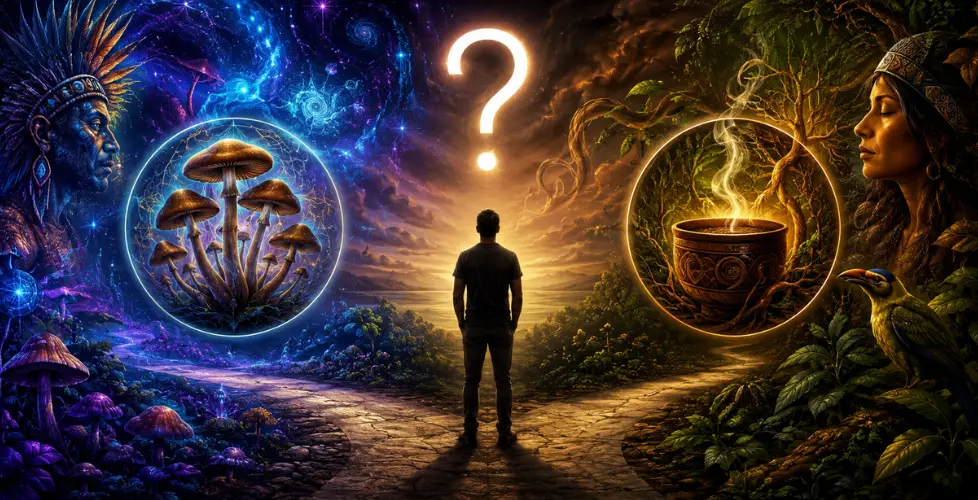
There is no universally superior option in the psilomethoxin vs ayahuasca comparison. The right choice depends on where you are, what you need, how prepared you are, and what support is available to you.
Psilomethoxin May Be More Appropriate If You:
- Are earlier in your entheogenic journey and seeking a gentler entry point into expanded states
- Value emotional warmth, heart-opening, and navigable clarity during the experience
- Want to engage in an ongoing, integration-focused protocol within a supportive community
- Are seeking neuroplasticity support without the logistical and physiological demands of ayahuasca
- Take medications that are contraindicated with MAOIs (subject to serotonergic drug review)
- Are looking for a ceremony accessible without international travel or complex preparation
- Want to explore spiritual growth within a contemporary, non-dogmatic church community
Ayahuasca May Be More Appropriate If You:
- Have experience with psychedelics and are ready for a significantly more intense journey
- Seek profound catharsis, visionary depth, or shamanic-style healing through traditional ceremony
- Are drawn to the specific cultural and energetic lineage of Amazonian plant medicine
- Want access to the most clinically researched evidence base among plant-medicine traditions
- Are prepared to complete a full dieta, medication washout, and multi-day retreat protocol
- Are working with a trauma background and have robust integration support in place
For many practitioners and seekers, these are not mutually exclusive. They can be engaged at different stages of a spiritual and healing journey — psilomethoxin as a consistent, community-embedded practice, and ayahuasca as a deeper ceremonial threshold entered with specific intent and preparation.
Integration: The Work That Makes It All Meaningful
Every serious practitioner and researcher in the psychedelic medicine space agrees on one thing: the experience is not the work. Integration — the process of grounding, understanding, and embodying insights from expanded states — is what translates temporary mystical experience into lasting transformation.
Ayahuasca’s intensity makes integration both more urgent and more complex. Material that surfaces in ceremony — trauma, grief, buried emotion — needs to be carefully tended to afterward, ideally with a trained integration therapist, somatic work, or community support. The interval between ayahuasca ceremonies should allow genuine processing time, often months.
Psilomethoxin’s gentler profile can make integration feel more accessible — but that does not mean it can be skipped. The Sacred Synthesis builds integration into its community framework through the church blog, educational resources, and the Skool community. The 30-Day Group Protocol specifically structures psilomethoxin work within a container of shared support, reflective practice, and ongoing guidance — recognizing that community and integration support are not add-ons but foundations of responsible entheogenic practice.
Frequently Asked Questions: Psilomethoxin vs Ayahuasca
Q1. What is the difference between psilomethoxin and ayahuasca?
Psilomethoxin is a novel tryptamine giving a 4–8 hour warm, clear, moderately ego-softening experience. Ayahuasca is a traditional DMT + MAOI brew giving an intense 4–6 hour visionary, cathartic journey.
Q2. Is psilomethoxin safer than ayahuasca for first-time users?
Psilomethoxin is anecdotally gentler with no MAOI interactions, but has no peer-reviewed safety data. Ayahuasca’s risks are well-documented; medical screening is advisable for either.
Q3. How long does a psilomethoxin experience last compared to an ayahuasca ceremony?
Psilomethoxin lasts 4–8 hours; ayahuasca ceremonies run 5–8 hours total with 2–4 hours of peak effect. Both are much longer than inhaled 5-MeO-DMT.
Q4. Can psilomethoxin be used as a legal alternative to ayahuasca?
Legal status for both varies by jurisdiction and changes frequently. Ayahuasca is Schedule I (DMT) with some religious exemptions; psilomethoxin’s status is complex and jurisdiction-dependent.
Q5. Does psilomethoxin produce visuals like ayahuasca?
Psilomethoxin can produce mild to moderate visuals but is far less visually intense. Ayahuasca is known for vivid, symbolically rich visionary content.
Q6. Which is better for emotional healing — psilomethoxin or ayahuasca?
Ayahuasca has RCT-level evidence for depression and PTSD reduction. Psilomethoxin lacks trial data but is reported to support emotional release and heart-opening.
Q7. What are the risks of combining psilomethoxin with SSRIs compared to ayahuasca?
Ayahuasca’s MAOIs make SSRI combinations dangerous (serotonin syndrome risk). Psilomethoxin has no MAOIs but is still serotonergic, so medication review is needed for both.
Q8. Do you need a dieta before taking psilomethoxin like you do for ayahuasca?
Ayahuasca requires a strict tyramine-free dieta due to its MAOI content. Psilomethoxin needs no such restriction, though mindful preparation is still recommended.
Q9. Can psilomethoxin replace ayahuasca for spiritual growth and ego dissolution?
Psilomethoxin supports spiritual growth and moderate ego softening but less complete dissolution than ayahuasca. It suits ongoing, community-based practice rather than deep shamanic work.
Q10. What does psilomethoxin feel like compared to an ayahuasca journey?
Psilomethoxin feels emotionally warm, clear, and gently expanding. Ayahuasca is typically more turbulent, visually rich, and physically intense.
Read More: What to Expect in a Psilomethoxin Ceremony: Before, During, After
Key Takeaways: Psilomethoxin vs Ayahuasca
- Psilomethoxin is a novel tryptamine with a gentler, more emotionally accessible profile — well-suited for community-based ceremonial work, ongoing integration practice, and those seeking heart-centered expansion without the intensity of ayahuasca.
- Ayahuasca is a centuries-old Amazonian plant medicine with a more complex pharmacology (MAOI + DMT), greater intensity, a richer research base, and more demanding preparation and contraindication requirements.
- Both modulate serotonin pathways and the Default Mode Network, supporting the neurological basis of psychological flexibility and therapeutic potential.
- Ayahuasca requires a strict dieta and carries significant MAOI drug interaction risks. Psilomethoxin does not require a dieta but warrants serotonergic medication review.
- Legal status for both substances varies by region and changes over time; do not assume legality without current, jurisdiction-specific legal advice.
- Integration is not optional with either substance — it is where the lasting transformation occurs.
- Always consult a qualified healthcare provider before working with any psychoactive substance, particularly if you are taking medications.
Choosing between psilomethoxin and ayahuasca is ultimately a question of readiness, intention, and what kind of support surrounds your work. They are not competitors — they serve different moments on a healing and consciousness-development path. Neither should be approached casually. Both deserve respect, preparation, and the support of a community that takes integration seriously.
Explore Psilomethoxin at The Sacred Synthesis
If you are drawn to psilomethoxin as a sacrament for healing, spiritual growth, and community-supported practice, The Sacred Synthesis offers a carefully considered framework for doing this work well. The Church of Psilomethoxin is a non-dogmatic, multi-faith spiritual community dedicated to soul expansion through entheogenic sacrament and education.
Here’s where to start:
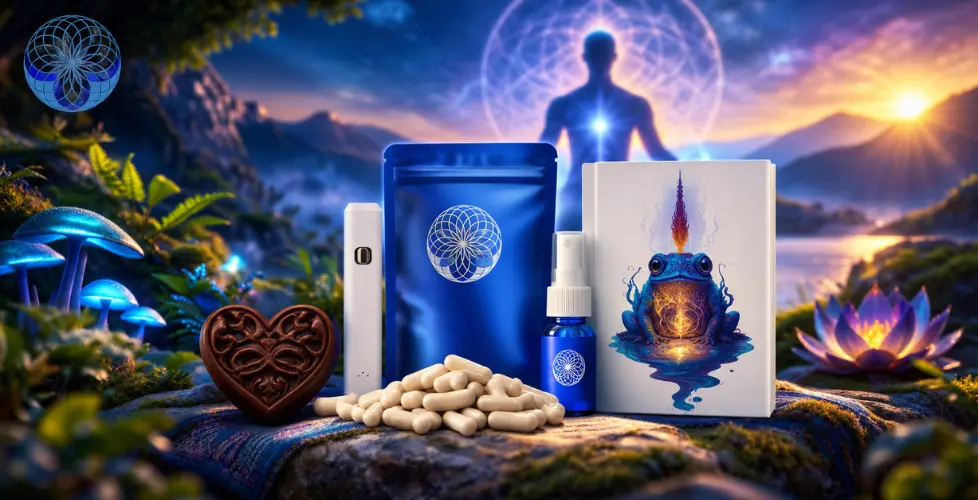
- Psilomethoxin Sacrament — The foundational sacrament of Sacred Synthesis, available to members.
- All Sacraments — Explore the full range including the Jaguar Light Wand, Jaguar Unity Mist, and Sacred Bundle.
- 30-Day Group Protocol — A structured, community-supported journey for those ready to engage psilomethoxin with intention and ongoing integration.
- Community on Skool — Join a growing community of practitioners sharing insights, support, and ceremonial experience.
Whatever path calls you — approach it with honesty about where you are, reverence for what you’re working with, and a commitment to bringing the insights home through lived integration. That is where the real work begins.