If you’ve recently discovered Psilomethoxin — or you’re deepening an existing practice — one of the first practical decisions you’ll face is which form to use. Capsules or powder? It sounds like a minor detail, but your choice has real implications for convenience, dosage precision, onset timing, taste, and how well the sacrament integrates into your daily life.
This guide breaks down every meaningful difference between the two forms so you can make an informed, confident decision — whether you’re just beginning or refining a practice you’ve been building for months.
What Is Psilomethoxin?
Psilomethoxin is a novel entheogenic compound created through an alchemical cultivation process in which 5-MeO-DMT is introduced during the growth of psilocybin-containing mushrooms, producing a unique molecule with its own distinct psychoactive and wellness profile — separate from both psilocybin and 5-MeO-DMT individually.
Quick Answer: Psilomethoxin is a biosynthetically novel tryptamine compound made by introducing 5-MeO-DMT into psilocybin mushroom cultivation. It is used as a religious sacrament by the Church of the Sacred Synthesis for emotional well-being, nervous system regulation, and consciousness exploration.
Read More: The Neuroscience Behind Psilomethoxin vs 5-MeO-DMT
What Makes Psilomethoxin Unique?
Psilomethoxin sits at the intersection of two well-studied compounds:
- Psilocybin — the active molecule in “magic mushrooms,” metabolized into psilocin, which acts on serotonin receptors
- 5-MeO-DMT — a potent tryptamine found in certain plants and the Bufo alvarius toad
What emerges from this biosynthetic process is not simply a mixture of the two. It is a genuinely novel molecule with its own pharmacological identity — one that users describe as simultaneously grounding and expansive, with qualities that neither parent compound produces on its own.
How Is Psilomethoxin Used?
Within the Church of the Sacred Synthesis — the organization that cultivates and provides Psilomethoxin as a religious sacrament — the compound is approached as a tool for:
- Deepening emotional well-being
- Expanding consciousness and clarity
- Supporting nervous system regulation
- Facilitating spiritual and personal growth
Members report a wide range of experiences depending on dose — from subtle mood shifts and heightened presence at lower amounts, to profound states of clarity and interconnection at higher ones.
How Psilomethoxin Works

Psilomethoxin is believed to interact with the serotonin system — specifically the 5-HT2A receptors that are also targeted by classical psychedelics like psilocin (the active form of psilocybin after metabolism). The compound’s unique structural properties, born from its dual-compound biosynthetic origin, may produce effects that blend and transcend those of its parent molecules.
Users commonly describe Psilomethoxin as producing an experience that is simultaneously grounding and expansive — less disorienting than high-dose psilocybin, less overwhelming than 5-MeO-DMT, but possessing qualities distinct from either in isolation. At microdose and low-dose ranges, reported effects often include heightened clarity, emotional openness, reduced anxiety, and enhanced presence.
The form in which Psilomethoxin is consumed — capsule or powder — does not change its fundamental pharmacological action. However, the delivery method influences factors like onset time, ease of dosing, and practical fit for different lifestyles. These differences matter, especially for those building a consistent, intentional relationship with the sacrament.
Important context: Psilomethoxin is provided within a religious sacramental context at the Church of the Sacred Synthesis. All use occurs within an educational and community support framework. The information in this article is educational and does not constitute medical advice.
The Two Forms of Psilomethoxin Explained
Psilomethoxin is offered in two primary physical forms: psilomethoxin capsules and powder. Both contain the same core compound, but they serve different needs and suit different types of practitioners.
Psilomethoxin Capsules
- Pre-filled with a precise, consistent dose
- No taste or smell — easy to swallow
- No measuring or prep required
- Ideal for daily protocols and on-the-go use
- Longer shelf life due to protection from air and moisture
- Slightly slower onset (capsule shell must dissolve first)
- Less flexible for custom dose adjustments
Psilomethoxin Powder
- Fully adjustable — dial in your exact dose
- Dissolves into liquids or food easily
- Faster potential onset when dissolved in water
- Stackable with other supplements or adaptogens
- May have an earthy or bitter taste
- Requires a milligram-accurate scale for dosing
- More sensitive to humidity and light exposure
Neither form is superior in an absolute sense. The right choice is the one that fits your goals, routine, and level of experience with the sacrament.
Absorption Rate & Bioavailability
How Does Each Form Enter Your System?
Both capsules and powder are taken orally, meaning the compound travels through the digestive system before being absorbed into the bloodstream. However, the physical form creates a meaningful difference in how quickly this process begins.
Capsules require an additional step: the gelatin or plant-based shell must first dissolve in the stomach before the compound itself can begin to be absorbed. This typically adds 15–30 minutes to the onset window compared to a dissolved powder. For most applications, this difference is minor — but for those who want to precisely time their experience or who metabolize slowly, it’s worth noting.
Powder dissolved in liquid skips this dissolution step. When mixed into water or another beverage, the compound is already in a form that can begin interacting with the digestive mucosa more quickly. This may translate to a slightly earlier onset — particularly noticeable for users who are sensitive to even subtle timing shifts.
Quick Answer: Psilomethoxin powder dissolved in liquid may absorb slightly faster than capsules because it bypasses the capsule dissolution step. The overall bioavailability of the compound itself is comparable between forms when taken at the same dose on an empty or lightly-fed stomach.
That said, bioavailability — the proportion of the compound that actually reaches systemic circulation — is not dramatically different between forms at equivalent doses. The capsule’s slight delay in onset does not reduce the total amount of compound absorbed; it simply shifts the timing curve.
Factors that influence absorption more significantly than form include whether you’ve eaten recently, individual metabolic rate, gut health, and whether the powder has been properly dissolved before ingestion. If you’re using powder, thoroughly mixing it into liquid ensures the compound is evenly distributed and not partially clumped.
Read More: Psilomethoxin and the Path to Unity Consciousness
Dosage Accuracy: Which Form Gives You More Control?
One of the most practically important differences between Psilomethoxin capsules and powder is how they affect your ability to control and adjust your dose. For a compound where precise dosing can significantly shape the experience, this distinction matters.
Capsules: Consistent, Pre-Measured Dosing
Capsules are manufactured to contain a standardized dose. This is their greatest advantage for most users: you always know exactly how much you’re taking without weighing, measuring, or calculating anything. Each capsule is identical, which reduces variability between doses and removes user error from the equation entirely.
This consistency is especially valuable for people using Psilomethoxin as part of a structured protocol — such as a daily or every-other-day microdosing schedule. You simply take your capsule at the same time each day and move on. No setup, no cleanup, no second-guessing.
The downside of capsules is inflexibility. If you want to take 1.5x the standard dose, you’d need to take one and a half capsules — which isn’t always clean or practical. If you want to step down slightly from the standard capsule amount, your only option is to open the capsule and try to eyeball a portion, which defeats the purpose.
Powder: Precise Custom Dosing
Powder gives you full control over your dose — provided you have a milligram-accurate scale. You can dial in a dose of exactly 75mg, 125mg, 180mg, or any amount that suits your personal response. This is particularly valuable for advanced users who have experimented enough to know their optimal dose windows and want to fine-tune their experience intentionally.
Powder also enables gradual dose titration: starting very low and incrementally increasing in small steps over time — a strategy that many experienced practitioners recommend for any new substance or protocol. With powder, those incremental adjustments are practical and precise.
Dosage accuracy verdict: Capsules win for simplicity and consistency. Powder wins for precision and flexibility. If you don’t own a milligram-accurate scale, start with capsules — eyeballing powder doses introduces unacceptable variability for an entheogenic compound.
Potency & Effects Profile: Does the Form Change the Experience?
Potency is determined by the compound and the dose — not the form. At equivalent doses, capsules and powder contain the same active content and produce comparable effects.
Where form does matter is onset. Powder may absorb slightly faster, so the initial wave can feel more immediate — especially for sensitive users. Some experienced practitioners dissolve powder in warm water to enhance this onset quality, something that may be partly physiological and partly the power of ritual intention.
Ultimately, neither form changes what Psilomethoxin is. The capsule or powder is simply the vehicle. What you’re experiencing is always the compound itself.
Taste & Palatability
1. Powder has a strong natural taste. Psilomethoxin powder is distinctly earthy and slightly bitter — a common characteristic of fungal compounds that many users find unpleasant.
2. Capsules eliminate the problem entirely. Swallow with water, no aftertaste, no prep. For daily use, this is a meaningful quality-of-life advantage.
3. Unpleasant taste undermines consistency over time. What starts as mild aversion can quietly erode your commitment to a daily protocol — and consistency is everything.
4. Powder users have simple workarounds. Mix into citrus juice, herbal tea, honey, coconut water, or a morning smoothie. These work well but add preparation steps.
5. Some users prefer the preparation as ritual. Mindfully mixing a powder drink can become an intentional moment before engaging with the sacrament — a feature, not a flaw.
6. If taste is a barrier, choose capsules. There is no benefit to tolerating daily discomfort when a simpler, equally effective form exists. Take the form you will actually stick with.
Convenience & Lifestyle Compatibility
Practical fit with your daily life is arguably the most underrated factor in choosing between forms. A supplement you consistently take is infinitely more valuable than one you take irregularly because it’s cumbersome.
- Capsules for busy lifestyles: Take one capsule with your morning water or coffee. No prep, no cleanup, fits seamlessly into any routine. Travel-friendly — capsules go in a carry-on without drawing attention or requiring special handling.
- Capsules for workplace or social settings: Discreet. Nobody watches you swallow a capsule and wonders what you’re doing. Powder preparation in a work environment is conspicuous.
- Powder for home practice: When you have space, time, and intention to prepare your sacrament mindfully, powder fits naturally into a morning ritual — brewing tea, measuring your dose, sitting quietly before the day begins.
- Powder for protocol flexibility: If you’re running stacking experiments — combining Psilomethoxin with Lion’s Mane, niacin, or other adaptogens — powder allows you to blend everything in one drink or measure each component individually.
Psilomethoxin Microdosing: Capsule vs. Powder
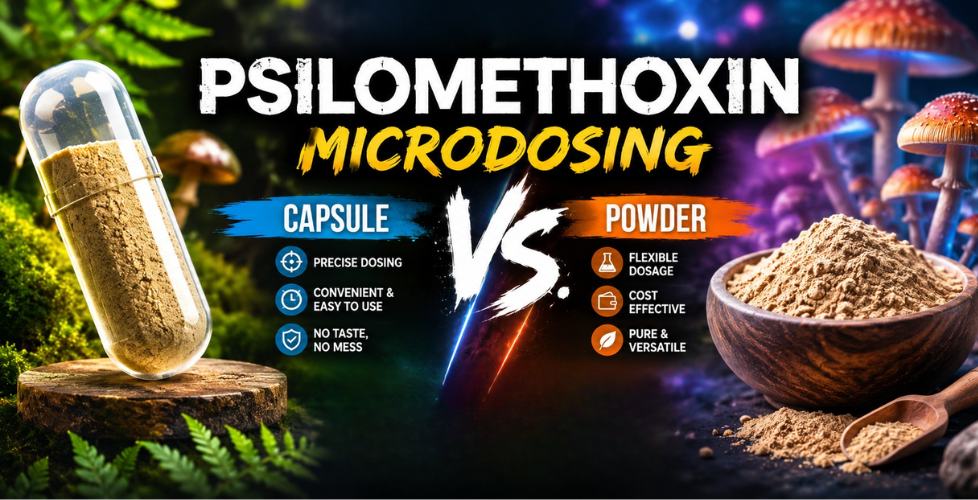
Microdosing — taking sub-perceptual or low-perceptual doses of an entheogenic compound on a regular schedule — has become a major lens through which many users approach Psilomethoxin. Understanding how each form serves a microdosing practice is essential.
Microdosing with Capsules
Capsules are arguably the gold standard for structured microdosing protocols. Their pre-measured doses remove daily cognitive load — you don’t need to think, weigh, or calculate. For protocols that involve consistent dosing on a schedule (every day, every other day, or a specific pattern), capsules make it easy to maintain discipline and track your usage accurately.
The key limitation for microdosing with capsules arises when the standard capsule dose doesn’t align with your personal sweet spot. Many experienced microdosers find they prefer a dose that’s slightly above or below the pre-measured capsule amount. In this case, either you work with the capsule dose and adjust expectations, or you switch to powder for the precision it provides.
Microdosing with Powder
For sophisticated microdosing practices — particularly those involving gradual titration, dose-finding experiments, or integration into a Fadiman, Stamets, or custom protocol — powder is the more flexible tool. You can start at a very low threshold dose and increase in precise increments until you identify your optimal range.
Powder-based microdosing does require investment in a good milligram-accurate scale (typically 0.001g resolution is needed for compound doses in the milligram range). This is a one-time cost that pays dividends across an entire microdosing practice.
Microdosing recommendation: Start with capsules to establish a baseline response and build comfort with the compound. Once you understand your sensitivity and have a target dose range in mind, transition to powder if you need to fine-tune your dose with greater precision.
Storage & Shelf Life
How you store Psilomethoxin affects its longevity and potency over time. Both forms benefit from cool, dark, dry storage — but they have different sensitivities.
Capsules are more forgiving in storage because the shell physically protects the compound from ambient humidity and light. Stored in an airtight container away from heat and direct sunlight, properly packaged capsules can maintain potency for a longer period. They’re also easier to store cleanly — no risk of spills, clumping, or powder migration.
Powder is more sensitive to environmental exposure. Humidity can cause clumping and may accelerate degradation if the container isn’t properly sealed. Powder should always be stored in an airtight, moisture-resistant container with desiccant packets if you’re in a humid climate.
Key storage principles for both forms:
- Store away from heat sources (above 25°C / 77°F accelerates degradation)
- Keep out of direct sunlight — UV light can break down tryptamine compounds over time
- Refrigeration is optional but beneficial for long-term storage of powder
- Never store in a bathroom medicine cabinet — humidity from showers is harmful
- Label your container with the date of first opening and dose per unit
Read More: Medicine Conclave: Psilomethoxin, Music & Dancing
Psilomethoxin Capsule vs. Powder
| Factor | Capsules | Powder |
| Onset Speed | Moderate (+15–30 min) | Slightly faster |
| Bioavailability | Comparable | Comparable |
| Dosage Accuracy | High — pre-measured | Highest — fully custom |
| Dosage Flexibility | Limited | Fully flexible |
| Taste | None | Earthy, bitter |
| Convenience | Excellent — no prep | Moderate — prep required |
| Travel Friendly | High — discreet | Moderate — spill risk |
| Stackability | Limited | Excellent |
| Storage | Low sensitivity | Moisture & light sensitive |
| Ritual Feel | Simple | Ceremonial |
| Best For | Beginners, daily use, travel | Advanced users, custom dosing |
| Equipment Needed | None | Milligram scale |
Best Use Cases for Each Form
Capsules Are Ideal When…
- You’re new to Psilomethoxin and want simplicity
- You’re running a structured daily protocol
- You travel frequently or have an unpredictable schedule
- Taste is a consistent barrier to compliance
- You want consistent, reproducible results without variables
- You prefer to minimize ritual and maximize ease
Powder Is Ideal When…
- You’re experimenting with precise dose titration
- You want to build a personal supplement stack
- You incorporate the preparation as a mindful ritual
- You’ve identified your optimal dose window and it differs from capsule increments
- You prefer dissolving your dose in a ceremonial tea or tonic
- You want to split doses throughout the day
Recommendations by Experience Level
New to Psilomethoxin
If you’re just beginning your relationship with Psilomethoxin, capsules are the recommended starting point. They eliminate the variables of measuring and preparation, allowing you to focus entirely on observing how the compound affects you at a standard dose. This clean data — how do I feel? what changed? what didn’t? — is invaluable before you start adjusting dosage parameters.
Begin with the manufacturer’s suggested serving size for at least two to four weeks before considering dose adjustments. Keep a simple journal noting your daily state before and after taking the sacrament. This baseline gives you something meaningful to compare against as you progress.
Intermediate Users (2–6 Months of Experience)
After several weeks of consistent capsule use, you’ll have a clear sense of whether the standard dose feels too subtle, well-calibrated, or too strong for your system. If you find yourself wanting to adjust, this is the natural moment to explore powder — or to experiment with splitting capsule doses (taking half in the morning, half in the afternoon).
Intermediate users often benefit most from intentional experimentation: try powder for 30 days, track the difference, and make an informed decision about which form best serves your practice going forward.
Advanced Users
Experienced practitioners who have developed a nuanced understanding of their personal dose response, explored different scheduling approaches, and are experimenting with stacking protocols will typically gravitate toward powder for the control it affords. At this stage, the extra preparation is less of a burden and more of a valued ritual — a deliberate act of setting intention before engaging with the sacrament.
Safety Considerations
Regardless of which form you choose, the same fundamental safety principles apply. A few core guidelines worth reinforcing:
- Start low, go slow. Whether using capsules or powder, your first several sessions should be at or below the suggested starting dose. Your individual sensitivity to tryptamine compounds cannot be predicted from prior psychedelic experience alone.
- Avoid combining with contraindicated substances. Psilomethoxin, like other serotonergic compounds, should not be combined with SSRIs, MAOIs, lithium, or tramadol without careful medical supervision.
- Set and setting still matter. Even at microdose levels, the context in which you take Psilomethoxin shapes your experience. Approach each session with intention and in an environment where you feel safe and supported.
- Track your doses. Whether using capsules or powder, maintain a record of what you took, when, and what you noticed. This data protects you and helps you optimize your practice intelligently.
- Don’t self-prescribe for clinical conditions. Psilomethoxin is not an approved medical treatment for any condition. If you’re exploring it in the context of mental health challenges, do so with professional guidance.
Buying Considerations
Psilomethoxin is available exclusively through the Church of the Sacred Synthesis as a religious sacrament, accessible to church members. This is not a supplement you’ll find on a commercial shelf — and that’s by design. The membership model ensures that everyone who accesses the compound does so within an educational and community support framework.
When deciding between capsule and powder forms at the point of purchase, ask yourself:
- Do I have a milligram-accurate scale, or am I willing to invest in one? (If no, start with capsules.)
- Is my schedule consistent enough that I can commit to daily preparation, or do I need something grab-and-go?
- Am I planning to stack Psilomethoxin with other supplements? (Powder is more stackable.)
- Do I want to participate in a structured group protocol where consistent dosing is emphasized?
- Is this for home-based ceremonial use or integration into a general wellness routine?
There’s no wrong answer here. Many members start with capsules and add powder to their practice later as their experience and curiosity deepen. Others — particularly those with prior microdosing experience — go straight to powder because they already have the tools and mindset for custom dosing.
Read More: Neuroplasticity: Rewiring the Soul with Psilomethoxin
Frequently Asked Questions
Q1. What is Psilomethoxin?
Psilomethoxin is a novel entheogenic compound created by introducing 5-MeO-DMT during the cultivation of psilocybin mushrooms — producing a unique molecule distinct from either parent compound. It is used as a religious sacrament by the Church of the Sacred Synthesis for consciousness exploration, emotional well-being, and spiritual growth.
Q2. Is Psilomethoxin better in capsule or powder form?
Neither form is objectively better — capsules offer convenience, consistency, and no taste, while powder offers flexibility, faster onset, and easy stackability. Your lifestyle, experience level, and dosing goals determine which form serves you best.
Q3. Which Psilomethoxin form absorbs faster?
Powder dissolved in liquid absorbs slightly faster because it skips the capsule shell dissolution step, reducing onset by roughly 15–30 minutes. For most users this difference is minor, but it matters for those sensitive to timing.
Q4. Is Psilomethoxin powder more potent than capsules?
No — potency is determined by the dose and the compound itself, not the delivery form. At equivalent doses both forms are equally potent; powder may simply feel more immediate due to its slightly faster onset.
Q5. Can I stack Psilomethoxin powder with other supplements?
Yes — powder dissolves easily alongside Lion’s Mane, niacin, adaptogens, or other powdered supplements in a single drink. This stackability is one of powder’s strongest practical advantages over capsules.
Ready to Go Deeper?
Choosing between capsule and powder is just the beginning of your relationship with Psilomethoxin. The most transformative outcomes tend to emerge not from the form factor but from the consistency of practice, the quality of intention, and the support you surround yourself with.
If you’re ready to move from curiosity to committed practice, the Sacred Synthesis offers several pathways to deepen your engagement. The 30-Day Group Protocol is one of the most powerful entry points available — a structured, community-guided experience in which participants follow a shared protocol together, share insights, and receive integration support throughout. It removes the guesswork from building a practice and replaces it with accountability, shared wisdom, and a genuine sense of collective journey.
For those looking to explore the full breadth of what the Sacred Synthesis offers — including complementary sacraments and curated combinations — The Sacred Bundle provides a thoughtfully assembled constellation of sacraments designed to work synergistically, guiding members toward deeper coherence, emotional liberation, and transformational clarity.
And perhaps most importantly: you don’t have to navigate any of this alone. Our community on Skool brings together members from across the world who are walking the same path — sharing experiences, asking questions, celebrating breakthroughs, and offering the kind of peer wisdom that no amount of research can fully replicate. Whatever form of Psilomethoxin you choose, the community walks with you.
Disclaimer: This article is for educational and informational purposes only. Psilomethoxin is provided exclusively as a religious sacrament through the Church of the Sacred Synthesis to its members. Nothing in this article constitutes medical advice. Consult your physician before beginning any new supplement or sacramental practice, especially if you take medications or have pre-existing health conditions.