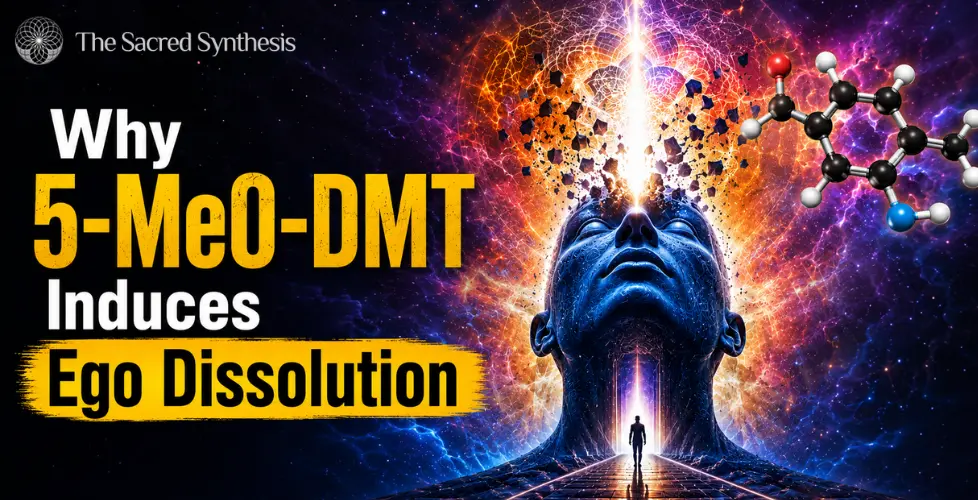
Imagine your sense of self — every memory, preference, worry, and identity — dissolving completely within minutes. No gradual unraveling. No slow fade. Just a sudden, total disappearance of the boundary between “you” and everything else.
This is ego dissolution, and among all known psychedelic compounds, 5-MeO-DMT is widely regarded as its most rapid and complete trigger. People who have undergone psilocybin ceremonies, LSD experiences, or traditional ayahuasca rituals often describe a gradual softening of the self. Those who encounter 5-MeO-DMT frequently describe something categorically different: an instantaneous collapse of personal identity into what many call pure, undivided awareness.
Why does this happen? What is it about this molecule that allows it to accomplish in seconds what other psychedelics take hours to approach? And what does modern neuroscience, pharmacology, and consciousness research tell us about the mechanisms involved?
This article takes a deep, evidence-based look at ego dissolution — what it is, how it works in the brain, and why 5-MeO-DMT occupies a unique position among psychedelic compounds. Whether you’re a curious reader, a researcher, or someone exploring the science of consciousness, you’ll find a thorough, honest, and scientifically grounded explanation here.
Important Disclaimer: This article is educational in nature and does not constitute medical advice. 5-MeO-DMT is a controlled substance in many jurisdictions. Nothing in this article should be interpreted as an endorsement of illegal activity or self-medication. Always consult qualified healthcare professionals for mental health support.
Key Takeaways
- Ego dissolution is the temporary reduction or disappearance of the sense of being a separate self.
- 5-MeO-DMT produces this effect faster than psilocybin, LSD, DMT, or mescaline, often within 1–5 minutes.
- The speed relates to its potent 5-HT2A receptor agonism, rapid brain penetration, and profound suppression of the Default Mode Network (DMN).
- Unlike classic psychedelics, 5-MeO-DMT appears to induce nondual consciousness — a state with minimal perceptual content and maximum dissolution of self.
- Current research suggests potential therapeutic applications, especially for treatment-resistant depression, anxiety, and existential distress.
- Significant risks exist, including psychological crisis and physiological effects, particularly when combined with other substances.
What Is Ego Dissolution?
Ego dissolution is a temporary alteration in self-perception in which the usual sense of being a separate individual becomes significantly reduced or disappears entirely. It is a core feature of profound mystical and psychedelic experiences, and is associated with a temporary collapse of the brain networks responsible for maintaining the narrative self.
The term “ego,” in both psychological and everyday usage, refers to the sense of being a distinct person — a continuous “I” with memories, opinions, a body, and a place in the world. This sense of individuality is not a fixed feature of consciousness but rather something the brain actively constructs moment by moment.
Ego dissolution refers to the breakdown of this construction. The boundaries between self and world become permeable, then vanish. The inner narrator goes quiet. The feeling of being a “someone” looking out at the world dissolves. What remains — according to consistent accounts across cultures and centuries — is a sense of pure, unbounded awareness: present, open, undivided.
This is not the same as losing consciousness. People experiencing ego dissolution often remain alert, responsive, and even highly functional. They are simply no longer experiencing themselves as a separate entity doing the experiencing.
Researchers measure ego dissolution using validated instruments such as the Ego Dissolution Inventory (EDI) and the Five Dimensions of Altered States of Consciousness (5D-ASC) scale. These tools allow scientists to quantify and compare the depth of self-transcendence across different substances and conditions.
Read More: Psilomethoxin Capsule vs. Powder: Which Form Is Right for You?
The Neuroscience Behind Ego Dissolution
The Default Mode Network: The Brain’s “Self Machine”
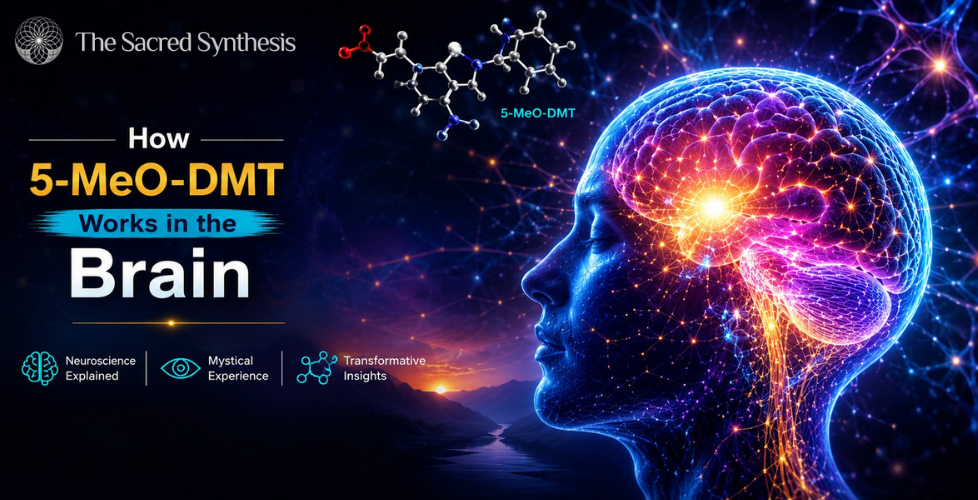
The Default Mode Network (DMN) is a collection of brain regions — including the medial prefrontal cortex, posterior cingulate cortex, and the angular gyrus — that work together to create and sustain the sense of self. The DMN is most active when you are daydreaming, reflecting on yourself, thinking about others, or imagining the future. It is, in a sense, the brain’s self-referential processing hub.
Landmark research by Robin Carhart-Harris and colleagues at Imperial College London demonstrated that psychedelics reliably and dramatically suppress DMN activity. The more the DMN is suppressed, the more profound the feeling of ego dissolution. This finding has been replicated with psilocybin, LSD, and ayahuasca.
What is distinctive about 5-MeO-DMT is the depth, speed, and completeness of this suppression. Preliminary neuroimaging data and theoretical models suggest that 5-MeO-DMT may produce the most comprehensive DMN disruption of any currently studied psychedelic compound.
Brain Entropy and the Dissolution of Ordinary Consciousness
Carhart-Harris’s Entropic Brain Hypothesis proposes that psychedelics increase the entropy — or informational disorder — of brain activity. This disrupts the rigid, hierarchical patterns of ordinary consciousness and temporarily allows the brain to explore a much wider range of states.
In everyday consciousness, the DMN constrains this entropy, holding the self in a relatively stable configuration. When 5-MeO-DMT disrupts this constraint dramatically and rapidly, the result is not just a loosening of identity — it is a complete reorganization of conscious experience into what researchers increasingly call a “nondual” state.
How 5-MeO-DMT Works in the Brain
Pharmacology: A Molecule Built for Speed
5-MeO-DMT (5-methoxy-N,N-dimethyltryptamine) is a naturally occurring tryptamine found in the venom of the Bufo alvarius toad and in various plants. Its chemical structure is closely related to DMT (N,N-dimethyltryptamine), with a critical difference: the addition of a methoxy group at the 5-position of the indole ring.
This seemingly small structural change has profound pharmacological consequences.
Key pharmacological features of 5-MeO-DMT:
- High affinity for 5-HT2A receptors: These serotonin receptors are the primary target responsible for psychedelic effects. 5-MeO-DMT binds to them with exceptional potency.
- Sigma-1 receptor activity: 5-MeO-DMT also interacts with sigma-1 receptors, which are involved in neuroplasticity, neuroprotection, and the modulation of several neurotransmitter systems.
- Rapid brain penetration: The methoxy group increases the lipophilicity (fat-solubility) of the molecule, allowing it to cross the blood-brain barrier extremely quickly when inhaled.
- Short duration: Despite its intensity, the acute effects of inhaled 5-MeO-DMT typically resolve within 15–45 minutes, which contrasts with psilocybin (4–6 hours) and LSD (8–12 hours).
Serotonin Receptors: The Gateway to Ego Dissolution
All classic psychedelics — including psilocybin, LSD, and DMT — produce their effects primarily through agonism of the 5-HT2A serotonin receptor subtype. This receptor is highly expressed in the prefrontal cortex, the anterior cingulate cortex, and other regions associated with self-referential thought.
When 5-HT2A receptors are strongly activated, they disrupt the top-down predictions that the brain ordinarily uses to filter experience. The brain’s predictive coding framework — its constantly updated model of the world and of itself — becomes temporarily unreliable. The result is a radical opening of perception and, at high doses, the dissolution of the self-model altogether.
5-MeO-DMT achieves this activation with a combination of high potency and high speed that has no equivalent among commonly studied psychedelics.
Why 5-MeO-DMT Produces Rapid Ego Dissolution
Several factors converge to make 5-MeO-DMT uniquely fast in its induction of ego dissolution:
1. Pharmacokinetics: Instant Delivery When inhaled (the most common route in ceremonial contexts), 5-MeO-DMT reaches peak plasma concentrations within minutes. This rapid absorption means that a high concentration of the molecule reaches serotonin receptors in the brain almost simultaneously, producing an abrupt and massive pharmacological effect rather than the gradual build characteristic of orally-ingested compounds like psilocybin.
2. Extreme 5-HT2A Potency Milligram for milligram, 5-MeO-DMT is roughly 4–6 times more potent as a 5-HT2A agonist than DMT, and significantly more potent than psilocin (the active form of psilocybin). This means that even a small dose produces receptor activation levels sufficient to completely overwhelm ordinary self-processing.
3. Suppression of Sensory Elaboration Unlike other psychedelics that typically produce vivid visual hallucinations (indicating widespread cortical excitation), 5-MeO-DMT at typical doses suppresses visual processing rather than enhancing it. This suggests that its primary action is not spreading cortical excitation but rather specifically disrupting the networks responsible for self-modeling. The result is less “psychedelic” in the colorful, visual sense, and more like a direct deletion of the sense of self.
4. Global Synchronization Emerging theoretical work suggests that 5-MeO-DMT may produce a global synchronization of brainwave activity — a kind of unified electrical resonance across brain regions that ordinarily maintain separate processing streams. This synchronization is thought to underlie the characteristic sense of unity, boundlessness, and nondual awareness reported by users.
5. Minimal “Ramp-Up” Period Most psychedelics have a distinctive onset phase during which the person is aware that something is changing. With 5-MeO-DMT, users frequently report that there is no such ramp-up: the ordinary sense of self is present, and then — with the next breath or two — it simply is not.
Read More: How Psilocybin Works in the Brain: Serotonin Pathways Explained
Comparison with Other Psychedelics

5-MeO-DMT vs. Psilocybin
Psilocybin is the prodrug form of psilocin, found in so-called “magic mushrooms.” It is among the most thoroughly researched psychedelics, with robust evidence for therapeutic benefit in depression, anxiety, addiction, and existential distress from institutions including Johns Hopkins, NYU, and Imperial College London.
Psilocybin does produce ego dissolution, but typically at higher doses and after a gradual 1–2 hour onset. The experience tends to be rich with imagery, emotional content, autobiographical memories, and narrative meaning. The DMN is suppressed, but the suppression unfolds relatively slowly and is often partial until the peak dose range.
5-MeO-DMT produces ego dissolution far more rapidly and, according to many user reports and preliminary research, more completely. The experience tends to be less narrative and less visual — closer to what contemplative traditions describe as “pure awareness” or “emptiness.” Psilocybin experiences often feel like journeys with content; 5-MeO-DMT experiences are often described as a sudden arrival at the absence of all content.
An interesting development in the field is psilomethoxin, a related compound that combines structural elements of psilocybin and 5-MeO-DMT. Preliminary discussions in consciousness research circles suggest it may occupy an interesting middle ground pharmacologically, though rigorous clinical data is still limited.
5-MeO-DMT vs. LSD
LSD (lysergic acid diethylamide) is the longest-acting major psychedelic, with effects lasting 8–12 hours. It has high affinity for an unusually broad range of receptor subtypes beyond 5-HT2A, including dopamine and adrenergic receptors, which contributes to its energetic, intellectually stimulating, and often complex quality.
LSD certainly can produce ego dissolution at sufficient doses, but its breadth of receptor activity means the experience tends to retain more self-referential content — more “you” observing and processing the experience — compared to 5-MeO-DMT. The duration also means users have significant time to move in and out of dissolution, rather than experiencing a single complete immersion.
5-MeO-DMT vs. DMT
DMT (N,N-dimethyltryptamine) is chemically very close to 5-MeO-DMT and also produces rapid, intense effects when inhaled. However, the phenomenology is markedly different. DMT experiences are characteristically filled with extremely vivid and complex visual hallucinations, often described as geometric, architectural, or populated with perceived entities.
This wealth of perceptual content suggests that DMT activates widespread cortical areas, generating visual experience rather than suppressing it. Ego dissolution can occur with DMT, but it tends to coexist with rich experiential content rather than replacing it. Users often still feel like a “witness” to the DMT experience, even when the ordinary self is significantly destabilized.
5-MeO-DMT, by contrast, tends to eliminate both the content and the witness. This is why its dissolution is often described as more complete.
5-MeO-DMT vs. Mescaline
Mescaline (found in peyote and San Pedro cacti) produces a long-duration experience (8–14 hours) that is colorful, richly sensory, and deeply connected to emotions and the natural world. It is among the least likely of major psychedelics to produce complete ego dissolution, though profound states of expanded awareness are certainly possible at high doses.
Its primary mechanism is also 5-HT2A agonism, but it is far less potent on a per-milligram basis and has different secondary receptor profiles. The gradual onset and long duration mean the self has considerable time to adapt and maintain partial coherence throughout the experience.
Comparison Table: Psychedelics and Ego Dissolution
| Compound | Onset | Duration | Ego Dissolution | Visual Content | Primary Mechanism |
| 5-MeO-DMT | 1–5 min (inhaled) | 15–45 min | Very high, very fast | Minimal | 5-HT2A, Sigma-1 |
| DMT (N,N) | 1–3 min (inhaled) | 15–30 min | Moderate–high | Very high | 5-HT2A |
| Psilocybin | 20–60 min (oral) | 4–6 hrs | Moderate–high (dose-dep.) | Moderate | 5-HT2A (via psilocin) |
| LSD | 30–60 min (oral) | 8–12 hrs | Moderate (dose-dep.) | High | 5-HT2A + broad |
| Mescaline | 60–120 min (oral) | 8–14 hrs | Low–moderate | High | 5-HT2A + broad |
Mystical-Type Experiences and Nondual Consciousness
What Is a Mystical Experience?
The term “mystical experience” has a specific operational meaning in psychedelic research, defined by the Mystical Experience Questionnaire (MEQ) developed by Walter Pahnke and later revised by William Richards and colleagues. The MEQ identifies a cluster of features that reliably appear across cultures, religions, and psychedelic contexts:
- A sense of unity (oneness with everything)
- Noetic quality (a feeling of having encountered profound truth)
- Sacredness
- Deeply felt positive mood
- Transcendence of time and space
- Ineffability (difficulty describing the experience)
- Paradoxicality (experiencing things that seem contradictory yet both true)
Ego dissolution is the foundation of nearly all of these features. Once the sense of being a separate self dissolves, unity, timelessness, and sacredness emerge naturally because they are what remains when division is removed.
Nondual Consciousness: A Scientific Concept
“Nondual consciousness” is a term from contemplative philosophy — particularly Advaita Vedanta, Tibetan Buddhism, and Dzogchen — that refers to an awareness that is not divided into subject and object. In ordinary experience, there is always a perceiver and a perceived. In nondual experience, this division itself disappears.
Researchers are increasingly taking this concept seriously. Judson Brewer, Zoran Josipovic, and others have studied nondual awareness in meditators and explored its neural correlates. The characteristics that appear in meditators with decades of practice — including suppression of DMN self-referential processing, increased global coherence, and decreased attachment to narrative identity — appear to be induced, rapidly and reliably, by 5-MeO-DMT.
This is not to say that drug-induced and meditation-induced states are identical. Decades of contemplative practice cultivate a stable orientation toward nondual awareness. 5-MeO-DMT appears to impose a temporary version of this state pharmacologically, without the gradual development of equanimity and integration that traditional practice provides.
Read More: The Neuroscience Behind Psilomethoxin vs 5-MeO-DMT
Subjective Reports and the Phenomenology of 5-MeO-DMT
Because controlled clinical studies of 5-MeO-DMT are still limited, survey research and ethnographic accounts provide important phenomenological data.
Research published by Malin Uthaug and colleagues (2019) conducted a naturalistic prospective study on participants who used 5-MeO-DMT in ceremonial settings. Key findings included significant reductions in depression and anxiety ratings that persisted at 4-week follow-up, alongside high ratings on mystical experience scales.
Separate survey research published in journals including PLOS ONE and Frontiers in Psychiatry has found that 5-MeO-DMT consistently produces among the highest rates of complete ego dissolution of any psychedelic, along with some of the highest rates of what participants classify as the “most meaningful or spiritually significant experience of my life.”
Common subjective features reported include:
- A sudden, complete dissolution of personal identity
- Merging with or becoming “everything”
- Cessation of mental chatter and narrative thought
- Profound peace, bliss, or overwhelming emotion
- Complete loss of sense of body and physical surroundings
- Return of ordinary identity, sometimes gradually, sometimes abruptly
It is important to note that not all reports are positive. Challenging experiences — including intense fear, confusion, and a sense of annihilation — are also documented, and the integration of such experiences requires appropriate support.
Current Scientific Research
Despite its profound effects, 5-MeO-DMT remains one of the least clinically studied major psychedelics, largely due to legal restrictions in many countries where it is scheduled alongside other controlled substances.
Notable research developments:
- A 2019 study by Uthaug et al. in Psychopharmacology documented significant reductions in depression, anxiety, and mindfulness improvements following ceremonial 5-MeO-DMT use, persisting for at least four weeks.
- Research by Alan Davis and colleagues at Johns Hopkins has examined the psychological effects of 5-MeO-DMT in retrospective and prospective survey designs, finding high rates of mystical experience and psychological benefit alongside some reports of challenging outcomes.
- Octavio Rettig and colleagues have published case series data from ceremonial Bufo alvarius sessions in Mexico, though these lack the rigorous controls of clinical trials.
- Ongoing work at institutions including Johns Hopkins, Maastricht University, and several European centers is beginning to formalize clinical protocols for 5-MeO-DMT research.
- Synthetic 5-MeO-DMT is increasingly the focus of commercial drug development, with several biotech companies pursuing regulatory pathways for treatment-resistant depression and PTSD indications.
The field is in early stages, and many fundamental questions about mechanisms, optimal protocols, and long-term effects remain open.
Potential Therapeutic Implications
Why Ego Dissolution May Be Therapeutically Valuable
One of the more counterintuitive findings in psychedelic research is that the depth of mystical experience — specifically including ego dissolution — appears to predict therapeutic outcomes. Studies of psilocybin for depression and addiction, and MDMA for PTSD, have found that the magnitude of mystical-type experience during the session correlates with long-term benefit.
The theoretical explanation varies by researcher, but common threads include:
- Interruption of rumination: The hyperactive self-referential processing associated with depression and anxiety is, at least temporarily, suspended.
- Perspective shift: Even a brief experience of radical selflessness can permanently alter a person’s relationship to their thoughts, fears, and sense of identity.
- Neuroplasticity: There is growing evidence that psychedelics, including 5-MeO-DMT, promote synaptic plasticity and BDNF (brain-derived neurotrophic factor) expression, potentially facilitating the formation of new cognitive and emotional patterns.
- Catharsis and acceptance: Many people report that the experience of ego dissolution allows them to confront material — grief, trauma, existential fear — from a place of spacious, non-identified awareness.
Conditions Being Investigated
Based on available survey data and early clinical work, 5-MeO-DMT is being investigated for relevance to:
- Treatment-resistant depression
- End-of-life anxiety and existential distress
- Post-traumatic stress disorder (PTSD)
- Addiction and substance use disorders
- General wellbeing and personal growth
These are preliminary areas of investigation. None represent established clinical treatments, and 5-MeO-DMT should not be self-administered for therapeutic purposes without appropriate medical oversight.
Risks, Limitations, and Unknowns
Honest discussion of 5-MeO-DMT must include a thorough account of its risks.
Psychological risks:
- Acute psychological crisis, including severe terror and panic
- Challenging or traumatic experiences requiring professional integration support
- Precipitating or exacerbating underlying psychological vulnerabilities, including psychosis risk in predisposed individuals
- Post-experience confusion, depersonalization, or derealization that may persist
Physiological risks:
- Cardiovascular strain, particularly relevant for individuals with heart conditions
- Dangerous interactions with serotonergic medications (including SSRIs, SNRIs, MAOIs, and lithium), potentially leading to serotonin syndrome — a life-threatening condition
- Rare reports of seizure-like activity
- Risk associated with the Bufo alvarius toad venom context, including exposure to additional compounds (bufotenin, bufadienolides with cardiac effects)
Setting and contextual risks:
- Physical safety risks when practiced without appropriate supervision (falling, aspiration)
- Exploitation by unqualified facilitators operating outside ethical frameworks
- Absence of medical screening and informed consent in informal settings
Unknowns:
- Long-term neurological effects remain unstudied
- Optimal dose, frequency, and population selection criteria are undefined
- The interaction between 5-MeO-DMT and specific psychiatric conditions requires far more research
Ethical and Scientific Considerations
The Question of Indigenous Knowledge and Intellectual Property
5-MeO-DMT has been used in traditional shamanic and ceremonial contexts, particularly in the Sonoran Desert region, for generations. As commercial and clinical interest grows, questions of benefit-sharing, cultural respect, and intellectual property are significant and unresolved within the field.
The Role of Set and Setting
Research consistently shows that the psychological and environmental context — “set and setting” in the language of psychedelic science — profoundly influences outcomes. The speed and intensity of 5-MeO-DMT make appropriate preparation, supportive environment, and qualified facilitation especially critical compared to slower-acting compounds.
Integrating the Experience
The therapeutic and personal-growth potential of ego dissolution experiences appears to depend significantly on integration — the process of making meaning from the experience in the days, weeks, and months following. Abrupt, unprepared encounters with complete ego dissolution, without subsequent integration support, may cause harm rather than healing.
Myth vs. Fact
| Myth | Fact |
| Ego dissolution means losing your mind permanently | Ego dissolution is temporary; ordinary identity reliably returns after the session |
| 5-MeO-DMT is just a stronger version of DMT | They are pharmacologically and phenomenologically distinct; 5-MeO-DMT has different receptor profiles and characteristically less visual content |
| Anyone can safely take 5-MeO-DMT | Significant contraindications exist, including cardiovascular conditions and serotonergic medications |
| Ego dissolution is always positive and healing | Challenging experiences are well-documented and can require professional support |
| The science fully explains 5-MeO-DMT’s effects | Consciousness science and psychedelic pharmacology are still in early stages; many mechanisms remain hypothetical |
| 5-MeO-DMT is legal everywhere | It is a scheduled substance in many countries and jurisdictions |
Expert Insights
The scientific study of 5-MeO-DMT and ego dissolution sits at the intersection of neuroscience, pharmacology, and the philosophy of consciousness. Prominent researchers have offered perspectives that help frame current understanding.
Robin Carhart-Harris, whose work on the entropic brain and DMN suppression underlies much of the current neuroscientific framework, has noted that the most complete states of ego dissolution — which 5-MeO-DMT appears uniquely able to produce rapidly — may represent the brain operating with maximum informational entropy, temporarily freed from the constraints of the ordinary self-model.
Alan Davis and colleagues at Johns Hopkins have emphasized that while the therapeutic signals from 5-MeO-DMT survey data are encouraging, the rigorous clinical infrastructure required for safe therapeutic use — screening, preparation, support, and integration — must be developed before widespread application is appropriate.
Researchers studying nondual consciousness, including Judson Brewer, have noted the conceptual convergence between 5-MeO-DMT-induced states and the advanced contemplative states described in Buddhist and Vedantic traditions, raising interesting questions about the nature of awakening and whether its neuroscientific basis can be pharmacologically accessed.
Research Highlights
- Uthaug et al. (2019): Naturalistic study showing significant reductions in depression and anxiety following ceremonial 5-MeO-DMT, persisting at 4-week follow-up (Psychopharmacology).
- Davis et al. (2018–2022): Survey research documenting high rates of mystical experience, ego dissolution, and psychologically transformative outcomes with 5-MeO-DMT (Johns Hopkins University).
- Carhart-Harris et al. (multiple): Foundational neuroimaging work demonstrating DMN suppression as the neural correlate of ego dissolution across psychedelic compounds (Imperial College London).
- Sepeda et al. (2020): Examination of challenging experiences following 5-MeO-DMT, providing important counterweight to purely positive accounts.
- Reckweg et al. (2021): First double-blind, placebo-controlled pilot study of synthetic 5-MeO-DMT (TOAD), published in Neuropsychopharmacology, documenting dose-dependent acute effects and safety profile.
Read More: Low vs. High Dose 5-MeO-DMT Ceremonies: A Sacred Practitioner’s Guide to Choosing Your Path
Frequently Asked Question
Q1. What is ego dissolution?
Ego dissolution is a temporary state where the ordinary sense of being a distinct individual becomes significantly reduced or disappears entirely. It occurs when psychedelics suppress the brain’s Default Mode Network, the system responsible for generating self-referential thought.
Q2. Why does 5-MeO-DMT cause ego dissolution faster than other psychedelics?
5-MeO-DMT binds with exceptional potency to 5-HT2A serotonin receptors and reaches the brain within minutes when inhaled, producing near-instant Default Mode Network suppression. No other commonly studied psychedelic delivers this combination of speed and intensity simultaneously.
Q3. Is ego dissolution the same as ego death?
Ego dissolution is the scientific term, emphasizing the experience is temporary and the sense of self reliably returns. Ego death is a colloquial phrase implying permanence or irreversibility, which current research does not support.
Q4. What role does the Default Mode Network play in ego dissolution?
The Default Mode Network continuously generates the brain’s narrative sense of “I” through self-referential processing. When psychedelics suppress it, that narrative dissolves — and 5-MeO-DMT does this more completely and immediately than any other currently studied compound.
Q5. Is ego dissolution permanent?
No — the experience is temporary, with ordinary self-awareness returning within 30–60 minutes as 5-MeO-DMT clears the brain. Lasting shifts in perspective are commonly reported, but the dissolution itself is a transient pharmacological state.
Q6. Can ego dissolution be therapeutic?
Research consistently shows that depth of ego dissolution predicts positive therapeutic outcomes for depression, anxiety, and addiction. Early 5-MeO-DMT data reflects similar promise, though benefit depends heavily on preparation, setting, and integration support.
Q7. Is there scientific evidence supporting the therapeutic effects of 5-MeO-DMT?
Yes, preliminarily — Uthaug et al. (2019) and multiple Davis et al. publications at Johns Hopkins document meaningful reductions in depression and anxiety persisting at four-week follow-up. The evidence remains early-stage and no clinical use is currently approved.
Conclusion
5-MeO-DMT stands apart from every other studied psychedelic through its unique combination of extreme 5-HT2A potency, rapid brain penetration, and immediate Default Mode Network suppression — producing complete ego dissolution within minutes rather than hours. The experiences it occasions are, by many accounts, among the most profound consciousness can undergo, carrying genuine potential for understanding the mind and treating psychological suffering.
Yet its intensity demands equal respect. The same qualities that make it remarkable make careful preparation, qualified facilitation, and proper integration non-negotiable rather than optional. As psychedelic neuroscience continues to mature, 5-MeO-DMT will remain one of its most compelling and instructive subjects — a single molecule capable of temporarily dissolving the self, and in doing so, revealing something fundamental about the brain that generates it.