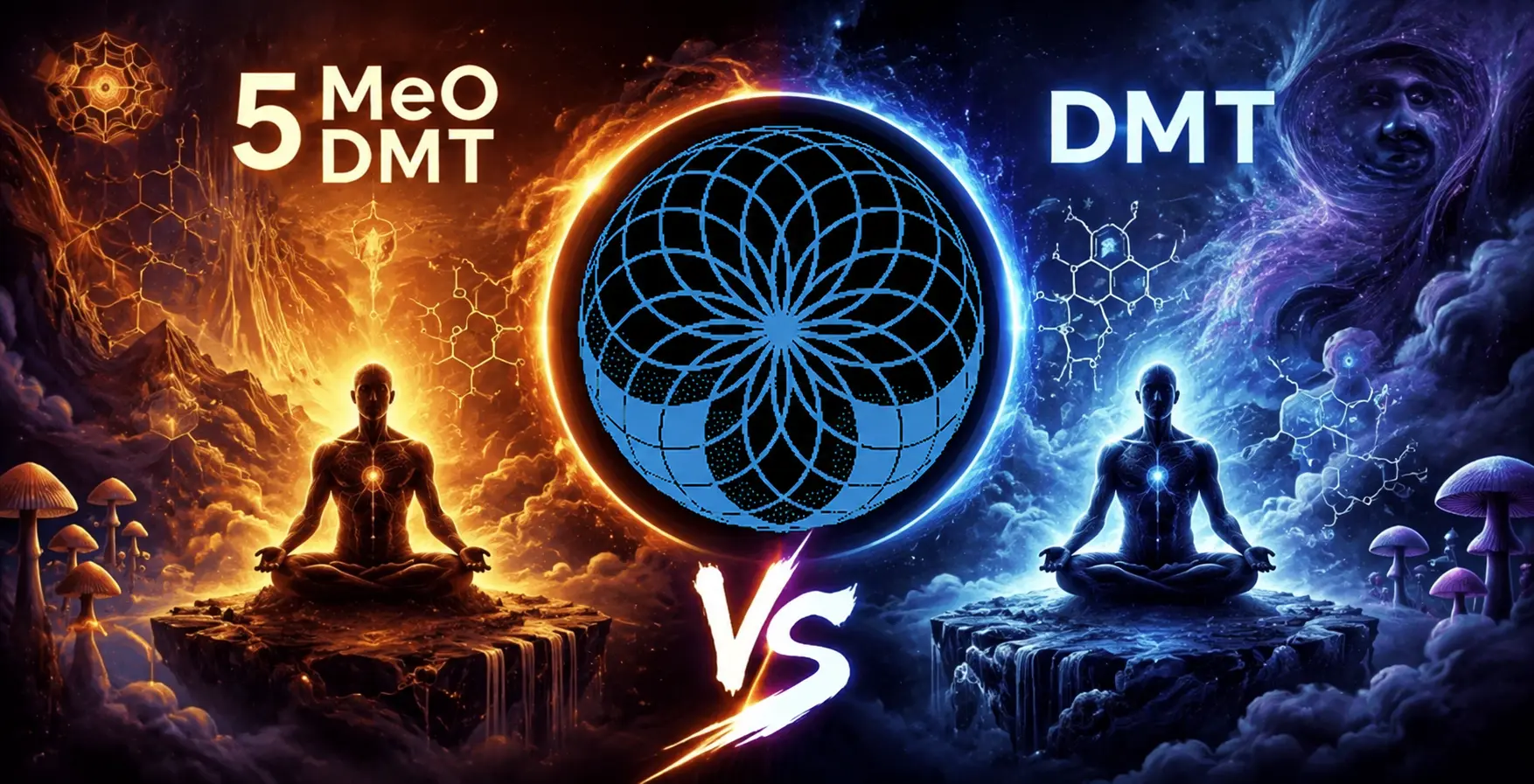
They share a name. They’re both tryptamines. They both produce experiences described as among the most profound a human being can have. And yet, if you put 5 MeO DMT vs DMT side by side and truly understand what each one does — to the body, the brain, and the depths of the self — you’ll quickly realize these are not the same medicine.
People ask about the difference between 5-MeO-DMT and DMT constantly, and understandably so. The naming convention makes them seem like close cousins, but in practice, the two compounds occupy entirely different territories of consciousness. One tends to be a vivid, visual journey outward. The other dissolves the very traveler making the journey.
Whether you’re approaching this topic from pure curiosity, a research perspective, or genuine spiritual inquiry, this guide will walk you through every meaningful distinction — grounded in science, honoring experience, and designed to give you a genuinely complete picture. And if you’ve encountered Psilomethoxin in your research — a newer biosynthetic compound that sits at the intersection of both molecules — this comparison will also help you understand exactly where it comes from and why it behaves the way it does.
What Is the Difference Between 5-MeO-DMT and DMT?
Quick Answer: DMT (N,N-Dimethyltryptamine) produces intense, visually rich psychedelic experiences lasting 5–20 minutes when inhaled, often featuring geometric patterns, otherworldly landscapes, and encounters with seeming entities. 5-MeO-DMT is structurally related but pharmacologically distinct, producing a non-visual, ego-dissolving experience of pure unity consciousness — often described as merging with existence itself — typically in under 30 minutes.
Quick Comparison
| Feature | DMT (N,N-DMT) | 5-MeO-DMT |
| Full Name | N,N-Dimethyltryptamine | 5-Methoxy-N,N-Dimethyltryptamine |
| Primary Sources | Plants (Mimosa hostilis, Psychotria viridis), human body | Colorado River toad venom (Bufo alvarius), plants, synthetic |
| Typical Dose (Inhaled) | 30–50 mg | 5–12 mg |
| Relative Potency | Baseline | 4–20× more potent by weight |
| Onset (Inhaled) | 15–30 seconds | 10–15 seconds |
| Duration | 5–20 minutes | 15–45 minutes |
| Visual Effects | Intense, complex, geometric | Minimal to absent |
| Ego Dissolution | Variable, dose-dependent | Frequent, even at moderate doses |
| Mystical Quality | Entity contact, alien environments | Non-dual unity, pure being |
| Primary Receptor Affinity | 5-HT2A (high affinity) | 5-HT1A (primary), 5-HT2A |
| Integration Challenges | Processing encounters, visuals, narratives | Processing formlessness, identity shift |
| Research Status | Growing clinical interest | Active clinical trials for depression, PTSD |
| Legal Status (US) | Schedule I federal controlled substance | Schedule I federal controlled substance |
Read More: What is Psychedelic Integration and Why Does It Matter?
What Is DMT?
DMT — or N,N-Dimethyltryptamine — is a naturally occurring tryptamine alkaloid found in hundreds of plant species and even in trace amounts in the human body. It belongs to the same chemical family as serotonin, and like serotonin, it interacts powerfully with the brain’s serotonin receptor system, particularly the 5-HT2A receptor.
Origins and Traditional Use
DMT has been used for centuries in indigenous Amazonian traditions, most famously in the form of ayahuasca — a ceremonial brew combining DMT-containing plants with a monoamine oxidase inhibitor (MAOI) that makes oral DMT active. When consumed as ayahuasca, the experience extends to four to six hours and has deep roots in healing, ceremony, and spiritual guidance across dozens of cultures.
In its purified, vaporized form, DMT produces a dramatically compressed version of this experience — sometimes called the “businessman’s trip” for its brief duration.
What Does a DMT Experience Feel Like?
The DMT experience is extraordinarily visual. Within seconds of inhalation, users report:
- Rapidly intensifying geometric patterns and fractals
- Tunneling or spinning visual phenomena that open into vast interior spaces
- Entry into apparently alternate dimensions or realities
- Encounters with “entities” — presences that feel intelligent, other, and often communicative
- Distorted sense of time, ranging from seconds to eternity
- Emotional responses ranging from awe and bliss to fear or confusion
The self typically remains recognizable during a DMT experience, even when dramatically altered. Most people can recall the sequence of events afterward, can interact mentally with what they encounter, and emerge with a distinct narrative — “I went somewhere, I saw something, I came back.”
DMT Duration
When inhaled, DMT’s effects peak within two to five minutes and generally resolve within 15 to 20 minutes. When consumed orally as ayahuasca, effects last four to six hours depending on preparation and individual metabolism.
What Does Research Say About DMT?
Psychedelic research on DMT is growing. Studies have documented its capacity to produce “complete mystical experiences,” shift subjective wellbeing, and potentially address treatment-resistant depression. The Imperial College London group, led by researchers including Robin Carhart-Harris, published foundational work on DMT’s neurological effects, including its role in altered brainwave states associated with dreaming and deep meditation.
What Is 5-MeO-DMT?
5-MeO-DMT — 5-Methoxy-N,N-Dimethyltryptamine — is a close structural relative of DMT with one significant addition: a methoxy group attached at the fifth position of the tryptamine molecule. That modest chemical change produces an experience that is, by most accounts, qualitatively unlike anything else.
Origins and Sources
5-MeO-DMT occurs in multiple plant species and is found in concentrated form in the venom of the Colorado River toad (Incilius alvarius, also called Bufo alvarius), a large toad native to the Sonoran Desert. Toad venom is dried and vaporized to release the compound. It can also be synthesized in laboratory settings, producing a chemically identical molecule — an important distinction both for consistency and for ethical reasons surrounding wildlife conservation.
Toad Venom vs. Synthetic 5-MeO-DMT
The toad venom and synthetic 5-MeO-DMT produce the same core compound, but toad-derived venom also contains additional alkaloids including bufotenine, which may contribute to some differences in subjective reports. Synthetic 5-MeO-DMT is increasingly favored by researchers and harm-reduction advocates for its purity, reproducibility, and the fact that it doesn’t require harvesting from wild toad populations.
A third pathway has also emerged: Psilomethoxin, a novel compound produced when 5-MeO-DMT is introduced during the biosynthetic growth of psilocybin mushrooms. The resulting molecule is chemically distinct from either parent compound, and many who work with it describe an experience that feels more gentle and integrative — bridging the visionary qualities associated with psilocybin and the non-dual depth characteristic of 5-MeO-DMT.
What Does a 5-MeO-DMT Experience Feel Like?
This is where the comparison with DMT becomes most striking. A 5-MeO-DMT experience is not primarily visual. It’s experiential in a way that goes beyond what most people can prepare for with language alone. Common descriptions include:
- Complete dissolution of the sense of personal identity (ego dissolution or “ego death”)
- Merging with a vast, undifferentiated field of being or consciousness
- Feeling of becoming “everything” rather than going anywhere
- Profound silence or “white light” quality — an absence of the constructed self
- Overwhelming feelings of love, unity, or what many describe as encountering the divine
- Temporary loss of body awareness and spatial orientation
Where DMT offers a journey, 5-MeO-DMT tends to dissolve the traveler. Many people describe it as the most intense experience of their lives — and many report immediate, lasting changes in how they relate to themselves and the world.
5-MeO-DMT Duration
Despite its intensity, 5-MeO-DMT is remarkably brief. When inhaled, the peak experience arrives in under a minute and typically resolves within 20–30 minutes. Total effects including afterglow may extend to 60–90 minutes. When administered via insufflation (nasal), onset is slower and total duration extends to 60–70 minutes.
What Does Research Say About 5-MeO-DMT?
5-MeO-DMT has attracted serious scientific attention. A landmark study published in Frontiers in Neuroscience found that administration of vaporized 5-MeO-DMT reliably produced complete mystical experiences in 75% of participants — comparable in intensity to high-dose psilocybin given in controlled laboratory settings.
Phase 1 and Phase 2 clinical trials have examined vaporized formulations for treatment-resistant depression. One Phase 2 trial found that 87.5% of patients in an individualized dosing regimen achieved remission (MADRS ≤ 10) by day 7. A 2024 Phase 1 study of intranasal 5-MeO-DMT (BPL-003) confirmed it was well tolerated up to 12 mg, with no serious adverse events, and that 60% of participants at the highest doses had “complete mystical experiences.”
Additional research has explored 5-MeO-DMT’s potential in PTSD, existential distress, and anxiety — areas where a brief but profound shift in self-perception may have lasting therapeutic benefit.
5 MeO DMT vs DMT: Key Differences
Intensity and Subjective Experience
The question “Is 5-MeO-DMT stronger than DMT?” is frequently asked — and the answer depends on what you mean by “stronger.”
By dose, 5-MeO-DMT is 4 to 20 times more potent than DMT by weight. A strong vaporized DMT experience typically requires 30–50 mg; a strong 5-MeO-DMT experience may occur at 5–12 mg.
By subjective intensity, they’re largely incomparable. DMT can be overwhelming, but most users retain a core sense of “I am here, experiencing this.” 5-MeO-DMT frequently removes that observer entirely. Many people describe 5-MeO-DMT as more psychologically challenging because there is no narrative anchor — no visual story to follow, no entities to engage with, just the raw disappearance and reappearance of self.
Visual Effects Comparison
This is one of the clearest distinctions between the two compounds.
DMT is famous for its visual richness. The “DMT visual” has become iconic: rapidly rotating geometric patterns, mandalas, machine elves, alien architectures, impossible colors, and fractal landscapes. The visual content can feel deeply meaningful and often carries symbolic weight.
5-MeO-DMT typically produces few to no complex visuals. What people commonly report is white light, colorless expansion, or simply the complete absence of visual processing as the experiential contents of the mind vanish entirely. The neurological reason is partially explained by receptor binding: DMT binds with higher affinity to the 5-HT2A receptor (responsible for complex visual hallucinations), while 5-MeO-DMT has four to ten times more potent affinity for the 5-HT1A receptor, which is more associated with emotional states and a sense of dissolution.
Ego Dissolution and Non-Dual Experiences

Ego dissolution — the temporary loss of the boundary between “self” and “other” — occurs with both compounds, but far more reliably with 5-MeO-DMT.
With DMT at high doses, ego dissolution can occur, but it’s typically embedded within a visual and experiential narrative. You may dissolve into the geometry or merge with an entity, but the dissolution tends to be contextual.
With 5-MeO-DMT, ego dissolution is the experience. Research using the Ego Dissolution Inventory (EDI) consistently shows higher scores for 5-MeO-DMT compared to other psychedelics at equivalent doses. The non-dual quality — a collapse of subject-object distinction into pure, undifferentiated awareness — is what many spiritual traditions have described as samadhi, moksha, or unity consciousness.
This makes 5-MeO-DMT particularly compelling from a contemplative and philosophical standpoint. It doesn’t present a vision of unity; for many, it delivers it directly.
Duration and Timeline
| Phase | DMT (Inhaled) | 5-MeO-DMT (Inhaled) |
| Onset | 15–30 seconds | 10–15 seconds |
| Peak | 2–5 minutes | 2–7 minutes |
| Total Duration | 10–20 minutes | 20–45 minutes |
| Afterglow | 1–2 hours | Up to 90 minutes |
Both compounds are remarkably brief relative to other psychedelics. Ayahuasca (oral DMT + MAOI) extends the DMT experience to 4–6 hours.
Read More: Ego Dissolution: Why 5-MeO-DMT Triggers It So Quickly
Safety Considerations
Both DMT and 5-MeO-DMT are potent psychoactive substances, and both carry real considerations for safety that deserve honest attention.
Shared Safety Principles
- Set and setting matter profoundly. Psychological preparation, intention, and environment shape the experience and its aftermath significantly.
- Serotonin syndrome risk exists when either compound is combined with MAOIs, SSRIs, or other serotonergic medications. This combination can be life-threatening and must be avoided.
- Cardiovascular effects. Both compounds temporarily elevate heart rate and blood pressure. People with cardiovascular conditions should approach with caution and medical consultation.
- Psychological readiness. Individuals with a personal or family history of psychosis, schizophrenia, or bipolar disorder face elevated risk of adverse reactions.
- Legal status. Both DMT and 5-MeO-DMT are classified as Schedule I controlled substances in the United States and are similarly restricted in most countries. The legal landscape is evolving, but this remains the current reality.
DMT-Specific Considerations
- Nausea is the most commonly reported side effect, particularly with oral (ayahuasca) administration
- The complex visual content can occasionally produce psychological distress or challenging content, especially for those with unprocessed trauma
- The narrative quality of DMT experiences can occasionally confuse symbolic content with literal reality, which warrants integration support
5-MeO-DMT-Specific Considerations
- Intensity of onset is extreme — for some people, the speed and completeness of ego dissolution is terrifying, especially without preparation
- Headache is a commonly reported side effect in clinical studies
- Re-emergence after the peak can involve confusion, disorientation, and emotional vulnerability
- Some individuals report a phenomenon called “re-activation” — spontaneous re-emerging of the experience in the hours or days following. This appears more common with toad-derived venom than with synthetic formulations
- The profound intensity means that appropriate preparation, trusted guidance, and post-experience support are considered especially important
What Current Research Says
The science on both compounds is advancing rapidly, driven by renewed interest in psychedelic-assisted therapy.
DMT has been studied for its neurological effects (including modulation of default mode network activity and brainwave states), its potential in treatment-resistant depression, and its capacity to produce lasting positive changes in psychological wellbeing. The Imperial College London group’s DMT research remains foundational.
5-MeO-DMT is progressing through formal clinical trials with impressive early results. The Frontiers study establishing its capacity to produce complete mystical experiences in 75% of participants laid the groundwork. Subsequent Phase 1 and Phase 2 work has confirmed safety profiles, dose-response relationships, and meaningful outcomes in depression. Research from Johns Hopkins and others has also documented sustained improvements in life satisfaction and reductions in anxiety following naturalistic 5-MeO-DMT use.
A 2023 Frontiers in Psychiatry longitudinal case study documented 5-MeO-DMT’s potential for PTSD, noting radical ego dissolution alongside significant symptom improvement.
Researchers have proposed that the profound mystical experiences occasioned by 5-MeO-DMT — particularly the ego-dissolution component — may be a primary mediator of its therapeutic effects, similar to findings in psilocybin research where “complete mystical experience” predicts positive outcomes.
Who Might Be Drawn to Each Experience?
This is not a prescriptive comparison — individual resonance varies enormously — but understanding the general character of each compound can help people approach their exploration more thoughtfully.
People drawn to DMT often describe an interest in the visionary, the symbolic, and the relational dimensions of consciousness exploration. DMT’s entity encounters and vivid landscapes resonate with those interested in shamanic traditions, artistic inspiration, or exploring the apparent depths of the imagination.
People drawn to 5-MeO-DMT often describe a longing to go beyond narrative — to touch something beyond form, image, and story. It tends to attract those interested in non-dual spiritual traditions, deep meditation, or a fundamental shift in their relationship to the constructed self. It’s also drawing significant attention for those seeking rapid, profound breakthroughs in areas like existential distress, grief, or persistent depression.
For those who feel uncertain about the full intensity of either compound, Psilomethoxin represents a different entry point. Because it blends the biosynthetic character of psilocybin mushrooms with 5-MeO-DMT, the resulting experience tends to be more gradual and grounded — making it appealing to those who want to explore non-dual states without the abrupt onset that characterizes pure 5-MeO-DMT.
Neither is “better.” They illuminate different facets of consciousness and serve different purposes.
5-MeO-DMT vs Psilomethoxin: A Closer Look
Because Psilomethoxin is formed through the biosynthesis of 5-MeO-DMT and psilocybin mushrooms, many people naturally wonder how the two compare. This is a question worth answering carefully — because while they share a chemical heritage, the experiences and practical considerations differ in meaningful ways.
Quick Comparison: 5 MeO DMT vs Psilomethoxin
| Feature | 5-MeO-DMT | Psilomethoxin |
| Origin | Colorado River toad venom, plants, synthetic | Biosynthetic — grown in psilocybin mushrooms fed 5-MeO-DMT |
| Chemical Class | Tryptamine (methoxylated) | Novel tryptamine (biosynthetically derived) |
| Onset | 10–15 seconds (inhaled) | 30–60 minutes (oral) |
| Duration | 20–45 minutes | 3–5 hours |
| Visual Effects | Minimal to absent | Mild to moderate; more present than pure 5-MeO-DMT |
| Ego Dissolution | Intense and rapid | Gradual, often gentler |
| Non-Dual Quality | Extreme — total dissolution of self | Present but more navigable |
| Integration Difficulty | High — often beyond language | Moderate — more accessible to reflection |
| Daily Practice Suitability | Low — too intense for frequent use | Higher — many use it as a regular sacrament |
| Community Use | Ceremonial, occasional | Ceremonial and daily protocol |
| Research Status | Active clinical trials | Emerging; limited formal research |
Onset and Duration
The most immediately obvious difference is timing. 5-MeO-DMT inhaled is one of the fastest-acting psychedelic compounds known — full onset within seconds, peak within minutes. For many people, this speed is itself part of what makes it so confronting. There is no easing in.
Psilomethoxin, taken orally in capsule or tea form, has an onset closer to psilocybin mushrooms — typically 30 to 60 minutes before effects become noticeable, with a full experience lasting three to five hours. This extended timeline allows for a much more graduated entry into the experience and a longer arc of integration within the session itself.
Which Is Right for You?
This is a deeply personal question with no universal answer. Some key considerations:
- If you are seeking a profound, rapid shift in self-perception — and are well-prepared with experienced support — 5-MeO-DMT may be what you’re drawn to.
- If you want to engage with non-dual consciousness in a more sustained, gradual, and daily-practice-oriented way, Psilomethoxin may offer a more suitable path.
- If you’re new to this territory, Psilomethoxin’s longer onset and gentler intensity often make it the more accessible starting point — and many people find that working with it over time deepens their ability to meet 5-MeO-DMT when and if the time comes.
Neither replaces the other. Within The Sacred Synthesis community, members often work with both at different stages of their journey — Psilomethoxin as a foundation of daily practice, 5-MeO-DMT as an occasional ceremonial deepening.
Read More: The Neuroscience Behind Psilomethoxin vs 5-MeO-DMT
The Importance of Integration
Any conversation about psychedelic experiences — particularly ones as profound as these — is incomplete without addressing what happens afterward.
Integration is the ongoing process of making meaning from a psychedelic experience and incorporating any insights, shifts, or challenges into everyday life. Both DMT and 5-MeO-DMT can generate experiences that fundamentally reorganize one’s sense of self, values, and relationship to life. Without adequate support, those reorganizations can be destabilizing rather than liberating.
DMT integration often involves working through the imagery, encounters, and symbolic content of the experience. Many people find journaling, artistic expression, or conversation with knowledgeable guides helpful.
5-MeO-DMT integration can be more challenging to articulate, because the experience itself is often beyond language. There may be no narrative to process — just a visceral memory of having been nothing and then being something again. Integration here often centers on grounding practices, somatic awareness, community connection, and gradual re-emergence into embodied life.
Psilomethoxin integration tends to occupy a middle ground. Because of its slower onset and more gradual quality, people often report clearer recall and a more conversational relationship with the insights that arose — making traditional journaling and reflection practices particularly well-suited. Many members at The Sacred Synthesis find that Psilomethoxin serves as a natural integration companion after more intense 5-MeO-DMT experiences, helping to gently consolidate what was encountered.
Both require time, patience, and ideally a supportive community or guide who understands the terrain.
How Community Support Changes Integration
One of the most consistent findings in psychedelic research is that set and setting — preparation, environment, and support — profoundly shape outcomes. The same compound can produce a transformative healing experience or a deeply destabilizing one, depending largely on context.
This is why community-based frameworks for exploring entheogenic compounds have emerged as a meaningful alternative to solitary or anonymous use. Structured programs that combine preparation, guided experience, and post-experience support create conditions where the natural intelligence of these experiences can be metabolized rather than bypassed.
At The Sacred Synthesis, this philosophy is central to the church’s mission. The community works with sacramental compounds — including Psilomethoxin, a novel compound formed through biosynthesis of psilocybin mushrooms and 5-MeO-DMT — within an educational and ceremonial framework designed to support each member’s journey. Psilomethoxin in particular has become a cornerstone of the community’s daily practice, valued for its accessibility and its capacity to gently open the same non-dual awareness that 5-MeO-DMT reveals more dramatically.
For those newer to consciousness exploration, the 30-Day Group Protocol offers a structured, supported pathway — combining guided intention, daily practice, and community accountability over a month-long arc. It’s an example of how integration isn’t just a post-experience task; it’s a continuous practice woven into the entire journey.
Those seeking ongoing community, shared learning, and peer support can explore Our Community on Skool — a space where members share experiences, ask questions, and navigate the integration process together.
Frequently Asked Questions
Q1: What is the main difference between 5-MeO-DMT and DMT?
DMT (N,N-DMT) produces intense visual experiences with geometric patterns, entities, and alternate dimensions, while 5-MeO-DMT typically produces a non-visual experience of ego dissolution and unity consciousness. DMT tends to feel like going somewhere; 5-MeO-DMT tends to dissolve the “someone” who would travel.
Q2: Is 5-MeO-DMT stronger than DMT?
By weight, yes — 5-MeO-DMT is estimated to be 4 to 20 times more potent than DMT, requiring much smaller doses (5–12 mg vs. 30–50 mg when inhaled). Whether it’s “stronger” subjectively depends on the individual; the experiences are qualitatively different rather than simply more intense versions of the same thing.
Q3: Which compound produces more ego dissolution?
5-MeO-DMT reliably produces higher levels of ego dissolution than DMT. Clinical research using the Ego Dissolution Inventory (EDI) consistently shows that 5-MeO-DMT produces greater dissolution of self-boundaries, even at moderate doses. DMT can produce ego dissolution at high doses, but it’s less consistent.
Q4: How long does each experience last?
When inhaled, DMT experiences typically last 5–20 minutes from onset to baseline. 5-MeO-DMT inhaled experiences peak within minutes and generally resolve in 20–45 minutes, with afterglow effects lasting longer. Ayahuasca (oral DMT with MAOI) extends the experience to 4–6 hours.
Q5: Are DMT and 5-MeO-DMT safe?
Both carry real risks and are not appropriate for everyone. Key concerns include serotonin syndrome risk when combined with MAOIs or SSRIs, cardiovascular stress, and psychological risk for those with personal or family history of psychosis. Both are Schedule I substances in the US. Clinical research has shown 5-MeO-DMT to be well-tolerated in controlled settings, but unguided or unprepared use carries meaningful risk.
Q6: What does a DMT trip look like?
DMT experiences are highly visual. Users typically report fractal geometries, rapidly shifting patterns, tunnel-like progression into alternate spaces, and encounters with apparently intelligent entities. The experience feels immersive and often carries emotional and symbolic meaning.
Q7: What does a 5-MeO-DMT experience feel like?
Most people describe a rapid, total dissolution of the sense of personal identity — often accompanied by a feeling of merging with everything, a vast silence, white light, or pure formless awareness. Unlike DMT, it’s rarely visual. Many describe it as the most intense experience of their lives.
Q8: Where does 5-MeO-DMT come from?
5-MeO-DMT is found in the venom of the Colorado River toad (Bufo alvarius / Incilius alvarius), in various plant species, and can be synthesized in laboratory settings. Synthetic 5-MeO-DMT is increasingly favored by researchers for purity and ethical reasons.
Q9: What is Psilomethoxin and how does it relate to 5-MeO-DMT?
Psilomethoxin is a novel compound formed through a biosynthetic process in which 5-MeO-DMT is introduced during the growth of psilocybin-containing mushrooms. The resulting compound combines elements of both psilocybin’s gentler, longer-duration quality and 5-MeO-DMT’s non-dual character, creating a distinctly different sacramental experience that some describe as more accessible.
Q10: What is integration and why does it matter after these experiences?
Integration is the process of making meaning from a psychedelic experience and translating insights into lasting change. Both DMT and 5-MeO-DMT can generate experiences profound enough to temporarily reorganize one’s sense of self. Without support, these shifts can be destabilizing. Integration practices — journaling, somatic work, community discussion, and ongoing reflection — help people ground and actualize what they encountered.
Conclusion
The comparison between 5 MeO DMT vs DMT ultimately reveals two distinct windows into the far territory of human consciousness — each profound, each asking something different of the person who enters.
DMT takes you somewhere. The experience unfolds as vision, encounter, landscape, and narrative. It expands the imagination and often leaves people with images and insights they spend months interpreting.
5-MeO-DMT removes the someone. It is not a journey to a place but a dissolution of the traveler — a brief, total, and often overwhelming return to what might best be called pure being. Its research profile is moving quickly, with clinical results that suggest remarkable potential for depression, PTSD, and existential healing.
And for those who want to explore the territory that 5-MeO-DMT opens — but with a more gradual, sustainable rhythm — Psilomethoxin offers a genuinely unique path. Born from the biosynthetic union of psilocybin mushrooms and 5-MeO-DMT, it carries something of both worlds, making it a meaningful sacrament in its own right rather than simply a lesser version of either.
Neither compound is casual. All deserve respect, preparation, and ideally the support of an experienced community before, during, and after the experience. The science is growing. The questions are deepening. And for those who feel drawn to explore consciousness in this way, the most important starting point is always honest, grounded education — which is exactly what this guide is intended to support.
Educational Disclaimer: This article is intended for educational and informational purposes only. Neither DMT nor 5-MeO-DMT are approved by the FDA for any medical use, and both are classified as Schedule I controlled substances in the United States. Nothing in this article should be construed as medical advice. Always consult a qualified healthcare professional before making decisions related to psychoactive substances.